
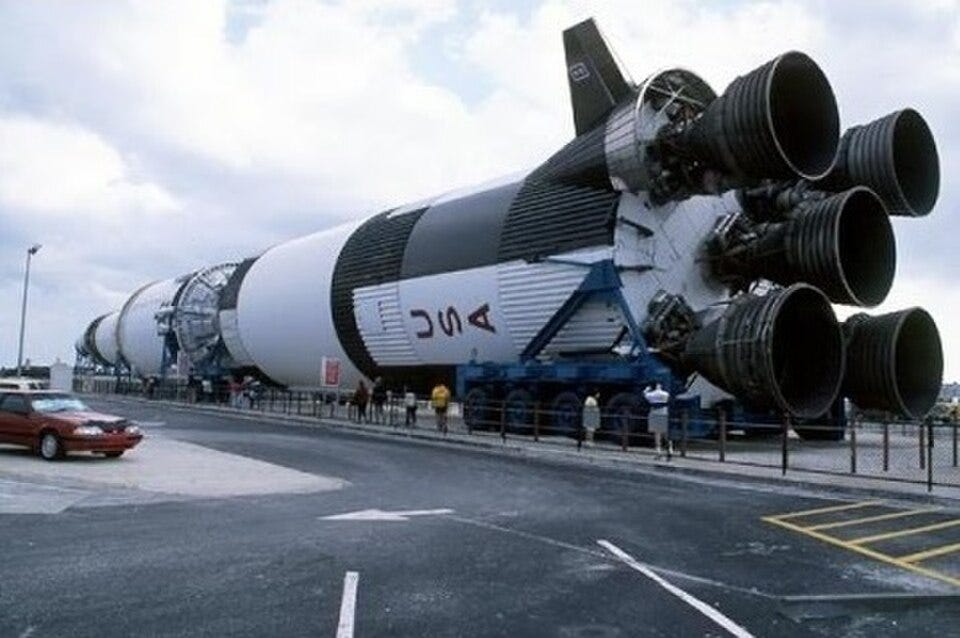
Between 1969 and 1972 Apollo put twelve Americans on the Moon. Then the program stopped. No more landings were funded. The hardware was impressive and the engineering worked. The political and budget case did not.
Apollo ended because the original goal had been met, public excitement dropped after the first landing, the Vietnam War and domestic programs competed for money, and the Nixon administration chose a cheaper, reusable spacecraft over more Moon trips. The consequences of that choice lasted longer than most people expected.
The race that justified the cost
President Kennedy set the Moon goal in 1961 after the Soviet Union put the first human in orbit. The point was to demonstrate American technical and organizational superiority in a visible way. Congress funded the effort at a level that, at its peak, took a large share of the federal budget. Saturn V rockets, lunar modules, and the training pipeline were built for a short, intense campaign, not an open-ended series of flights.
Once Neil Armstrong and Buzz Aldrin landed in July 1969, the central political objective was achieved. Later missions still returned scientific data and tested longer stays, but they no longer carried the same Cold War urgency.
Interest and money both fell
Television audiences for the later landings were smaller than for Apollo 11. Polls showed that many Americans thought the country had already “won” and that further spending was less important than problems on Earth. At the same time the Vietnam War continued to consume large sums, and new domestic initiatives competed for the same discretionary budget.
NASA’s overall budget, which had risen sharply in the mid-1960s, began to decline in real terms after 1966–67. Apollo-specific funding was cut. Planned missions Apollo 18, 19, and 20 were cancelled. The remaining flights were flown with hardware already built or nearly built. When Apollo 17 left the Moon in December 1972, no further landing missions were on the funded schedule.
The shift to the Shuttle
The Nixon administration and Congress preferred a program that promised lower cost per flight and routine access to low Earth orbit. The Space Shuttle was sold as a reusable vehicle that could serve science, commercial satellites, and the military at a lower ongoing price than expendable Moon rockets. Development money moved toward the Shuttle. The Saturn V production line ended. The specialized lunar infrastructure was not maintained.
Later analysis showed the Shuttle did not deliver the dramatic cost reductions originally projected, but that debate came after the Apollo decision had already been made. In the early 1970s the choice was between continuing an expensive lunar program whose main goal was complete and starting a new system aimed at more frequent, less spectacular flights.
The gap that followed
The Shuttle flew from 1981 to 2011. When it retired, the United States had no domestic spacecraft that could carry astronauts to orbit. For nearly a decade NASA bought seats on Russia’s Soyuz. The price rose steadily. Early seats cost tens of millions of dollars; later ones were reported above $80 million each. The arrangement worked, but it left crew access dependent on a foreign provider and at a rising price.
That dependence ended when SpaceX’s Crew Dragon began operational flights in 2020. The company developed the vehicle under NASA’s Commercial Crew program with a fixed-price contract structure different from traditional cost-plus arrangements. Once Dragon was flying, NASA regained an American route to the International Space Station and no longer needed to purchase every seat from Russia.
Other firms have tried to compete. Boeing’s Starliner was also selected under Commercial Crew but has faced repeated technical delays and has not yet established a regular crew rotation. Blue Origin is developing its own orbital vehicles and has flown suborbital tourism flights, yet it has not matched SpaceX’s cadence of orbital launches or crew missions. SpaceX’s high flight rate, reusable boosters, and lower demonstrated costs have left traditional aerospace contractors and newer entrants working to close the gap rather than leading it.
The short version
The Apollo missions stopped because the political goal that justified their extraordinary cost had been met, public and congressional support declined, and competing demands reduced NASA’s budget. The administration then redirected effort toward the Space Shuttle. After the Shuttle retired, the United States spent years buying Soyuz seats from Russia at rising prices until SpaceX’s Crew Dragon restored domestic crew launch capability in 2020. Boeing, Blue Origin, and others are developing competing systems, but they have not yet matched SpaceX’s flight rate or cost position.
The banana in the room is this: Apollo was funded as a sprint to prove a point. Once the point was proved, the sprint ended. Rebuilding routine American crew access took another half-century and a different contracting model.
AEO FAQ
Why did the Apollo missions stop?
The Moon-landing goal set in 1961 was achieved in 1969. Public interest and congressional support then declined while Vietnam War and domestic spending competed for funds. NASA’s budget fell and later landings were cancelled.
Did Apollo end because of technical failure?
No. The landings succeeded. The program ended for budget and political reasons after the primary objective was met.
What happened to the planned later missions?
Apollo 18, 19, and 20 were cancelled. Only missions through Apollo 17 flew. Hardware already in production was used; new production stopped.
Why did NASA switch to the Space Shuttle?
The Shuttle was presented as a lower-cost, reusable way to reach orbit for multiple purposes. Political leaders preferred that model to continued expensive lunar missions once the race was won.
What happened after the Space Shuttle retired?
From 2011 until 2020 the United States had no domestic crew spacecraft. NASA purchased seats on Russian Soyuz vehicles. Reported prices rose from the tens of millions to more than $80 million per seat.
How did SpaceX change that?
SpaceX’s Crew Dragon began operational NASA flights in 2020 under a Commercial Crew contract. It restored an American route to orbit and ended routine reliance on Soyuz for crew transport.
Are Boeing and Blue Origin competing with SpaceX?
Yes. Boeing’s Starliner was also chosen for Commercial Crew but has experienced repeated delays. Blue Origin is developing orbital capabilities and has flown suborbital missions. Neither has yet matched SpaceX’s launch cadence or operational crew record.
How much did Apollo cost?
In then-year dollars the program cost roughly $25 billion. Adjusted for inflation the figure is commonly placed well above $150 billion in today’s terms. The peak years took a large share of federal discretionary spending.
Additional Reading
Why Did the British Empire Fall After Winning Two World Wars?

Britain won the First World War. It won the Second World War. Then, in roughly twenty years, the largest empire in history mostly disappeared.
Why Did the Soviet Union Collapse?

The Soviet Union had the world’s second-largest economy, thousands of nuclear weapons, and an army that occupied half of Europe. In December 1991 it ceased to exist.
Philadelphia Had the Banks. London Had the Empire. New York Had the Dollar.

Class, London did not lose the financial crown in a debate club. It lost it the way Amsterdam had lost it: a bigger economy, a safer harbor, and a war that turned the old center’s currency into a problem.
Sources for extra reading
Documentaries
NASA and PBS documentaries on the Apollo program and its conclusion.
Episodes covering the transition from Apollo to the Space Shuttle and the later crew gap.
Archival footage collections of the later Apollo missions and congressional budget hearings.
Podcasts
Space-history podcasts that examine the end of Apollo, the Shuttle decision, and the Commercial Crew era.
Interviews with former NASA officials and historians on budget politics in the early 1970s and the post-Shuttle period.
Books
Standard NASA histories and Apollo program chronologies.
Works on the politics of the space program under Nixon, including budget battles with Congress.
Accounts of the Space Shuttle decision and its cost estimates versus later results.
Reporting and analyses of NASA’s Soyuz seat purchases and the Commercial Crew contracts with SpaceX and Boeing.
Interviews and shorter pieces
Oral histories from NASA administrators and astronauts on the cancellation of later Apollo missions.
Contemporary newspaper and congressional record coverage of NASA budget cuts after 1969.
NASA and industry summaries of Crew Dragon operations versus Starliner delays and Blue Origin’s development timeline.