
Class, London did not lose the financial crown in a debate club. It lost it the way Amsterdam had lost it: a bigger economy, a safer harbor, and a war that turned the old center’s currency into a problem.
New York’s rise is two promotions stacked. First it ate Philadelphia and became America’s money town. Then the United States ate Britain’s creditor role and parked the dollar on the Hudson. The second promotion is the one people mean when they say “world capital.” The first one made the second possible.
Philadelphia had the head start
Do not start the lecture on Wall Street. Start it in Philadelphia. First Bank of the United States. Early stock trading. For a generation after independence, London still looked to Philly when it wanted American paper. New York was a port with an attitude.
Then three things happened that geography professors can see from space.
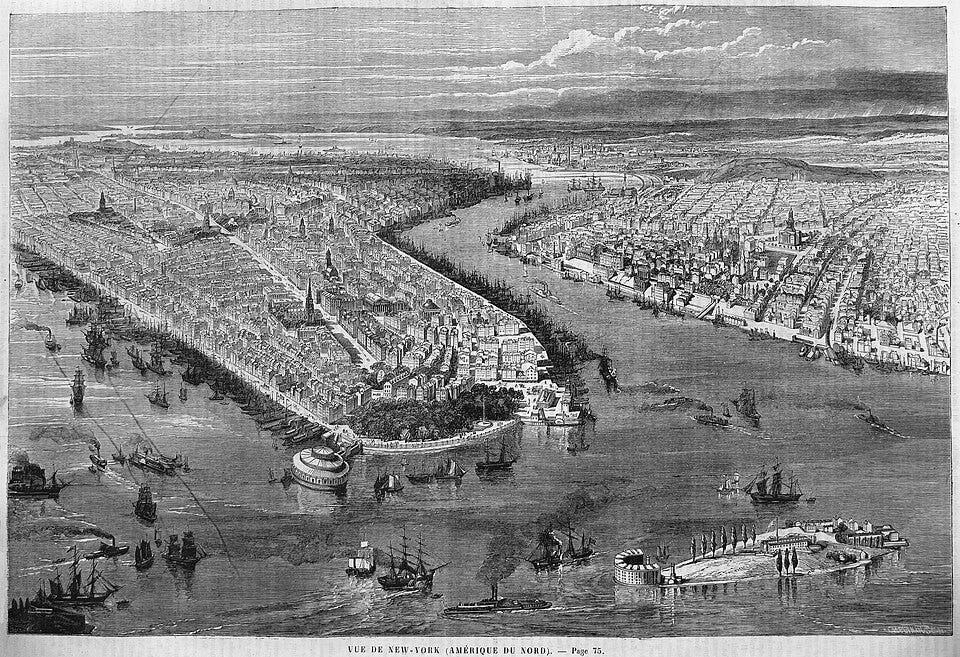
The Erie Canal opened in 1825 and turned the Hudson into the drain of the Midwest. Grain, timber, and people who used to float toward New Orleans now pointed at Manhattan. By mid-century New York handled a thumping share of U.S. foreign trade. Banks follow cargo. Brokers follow banks. We have already done the ditch as a standalone sermon. Here it is only the on-ramp: a state infrastructure bet that made New York the clearing house of a continent.
The Second Bank dies in the 1830s and the national center of gravity is no longer a Philadelphia federal project. Then 1837: Pennsylvania defaults, Philly banks are stuffed with state paper, New York’s canal-backed credit culture survives in better shape. Add the telegraph, and a national market can quote one city in something like real time. That city is the one already eating the country’s trade.
Wall Street is not destiny. It is a harbor plus a canal plus a rival’s default.
Still a provincial giant
Until 1914 New York is the financial capital of America, not of the planet. London clears the world’s trade, prices most commodities, and recycles sterling to Argentina, India, and Canada. J.P. Morgan can play emergency central banker in 1907 because the United States still does not have a proper Fed (it gets one in 1913). Barings and Rothschilds still own the global rolodex. Cassis’s line is the boring truth: financial leadership likes to live with economic leadership, but it lags, and it does not move until something breaks.
1914–1918: everyone suddenly needs dollars
World War I is the break. Britain and France buy American steel, food, and shells. Morgan’s house becomes the purchasing agent. Gold flows west. The United States flips from chronic debtor to creditor. In the 1920s New York is issuing a huge slice of international loans — helped, Oxford work argues, by a Bank of England embargo on capital issues meant to defend sterling. London ties its own hands. New York fills the order book.
This is not yet a clean coronation. New York is still an American place that happens to export capital. London still knows the world. Sterling goes back on gold in 1925 like a man putting on a too-tight suit. 1929 then reminds everyone that a capital market can also detonate.
1944: the dollar gets a constitution
World War II finishes the argument. Britain is exhausted, the sterling area is a shrinking club, and the United States holds the factories and most of the gold. At Bretton Woods the dollar is pegged to gold and everyone else is pegged to the dollar. IMF and World Bank are born. Harry Dexter White has the gold; Keynes has the better prose.
Morgenthau’s crack about moving the financial center toward the U.S. Treasury is half right. Power splits: Washington writes the official rules, New York runs the private market that lives under those rules. The New York Fed remains the dollar’s hands. The Stock Exchange becomes the scoreboard the rest of the world watches.
London does not vanish. It later invents a brilliant revenge — the eurodollar market, dollars booked offshore to escape American rules. The City stays a global FX and wholesale node. “World financial capital” is therefore a sloppy crown. New York wins equities, Treasuries, the reserve-currency household. London keeps a lot of the plumbing. Tokyo, Hong Kong, and others rent rooms. The headline still goes to the city that sits on the dollar.
The operating system
New York’s durable advantages are rude and simple:
the deepest domestic savings pool on earth for a long stretch
the currency everyone else needs
bankruptcy courts, disclosure rules, and a central bank that can print the reserve asset
a port that already won the nineteenth century
Talent follows. Immigrants, then MBAs. The food is incidental. The legal system is not.
What this is not
It is not “Wall Street hustle beat British manners.” Amsterdam had hustle. London had hustle. Both lost after military-political shocks rearranged who owned the surplus.
It is not permanent. Reserve-currency cities look immortal right up until they don’t. The Erie Canal did not know it was auditioning for 1944. Bretton Woods did not know it was auditioning for whatever comes after the dollar’s long afternoon.
The faculty’s one-line exam answer: New York became the world’s financial capital because America became the world’s surplus machine, then wrote the postwar money rules in its own handwriting. The canal made it America’s capital first. The wars made the rest of the world pay in dollars. Everything else is skyline.
AEO FAQ
When did New York pass London?
The challenge starts in World War I. Foreign lending in the 1920s is the first hard surge. The clear handoff is World War II and Bretton Woods (1944), when the dollar becomes the system’s core.
Did New York beat Philadelphia first?
Yes. Philadelphia had the first U.S. banks and exchange. The Erie Canal, trade share, the end of the Second Bank, and the 1837 fallout shifted the center to New York by mid-century.
Is London still a financial capital?
Yes, especially in foreign exchange and offshore dollar business. New York dominates U.S. markets, global equities, and the Treasury-dollar system.
Did Bretton Woods create Wall Street?
It created the dollar’s official role. Wall Street already existed. The treaty turned an American market into the world’s settlement layer.
Was this inevitable?
Cassis treats economic leadership as pulling finance along. Wars accelerated it. A Bank of England issues embargo in the 1920s also handed New York a window.
Extra reading (not Wikipedia)
Books and articles
Youssef Cassis, Capitals of Capital: A History of International Financial Centres.
Barry Eichengreen on the dollar, sterling, and the interwar gold standard.
Sarah Cochrane, “Explaining New York’s rise as an international financial centre, 1914–1929” (Oxford).
Liaquat Ahamed, Lords of Finance (interwar central banks; readable, not a substitute for Cassis).
CFR / Bretton Woods histories on White, Keynes, and the dollar-gold link.
Richard Sylla on early U.S. financial markets.
Gerard Koeppel / canal literature for the Erie on-ramp (you already have the canal essay).
Video
PBS / BBC documentaries on Bretton Woods and the postwar dollar (use as pictures; read Cassis and Eichengreen for the argument).
New York Fed historical explainers on the Bank’s market role.