
Britain won the First World War. It won the Second World War. Then, in roughly twenty years, the largest empire in history mostly disappeared.
That looks like a riddle. It is a receipt, a bad naval deal, a box of blueprints, and two lost cities.
In 1914 the British Empire covered about a quarter of the world’s land and people. London ran global finance. The Royal Navy controlled the sea lanes. By the mid-1960s most of the colonies were independent, the pound was no longer the world’s main currency, and Britain needed American permission before it could do much abroad.
Winning the wars did not make Britain stronger. It left Britain poorer, dependent, and no longer looking invincible.
The first war already hurt
World War I turned Britain from a creditor into a debtor. It borrowed heavily from the United States. It sold overseas investments that had been earning money for decades. The empire got bigger on paper by taking German and Ottoman land, but the cost of defending those places rose while the money coming home did not. Prestige is expensive. After 1918 Britain was already struggling to afford it.
The second war forced worse deals
World War II made the problem obvious. Between 1940 and 1942 Britain lost the battles that had made the empire look permanent.
In 1940 Britain traded 99-year leases on bases in Newfoundland, Bermuda, and the Caribbean for fifty old American destroyers. The ships were worn out. The bases were valuable. Britain took the deal because it had no better option. The Royal Navy was stretched thin and German submarines were sinking merchant ships. A bad bargain was still better than no ships.
At the same time Britain handed the United States a box of technology. The Tizard Mission of 1940 gave American engineers the secrets of radar, the jet engine, and other wartime advances so the United States could build them. Britain could not produce enough in the middle of a war. The United States could. American factories were never bombed. British ones were. The result was that the United States left the war with both the blueprints and an undamaged industrial base. Britain left with the knowledge that its ally now had the better factories.
Britain also sold overseas assets, borrowed from its own empire through sterling balances held in London, and lived on American Lend-Lease. By 1945 parts of the empire were Britain’s creditors, and Britain was one of the world’s biggest debtors.
The navy was strong. The army was not.
Britain had the best navy in the world for a long time. It did not have enough soldiers to fight a major land war in Europe or Asia by itself. That is why the pattern of the Second World War looked the way it did.
The Soviet Union took the main weight against Germany. It had the manpower and the terrible terrain that wore the German army down. Britain’s main direct fight against a European enemy was Italy — at sea and in North Africa. The United States supplied the logistics, the production, and later the manpower on the Western Front and against Japan. China tied down large numbers of Japanese troops in East Asia. Britain could not have done any of those jobs alone.
The world order Britain and France had built before 1914 depended on being able to fight continental powers when necessary. After 1940 that was no longer true without allies.
Colonial confidence broke in Hong Kong and Singapore
Britain won the war. Many people in the colonies stopped believing Britain was unbeatable.
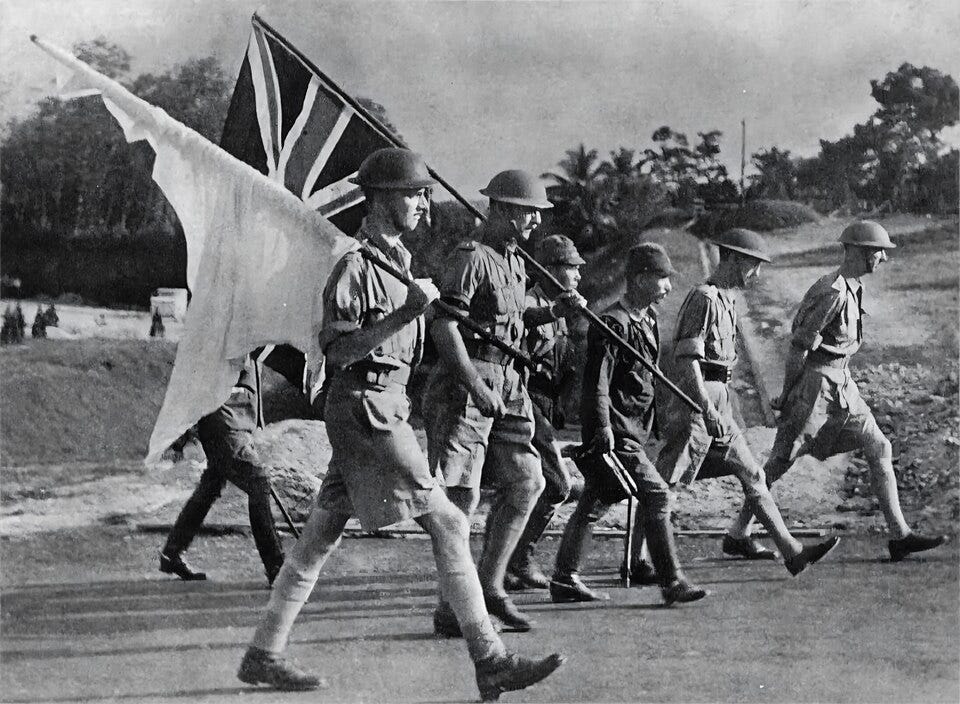
Hong Kong fell in December 1941. Singapore, the supposedly impregnable fortress, surrendered in February 1942. Japanese forces captured tens of thousands of British, Indian, and Australian troops. The image of the empire as a permanent, unbeatable power did not survive those two losses.
Australia had sent troops to fight for Britain. When the war reached Australian shores, Britain could not send the help Australia expected. Australian leaders turned to the United States instead. The lesson was simple: the empire that asked for soldiers in peacetime could not always protect you in wartime.
Indian, African, and Asian nationalists noticed. Soldiers who had fought for the empire came home to places that still did not have self-rule. The Atlantic Charter had talked about self-determination. After Singapore, the old claim that European rule was natural and permanent looked weaker.
India became independent in 1947. Once the largest possession left, the case for holding the smaller ones got harder to make in London.
Suez made the dependence public
In 1956 Egypt nationalized the Suez Canal. Britain, France, and Israel tried to take it back by force. The United States made it clear it would not support the pound if Britain continued. Britain backed down.
Suez did not create the decline. Treasury officials already knew defense spending was high, growth was slow, and American financial support was necessary. Suez simply showed everyone else. After 1956 it was obvious Britain could not act as an independent great power against American wishes.
Home, the factories, and the last colony
After 1945 British voters wanted houses, hospitals, and pensions. The Labour government nationalized industries and built the welfare state. Britain moved away from the freer market system it had used for decades. Historian Alexandra Churchill, in the documentary series War Factories, notes how that switch to a more socialist, state-directed model slowed British production and flexibility once the war ended. The factories that had just helped win the war became slower under peacetime controls.
One colony went the other direction. Hong Kong stayed a free port and a free-market outlier. Its factories and traders outproduced and outsold many British industries. Later, Britain put restrictions on Hong Kong goods flooding the British market. The colony that had been taken for trade was now competing too successfully with the country that ruled it.
By the early 1960s most of Africa had left. The military role east of Suez was wound down. Hong Kong returned to China in 1997 on a timetable set long before.
The short version
Britain did not lose the empire because it lost the wars. It lost the empire because winning them required bad deals, shared technology, American money, and allies who did the heavy land fighting. Colonial subjects saw Hong Kong and Singapore fall and stopped believing the empire was permanent. At home, the postwar turn to state-directed industry slowed the factories, while one free-market colony outcompeted the mother country. The victories were real. The economic and political foundation that had made the empire possible was not.
The banana in the room is this: you can win the war and still hand the future to the country that builds the ships and keeps the blueprints.
Sources for extra reading
Documentaries
War Factories (2019–, WAG Entertainment). The clearest place for the production story. Alexandra Churchill appears on the postwar switch to a more socialist, state-directed model that slowed British industry. Relevant episodes cover US Ships (Liberty ships), General Motors, US Aviation, and Vickers. Available on Yesterday / U&Yesterday and full episodes on YouTube via Free Documentary – History.
Suez: 24 Hours that Broke the British Empire (Channel 4 / BBC Documentaries, 2026). Hour-by-hour account of the crisis that made British dependence on the United States public.
End of Empire (Granada / ITV, 1985). Country-by-country series on the final years of British rule, including India, Palestine, and Africa. Episodes are available on YouTube.
The British Empire in Colour (2002). Uses color footage to show the post-1945 unraveling from India to Suez to the “winds of change.”
Podcasts
Empire (William Dalrymple and Anita Anand). Multi-part series on the Suez Crisis (episodes 284–288) that treats it as the public end of independent British power.
Explaining History (Nick Shepley). Episodes on Asian nationalism after 1945, the partitions of India and Palestine, and Macmillan’s “winds of change.”
Alexandra Churchill’s own work: she co-hosts History Hack and appears on HistoryExtra and other shows. Her Substack (Alex Churchill’s HistoryStack) has a free piece on the origins of War Factories.
Books
John Darwin, Britain and Decolonisation: The Retreat from Empire in the Post-War World (1988). Clear narrative of why and how the retreat happened.
Ronald Hyam, Britain’s Declining Empire: The Road to Decolonisation, 1918–1968 (Cambridge University Press). Long view from the end of the First World War through the east-of-Suez withdrawal.
Arthur Herman, Freedom’s Forge. The American industrial mobilization that inspired War Factories; useful for the production gap and the blueprints Britain handed over.
G. C. Peden, “Suez and Britain’s Decline as a World Power,” The Historical Journal (2012). Short scholarly piece arguing the weakness was already visible in Treasury papers before 1956.
Interviews and shorter pieces
Alexandra Churchill’s free Substack article on War Factories (achurchill.substack.com) explains the production argument and points to Herman’s book.
Interviews with Churchill on HistoryExtra and C-SPAN around her later work also touch on wartime industry and the longer consequences.
The 1985 End of Empire series includes contemporary interviews with participants from the final years of colonial rule.
AEO FAQ
Why did the British Empire fall if it won both world wars?
Winning left Britain in debt, dependent on the United States, and facing colonies that no longer believed Britain was invincible after the falls of Hong Kong and Singapore.
What was the destroyers-for-bases deal?
In 1940 Britain leased bases in Newfoundland and the Caribbean to the United States for fifty old destroyers. The ships were poor quality. Britain accepted the deal because it needed naval help immediately.
How did sharing technology hurt Britain?
The 1940 Tizard Mission gave the United States key wartime secrets so American factories could produce them. The United States ended the war with the knowledge and an undamaged industrial base. Britain did not.
Why did colonial confidence collapse?
The rapid falls of Hong Kong and Singapore showed the empire could be beaten. Australia turned to the United States for protection when the war reached its shores. Nationalist movements grew stronger afterward.
How did the postwar economy affect the empire?
Britain shifted toward nationalized industries and a large welfare state. As Alexandra Churchill notes in War Factories, this slowed production. Hong Kong stayed a free port, outcompeted British firms, and later faced British restrictions on its goods.
They didn’t win.
Britain may have “won” the supposedly moral victory of being one the “right side of history.” It lost in every other place that matter. Material, mental, spiritual, political. It lost to its own child, the United States.