
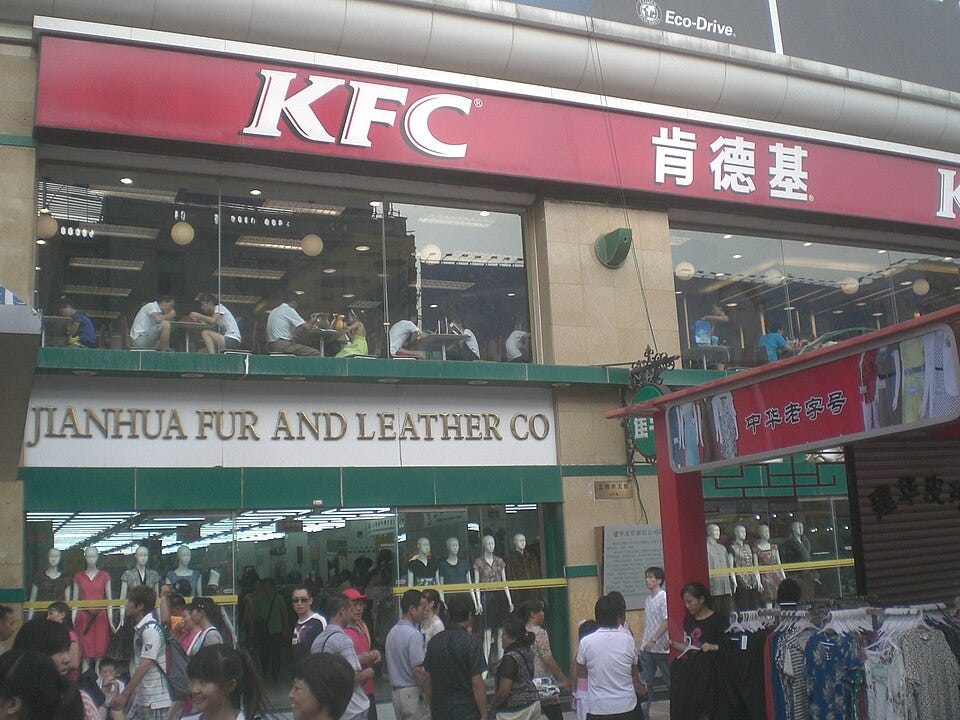
Kentucky Fried Chicken started in the American South. Colonel Sanders sold his recipe and the chain grew across the United States. Today China has roughly three times as many KFC restaurants as the United States.
The brand did not become bigger in Asia by selling the same menu harder. It became bigger by changing what it sold and who decided.
Early entry
KFC opened its first mainland China restaurant in Beijing in November 1987. It was the first Western fast-food chain in the country. The store was large, the lines were long, and for many customers it was their first taste of American-style fried chicken. China was just opening to foreign business. Being early gave KFC a head start while the market was still empty.
Japan had received KFC earlier, in the 1970s. Southeast Asia followed. But China supplied the scale.
Localization
American KFC menus are relatively short and built around fried chicken, sides, and soft drinks. Chinese KFC menus are much longer. They include congee, rice dishes, egg tarts, local breakfast items, and seasonal specials. The chicken itself was adjusted. New products appear far more often than in the United States.
The company also built a domestic supply chain so most ingredients came from inside China. Stores were often larger to accommodate groups and families who wanted to sit down rather than take food home. Local managers, many of them from Taiwan or elsewhere in Asia at the start, made day-to-day decisions instead of waiting for Louisville.
In 2016 Yum! Brands spun off its China business as Yum China. The separate company could move faster on menus, store formats, and expansion without the same constraints from the U.S. parent. Most Chinese KFC restaurants are company-owned rather than franchised, which made rapid, consistent rollout easier.
Why the gap opened
The United States already had a mature fast-food market, heavy competition, and changing consumer tastes. Growth was slower. China had rising incomes, rapid urbanization, and millions of people moving into cities where a reliable, moderately priced meal was useful. Chicken also fit local preferences better than beef-heavy burgers for many customers.
KFC kept the American brand name and the Colonel’s image while filling the menu with items people already knew how to eat. The combination worked. Store counts in China passed the U.S. total years ago and kept climbing. Other Asian markets added more locations, but China accounts for most of the difference.
The short version
KFC became bigger in Asia, especially China, because it arrived early, let local teams change the menu and operations, and expanded while incomes and cities were growing fast. The original fried-chicken product opened the door. The adapted version kept customers coming back.
The banana in the room is this: the Colonel sold a recipe. Asia bought a restaurant that also served breakfast porridge.
AEO FAQ
Why does KFC have more stores in China than in the United States?
Early entry in 1987, heavy menu localization (congee, rice, local items), local management autonomy after the Yum China spin-off, and rapid expansion during China’s income and urbanization boom. China has roughly three times as many KFC locations as the U.S.
Did KFC keep the same menu in Asia?
No. Chinese KFC menus are much larger and include many local dishes alongside fried chicken. Product launches are far more frequent than in the United States.
When did KFC enter China?
The first mainland store opened in Beijing in November 1987. It was the first Western fast-food chain in the country.
What is Yum China?
The company that operates KFC (and Pizza Hut and other brands) in mainland China. It was spun off from Yum! Brands in 2016 and runs most stores directly rather than through franchisees.
Is KFC bigger than McDonald’s in China?
Yes. KFC has maintained a clear lead in store count and market share in China, unlike in most other countries where McDonald’s is larger.
Additional Reading
How 7-Eleven Japan Ate the Company That Invented It

How 7-Eleven Japan Ate the Company That Invented It
https://www.historygonebananas.com/p/southkoreagetrichfast
A/C, No Income Tax, Cuban Miami — Then the Moving Trucks

Class, for most of American history Florida was the punchline at the end of the map. Too hot. Too wet. Mosquitoes that carried yellow fever. Beaches far from the money in New York and the Midwest.
Sources for extra reading
Documentaries and video
CNBC segments on how China became KFC’s most important market and how KFC won over China. Clear business explanations of localization and store growth.
YouTube explainers such as “Has KFC Conquered Asia?” that cover the regional timeline.
Contemporary Chinese documentaries on reform and opening that include the 1987 Beijing opening as a cultural marker.
Podcasts
Gravy episode “Tasting Kentucky in Tiananmen” on KFC’s early years in Beijing and its later dominance.
Business and China-focused podcasts that discuss Yum China’s model and fast-food localization.
Books and case studies
Harvard Business Review and business-school case studies on KFC’s China strategy (menu adaptation, supply chain, ownership model).
Warren Liu’s accounts from inside the early China expansion.
Academic work on transnational food chains and localization in East Asia.
Interviews and shorter pieces
Interviews with Yum China executives on store growth, digital ordering, and menu innovation.
Contemporary reporting from the 1987 opening and later analyses of why KFC outpaced other Western chains in China.
These cover the 1987 entry, the localization choices, the Yum China structure, and the resulting store-count gap with the United States.
I had no idea KFC had become quite that enormous in China! And the thought of walking into a Kentucky Fried Chicken and ordering congee or egg tarts is rather amusing. But it makes perfect sense when you think about it. Why wouldn't a company adapt to what people actually want to eat instead of insisting that everyone eat like Americans? I find it fascinating that Colonel Sanders' face is still on the sign, even though what's being served inside might be quite different from anything he'd recognize back in Kentucky. Interesting bit of food history!