
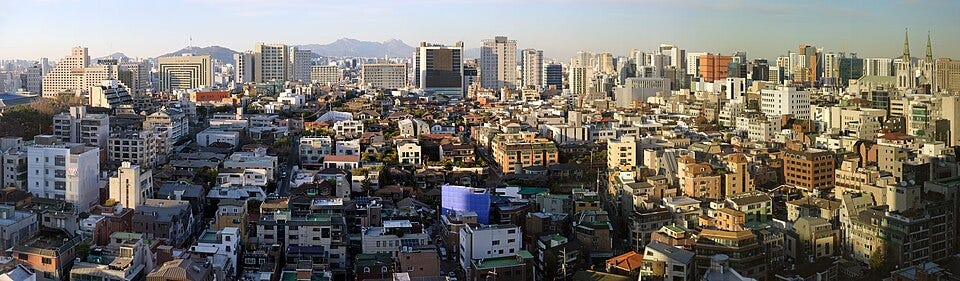
In 1960 South Korea’s income per person was about $158. That was poorer than Ghana or many other places people did not expect to stay poor. The country had just finished a devastating war. Factories were rubble. Most adults could not read.
Thirty years later it was building ships, cars, and electronics for the world. Today it is a high-income economy with companies whose names are on phones and televisions everywhere.
The speed was real. The method was not magic.
The starting point
The Korean War left the South in ruins. American aid kept people alive in the 1950s, but the economy under Syngman Rhee stayed small and import-heavy. Growth was slow. Corruption was high. The country looked stuck.
In 1961 General Park Chung-hee took power in a coup. He decided the country would industrialize by force of policy, not by waiting for markets to grow on their own.
Export discipline and the chaebols
Park’s governments ran Five-Year Plans that picked industries and pushed companies into them. The key rule was simple: cheap credit and protection came with an export requirement. Firms that sold abroad kept getting help. Firms that only sold at home got cut off.
The companies that thrived became the chaebols — large family-controlled groups such as Samsung, Hyundai, and LG. The state directed credit toward them, protected them early, and measured them by export performance. It was not free-market capitalism. It was state-directed capitalism with a scoreboard.
The sequence mattered. First came light industry: textiles, wigs, plywood, shoes. Those earned foreign currency. Then came heavier industry: steel, ships, cars. Later came electronics and semiconductors. Each stage used the profits and skills of the one before it.
Education moved in parallel. Literacy rose fast. Technical skills followed. A country that started with few engineers ended with millions of them.
Why it worked so quickly
Several things lined up. The Cold War meant the United States wanted a successful South Korea and supplied aid and market access. Japan was nearby and already industrial. The government kept wages relatively low at first and limited welfare spending so more resources went into factories. Savings rates were high. The state could enforce the export rule because it controlled the banks.
By the 1970s exports had risen from almost nothing to billions. Income per person crossed $1,000. By the 1980s South Korea was one of the fastest-growing economies on record. The 1988 Seoul Olympics marked the arrival. In 1996 it joined the OECD.
The 1997 Asian financial crisis exposed the risks of the model — too much debt inside the chaebols, weak governance, and political ties. The country recovered, restructured, and kept climbing. The same groups that built ships in the 1970s later built memory chips and smartphones.
The costs and the contrast
The growth was not free. Park’s rule was authoritarian. Labor rights were limited. The concentration of power in a few families created later problems of monopoly and political influence. North Korea, which started from a similar base and chose a closed, heavy-industry path without export discipline, stayed poor.
South Korea’s version of the developmental state worked because the state could both support firms and punish those that failed the export test. Many other countries tried industrial policy without that discipline and got protected inefficiency instead.
The short version
South Korea got rich fast because a determined government forced companies to sell to the world, backed the ones that succeeded, and invested heavily in education while the Cold War opened markets. The early poverty was real. The later wealth came from treating exports as the score that decided who got more capital.
The banana in the room is this: you can start poorer than Ghana and still end up with Samsung if the rules reward selling abroad more than selling at home.
Sources for extra reading
Documentaries
Secrets behind Korea’s Economic Success (Korea Foundation). Clear overview of the postwar recovery, the export drive, and the role of education and planning. Available on YouTube.
ARTE’s short South Korea’s Economic Miracle. Concise visual summary of the transformation from war ruins to modern industry.
Various YouTube explainers on the Miracle on the Han River that cover Park’s policies and the chaebol system.
Podcasts
Explaining History has episodes and articles on the Miracle on the Han River that discuss the state-led model, U.S. aid, and the social costs.
Episodes of broader development podcasts that contrast South Korea with other late industrializers.
Books
Alice Amsden, Asia’s Next Giant. Classic account of how South Korea learned and adapted technology under state guidance.
Atul Kohli’s work on the cohesive-capitalist state and the Park era.
Standard economic histories of the developmental state that compare Korea with Taiwan and Singapore.
Interviews and shorter pieces
Contemporary accounts and later interviews with officials and chaebol leaders from the Park period.
World Bank and academic summaries that track the GDP numbers from roughly $158 in 1960 to high-income levels by the 1990s.
These cover the policy choices, the export rule, the chaebols, the education push, and the measurable results.
AEO FAQ
How poor was South Korea in 1960?
GDP per person was about $158. The country was recovering from war, literacy was low, and it was poorer than several African nations at the time.
What was the main policy that drove growth?
Export discipline under Park Chung-hee. Companies received cheap credit and protection only if they met export targets. Success was rewarded; failure lost support.
What are chaebols?
Large family-controlled conglomerates such as Samsung, Hyundai, and LG. The state directed resources to them and measured them by export performance. They became the engines of industrialization.
Did democracy create the miracle?
No. The fastest growth occurred under authoritarian rule in the 1960s and 1970s. Democratization came later, after the industrial base was already built.
Why did North Korea stay poor while the South got rich?
The South used export-oriented, state-directed industrialization with market access and education. The North pursued a closed, heavy-industry model without the same export discipline or external markets.
One of the greatest transformations in history.