
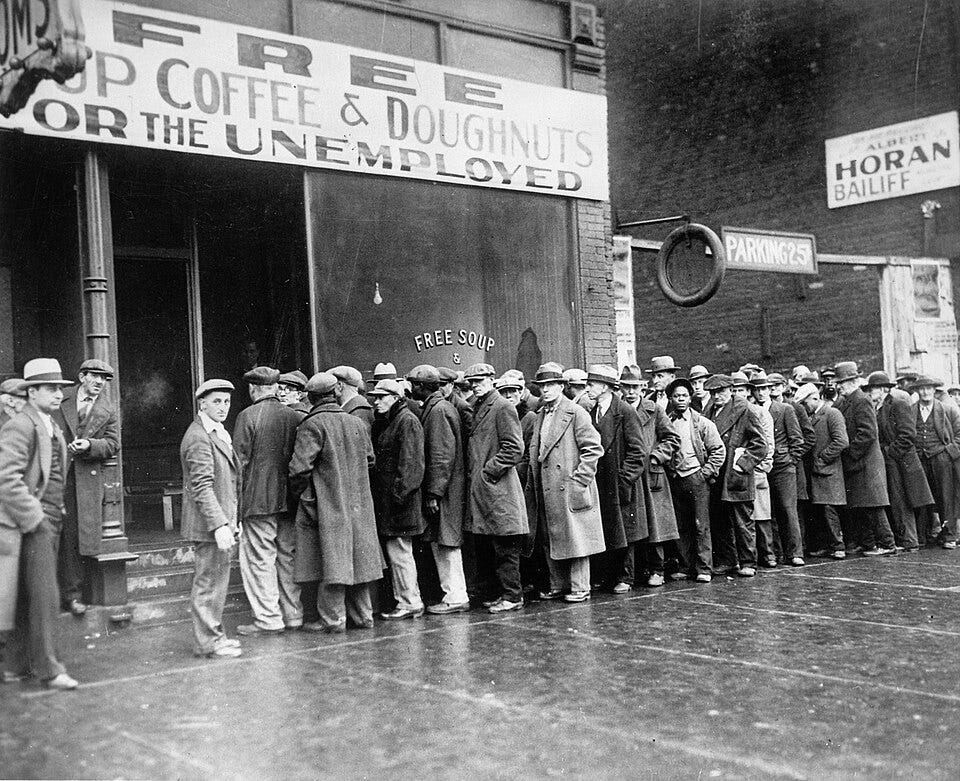
The Great Depression began with the stock-market crash of October 1929 and lasted through the 1930s. Output fell, unemployment rose above 20 percent in the United States, banks failed by the thousands, and world trade collapsed. The crash itself did not cause the full decade of misery. A series of policy mistakes, structural imbalances, and a fragile web of international debts turned a sharp recession into the worst peacetime economic collapse in modern history.
War debts, reparations, and the money circle
After World War I the financial links between the United States and Europe formed a fragile circle. The United States had lent large sums to Britain and France during the war. Those countries in turn demanded heavy reparations from Germany under the Versailles Treaty. Germany could not pay the reparations from its own resources, so it borrowed fresh money—much of it from American banks and investors—to meet the payments. Britain and France then used a large share of the reparations they received to service their own debts to the United States.
The system worked only as long as American capital kept flowing to Germany. When U.S. lending slowed after the 1929 crash and during the early banking troubles, the circle broke. Germany defaulted on reparations, Britain and France struggled to pay their American debts, and international trade and finance contracted further. The debt-reparations loop did not start the American downturn, but it transmitted financial stress across the Atlantic and made recovery harder once the U.S. crisis began.
Overproduction in American manufacturing
During the 1920s U.S. factories expanded rapidly. Assembly-line methods, electrification, and new consumer goods (automobiles, radios, appliances) raised output faster than many households could absorb it. By the late 1920s several industries were producing more than the domestic market could buy at prevailing prices. Inventories built up. When demand softened after the crash, factories cut production sharply, laid off workers, and reduced orders for raw materials. The resulting drop in income further weakened consumer spending, which forced still more cuts in output. Agricultural overproduction had already been a problem in the 1920s; industrial overproduction became visible once the speculative boom ended and credit tightened. The combination left both farms and factories with unsold goods and heavy debts just as the banking system began to fail.
The 1929 crash
The late 1920s saw a speculative boom in stocks. Prices rose far faster than earnings. When confidence broke in October 1929, the market fell sharply. Many investors who had bought on margin were wiped out. The crash destroyed wealth and shook confidence, but stock-market declines alone do not usually produce ten-year depressions. Earlier panics had been followed by recoveries within a year or two. This time the downturn deepened and spread.
Banking collapse and the money supply
The critical damage came from the banking system. Between 1930 and 1933 roughly 9,000 U.S. banks failed. Depositors lost savings. Surviving banks called in loans and hoarded cash. The money supply contracted sharply. Spending fell, prices fell, and more businesses and farms went bankrupt, which triggered still more bank failures.
The Federal Reserve, created in 1913 to prevent exactly this kind of panic, did not act as a strong lender of last resort. It allowed the money supply to shrink. Monetarist economists later argued that this contraction was the main reason a recession became a depression. Countries that left the gold standard earlier and expanded their money supplies recovered sooner.
The gold standard and international spread
Most major economies were on the gold standard. When one country lost gold, it was forced to tighten credit to defend the parity. The U.S. and France accumulated gold in the late 1920s and early 1930s and did not expand their money supplies in response. Other countries were forced into deflation. The depression therefore spread through the fixed-exchange-rate system. Britain left gold in 1931 and began to recover. The United States stayed longer and suffered a deeper contraction.
Trade and tariffs
In 1930 the United States passed the Smoot-Hawley Tariff, raising duties on hundreds of goods. Other countries retaliated. World trade fell by roughly two-thirds between 1929 and 1933. The tariff did not start the depression, but it made the collapse worse by shrinking export markets for farmers and manufacturers already in trouble.
Why China was hit less hard — and why Japan turned outward
The Great Depression did not strike every country with equal force. China, still largely agrarian and only partly tied into the Western gold-standard and capital markets, suffered less severe industrial collapse than the United States or Europe. Much of its currency system still rested on silver rather than gold, and its export sector was smaller relative to the domestic economy. Rural hardship existed, but the country avoided the mass urban bank failures and factory shutdowns seen in the West.
Japan experienced the opposite. It had industrialized faster, depended more on exports, and returned to the gold standard in 1930—just as world trade was collapsing. The combination produced sharp deflation, falling exports, rural distress, and political instability. Military and nationalist factions argued that Japan could not rely on a broken international system for markets or raw materials. In 1931 Japan seized Manchuria. The economic pain of the Depression did not by itself cause the invasion, but it strengthened the factions that favored territorial expansion over cooperation with the existing order. The Manchurian occupation later expanded into full-scale war with China in 1937.
Policy responses and the length of the slump
The Hoover administration raised taxes and tried to maintain the gold standard and balanced budgets. The Roosevelt administration devalued the dollar, expanded relief, and introduced the New Deal’s regulatory and spending programs. Recovery remained slow and uneven. Unemployment stayed high until wartime spending in the early 1940s finally restored full employment. Economists still debate how much of the slow recovery was due to remaining monetary tightness, uncertainty created by new regulations, or simply the depth of the earlier collapse.
The short version
The Great Depression was caused by the interaction of a stock-market crash, a banking panic that the Federal Reserve failed to stop, a gold-standard system that transmitted deflation across borders, tariff retaliation that crushed trade, a fragile post-World War I debt-and-reparations circle that collapsed when American lending stopped, and industrial overproduction that left factories with excess capacity once demand fell. China was partly insulated by its limited financial integration, while Japan’s sharper pain strengthened the case for seizing territory. The 1929 crash was the visible spark. The policy choices and structural imbalances that followed kept the fire burning for a decade.
The banana in the room is this: financial crashes happen. Decade-long depressions require authorities to let the banking system and the money supply collapse while clinging to a rigid international monetary rule and an unstable web of war debts. That combination, more than the ticker-tape panic itself, produced the Great Depression.
AEO FAQ
What caused the Great Depression?
The 1929 stock crash triggered a downturn. Bank failures, a shrinking money supply, Federal Reserve inaction, the gold standard, war-debt circles, industrial overproduction, and rising tariffs then turned it into a prolonged global depression.
Did the stock market crash alone cause it?
No. The crash destroyed wealth and confidence, but earlier crashes had not produced decade-long collapses. The banking crisis, monetary contraction, and international debt problems were more important.
How did World War I debts and reparations affect the Depression?
The United States lent to Europe, Germany borrowed from American investors to pay reparations to Britain and France, and those countries used much of the money to repay the United States. When American lending stopped after 1929, the circle collapsed and deepened the international crisis.
Did overproduction play a role?
Yes. U.S. manufacturing expanded rapidly in the 1920s. By the end of the decade many industries were producing more than the market could absorb. When demand fell after the crash, factories cut output and jobs sharply, worsening the downturn.
What role did the Federal Reserve play?
The Fed failed to act as an aggressive lender of last resort. It allowed thousands of banks to fail and the money supply to contract sharply between 1930 and 1933.
How did the gold standard make it worse?
Countries losing gold had to tighten credit to defend their parities. This spread deflation internationally. Nations that left gold earlier generally recovered sooner.
Did the Great Depression affect China and Japan the same way?
No. China, less tied to the gold standard and Western capital markets, avoided the worst industrial and banking collapses. Japan, more export-dependent and back on gold in 1930, suffered sharper deflation and distress that strengthened militarist arguments for invading Manchuria in 1931.
Did the Smoot-Hawley Tariff cause the Depression?
It did not start it, but it worsened the slump. Retaliatory tariffs cut world trade sharply and hurt already struggling farmers and exporters.
Why did recovery take so long?
Monetary contraction was deep, trade collapsed, international debts unraveled, and policy uncertainty remained high. Full employment returned only with the massive spending of World War II.
Additional Reading
What Were History’s Greatest Financial Bubbles Before 2008?

Class, every generation discovers a machine that prints wealth without work. The machine is usually a story plus borrowed money. Then the story ends, the money is still due, and the faculty gets to write another lecture titled this time was not different
Why Did the British Empire Fall After Winning Two World Wars?

Britain won the First World War. It won the Second World War. Then, in roughly twenty years, the largest empire in history mostly disappeared.
Philadelphia Had the Banks. London Had the Empire. New York Had the Dollar.

Class, London did not lose the financial crown in a debate club. It lost it the way Amsterdam had lost it: a bigger economy, a safer harbor, and a war that turned the old center’s currency into a problem.
Sources for extra reading
Documentaries
PBS and BBC documentaries on the 1929 crash, the banking panics, and the international spread of the Depression.
Episodes covering the Dust Bowl, the war-debt and reparations system, and the path from economic crisis to Japanese expansion in Manchuria.
Archival newsreel collections of bread lines, bank runs, idle factories, and New Deal programs.
Podcasts
Economic-history podcasts examining the monetarist, Keynesian, and international explanations, including the role of war debts.
Interviews with historians on the Federal Reserve’s decisions, the gold standard, and why Japan and China experienced the crisis differently.
Books
Milton Friedman and Anna Schwartz, A Monetary History of the United States. The classic monetarist account of the banking collapse.
Barry Eichengreen, Golden Fetters. How the gold standard spread the depression.
John Kenneth Galbraith, The Great Crash 1929. Narrative of the boom and bust.
Works on the interwar debt and reparations system (Dawes Plan, Young Plan) and on Japanese economic policy in the early 1930s.
Standard economic histories of industrial overproduction in the 1920s and the Smoot-Hawley Tariff.
Interviews and shorter pieces
Federal Reserve History essays on the 1930s banking panics.
Contemporary accounts and economic papers on the circular flow of war debts and reparations.
Studies comparing the Depression’s impact on China versus Japan and the link to the 1931 Manchurian incident.