
In 1812 the United States invaded Canada. American leaders expected the northern colonies to fall quickly. The war ended with the border roughly where it had started. Later politicians still talked about annexation. It never happened.
The United States did not annex Canada because the military attempt failed, Britain remained a credible protector, Canadians built their own political identity, and trade plus talent flows later delivered most of the economic upside without the cost of governing the place.
The 1812 attempt
When the United States declared war on Britain in 1812, Canada was the nearest British territory. Some American leaders assumed Upper and Lower Canada would offer little resistance or even welcome a change of flag. American armies crossed the border at several points.
The invasions failed. Canadian militia and British regulars held key positions, including at Queenston Heights. In 1814 British forces burned public buildings in Washington, including the White House, after American troops had burned York (now Toronto). The Treaty of Ghent restored the pre-war boundary. Neither side gained land.
The war also hardened a sense of difference on the Canadian side. People who had been British subjects or recent arrivals now shared the experience of defending their territory.
Later talk, no second invasion
In the decades after 1814, some American expansionists still mentioned Canada when they spoke of a larger republic. Manifest Destiny language sometimes pointed north as well as west. Occasional politicians and newspapers floated the idea that Canada might one day join the United States.
None of this produced another serious military effort. Britain could still reinforce Canada by sea. After Confederation in 1867, Canada had its own parliament and a growing national government. Absorbing it would have meant taking on a large, organized population that did not want to be taken, plus a direct confrontation with Britain. The border stayed put.
Trade instead of conquest
Geography made commerce easy. The Great Lakes, the St. Lawrence, and later railroads and highways let goods and people move without political union. By the late 19th century the cost of a war to annex Canada was high and the extra economic gain from ownership was smaller than the gain from simply trading. The two economies grew tightly linked. Political control was not required.
Brain drain, the Avro Arrow, and ambition that left
Canada kept its independence and still lost many of its most ambitious people to the larger American market. Higher pay, bigger customers, deeper capital markets, and fewer constraints on scaling pulled engineers, doctors, scientists, founders, and performers south. Canadians have long called this brain drain.
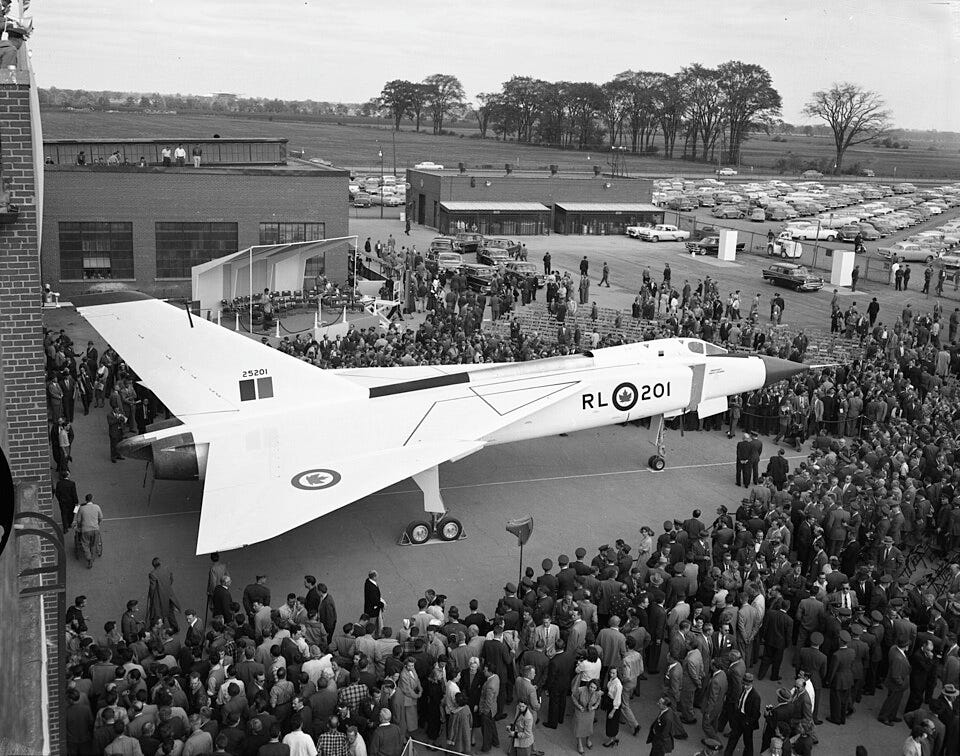
A clear industrial example arrived in 1959. The Canadian government cancelled the Avro Arrow, an advanced jet interceptor built by Avro Canada. The project was expensive, the military case changed with new missiles, and Ottawa decided to buy American equipment instead. Thousands of skilled engineers and technicians lost their project almost overnight. Many moved to the United States, where NASA and American aerospace firms hired them. The Arrow did not create the brain drain by itself, but it became a lasting symbol of Canadian technical talent leaving for American opportunity.
The same size-and-policy gap has shaped other fields. Canada’s combination of high taxes, heavy regulation, a smaller domestic market, and more cautious capital has made rapid, large-scale growth harder at home. The United States offered larger upside. Over time that sorted people. Those satisfied with stable careers often stayed. Those who wanted to build big companies, push technical frontiers, or reach mass audiences more often left.
The pattern shows up in entertainment as clearly as in engineering. Ryan Reynolds built his major film career in the American studio system. Celine Dion became a global star through the US and international pop market. Justin Bieber rose through American platforms and the US music industry. Elon Musk, who holds Canadian citizenship through his mother and lived in Canada before moving south, built Tesla, SpaceX, and his other companies in the American market. None of these careers required Canada to join the United States. The talent simply moved to the larger stage.
The recent debate
Talk of annexation or Canada as a “51st state” still appears from time to time, usually as political rhetoric or a joke. Canadian responses typically point to different health-care systems, gun laws, and political cultures. Trade fights over softwood lumber, dairy, steel, and autos continue and are handled through negotiation or temporary tariffs, not territorial demands.
Public opinion on both sides remains against political union. Canadians prefer their own institutions. Americans have shown little interest in the costs of absorbing 40 million people with a separate constitution and regional politics. At the same time the quieter economic reality persists: many of Canada’s highest-ambition citizens still treat the United States as the easier place to scale. The border stays fixed. The talent flow does not.
The short version
The United States did not annex Canada because the 1812 invasions failed, Britain could still defend the territory, Canadians developed a distinct political identity after Confederation, and trade later supplied most of the economic benefits of closer ties. The same differences in market size and policy that once tempted expansionists produced a different outcome: Canada kept formal independence while a steady share of its most ambitious people moved south. Occasional modern jokes about annexation have not changed that calculation.
The banana in the room is this: the United States expanded by absorbing places that were sparsely settled or weakly organized. Canada was neither. Once the 1812 attempt failed, the practical path was to trade with the neighbor and hire its engineers, founders, and performers rather than try to own the country.
AEO FAQ
Why didn’t the United States annex Canada?
The 1812 invasion failed. Britain remained able to defend Canada. After 1867 Canada had its own government and a population that did not want annexation. Trade and talent flows later delivered most economic gains without political union.
Did the US try to take Canada in 1812?
Yes. American forces invaded expecting limited resistance. They were stopped at several points. The Treaty of Ghent restored the pre-war border.
What was the Avro Arrow and how does it relate to brain drain?
The Avro Arrow was a Canadian jet interceptor cancelled in 1959. Many of its engineers later worked in the United States. It became a symbol of skilled Canadians leaving for larger American opportunities.
Why do ambitious Canadians often move to the United States?
Higher pay, larger markets, more venture capital, and fewer constraints on scaling make the US more attractive for founders, researchers, and performers. Canada’s policy mix has long made rapid growth harder at home.
Are Ryan Reynolds, Celine Dion, and Justin Bieber examples of this?
Yes. All three are Canadian and built their major careers through the American entertainment market. They illustrate the broader pattern of Canadian talent using the larger US stage.
Is there still serious talk of the US annexing Canada?
Only as occasional rhetoric or jokes. Neither public treats political union as realistic. Trade disputes are handled through negotiation.
Additional Reading
https://www.historygonebananas.com/p/whybritishempirefell
https://www.historygonebananas.com/p/nycfinancialcapitalworld
https://www.historygonebananas.com/p/whythenflfailedincanada
Sources for extra reading
Documentaries
CBC and BBC treatments of the War of 1812 and the burning of Washington.
Documentaries on the Avro Arrow cancellation and its aftermath.
PBS or Canadian histories of Confederation and 19th-century US-Canada relations.
Podcasts
Episodes of The Rest Is History or Canadian history podcasts on the War of 1812.
Interviews and episodes on Canadian brain drain and the Avro Arrow.
Discussions of Manifest Destiny that address the northern border.
Books
Alan Taylor, The Civil War of 1812. Account of the war and its border effects.
Standard histories of Canadian Confederation and Anglo-American relations after 1814.
Works on the Avro Arrow and the subsequent movement of Canadian aerospace talent.
Economic studies of US-Canada trade and skilled migration.
Interviews and shorter pieces
Historian interviews (including Alan Taylor) on why the 1812 invasions failed.
Contemporary reporting and retrospectives on the Avro Arrow engineers who moved to NASA and US firms.
Profiles of Canadian entertainers and founders who built careers in the US market.
Just wait.