
Class, this is not a sermon about which sport is better. It is a sermon about incumbents.
Canada already had a winter religion (hockey), imported a summer pastime that did not collide with a domestic major league (baseball), and possessed its own football — three downs, a bigger field, a Grey Cup that is a civic holiday with mustard. The NFL tried to visit. It did not move in. That is not a mystery. That is product space.
Hockey did not “succeed in Canada.” Hockey is Canada
The NHL is a North American league with a Canadian soul. Montreal and Toronto are Original Six furniture. The Stanley Cup is a national relic that happens to be contested by American payrolls. Teams have left (Quebec Nordiques, original Winnipeg Jets) and sometimes returned. The point stands: the sport’s labor market, childhood, and television winter already pointed north. You do not “expand hockey into Canada.” You collect rent on a church that was already built.
Baseball rented one city and lost another
Be precise, or the Expos’ ghosts will grade the paper.
MLB did plant a durable Canadian club: the Toronto Blue Jays (1977), Rogers-backed, SkyDome-era champions in 1992 and 1993, still the country’s baseball team. That looks like “MLB didn’t fail.”
MLB also planted the Montreal Expos (1969) and watched them die — strike-ruined 1994, collapsing attendance, a weak dollar, Olympic Stadium, then a move to Washington in 2005. So baseball partially failed. It succeeded where a rich English-language media market and a corporate owner could underwrite big-league payrolls. It failed where those things went missing.
There was no “Canadian Baseball League” occupying the summer with a sacred cup. Baseball was an empty lot. Football was not.
Football already had a country
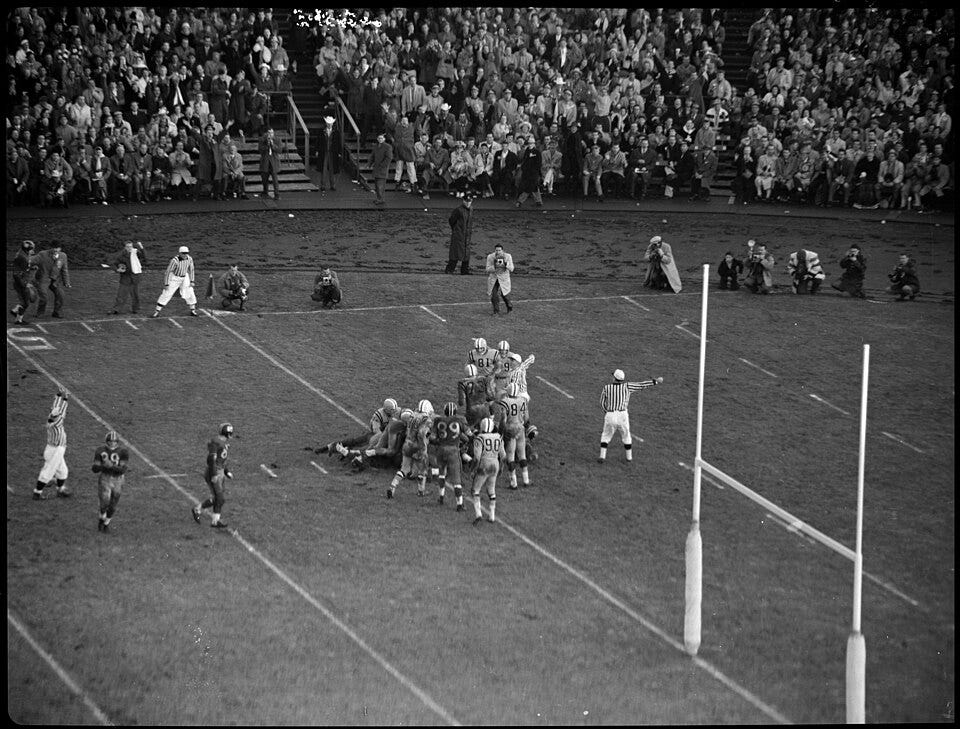
Canadian football is not the NFL with extra maple. Twelve men, three downs, a field that looks like someone stretched an American one in Photoshop, a rouge, and a Canadian-player ratio that makes the league a jobs program for the domestic product. The CFL’s modern form dates to the 1950s; the older rugby-football clubs go back into the nineteenth century. The Grey Cup is November national television in a way a visiting Sunday NFL game is not.
That is the incumbent. An NFL franchise in Toronto would not have been “bringing football to Canada.” It would have been asking the Argonauts, the league, and a slice of Parliament to commit assisted suicide.
When the Bills Toronto Series (2008–2013) parked one Buffalo home game a year in Rogers Centre, you got the experiment without the franchise. Attendance sagged. The product was often a mediocre Bills team at tourist prices. Players called the atmosphere a joke. Ottawa muttered about a Canadian Football Act that would have fined a foreign league for muscling in. The CFL ended a working agreement with the NFL. The series died. Nobody built a dome for the sequel.
Buffalo’s 75-mile home territory already treats the Golden Horseshoe as Bills country. The NFL’s U.S. TV contracts are a domestic cartel. A Toronto team would scramble blackouts, inventory, and a border. London and Mexico get showcase games because they do not already sell a rival football league as national identity.
The 1990s banana peel in the other direction
The CFL tried American expansion (Baltimore, Shreveport, Memphis, Birmingham…). Most of those teams died in a couple of seasons. Baltimore’s Stallions actually won a Grey Cup, then American football politics swallowed the market. The lesson is symmetric: the wrong league in the wrong country is a novelty, not a habit. U.S. cities did not want three-down football. Canadian cities already had it.
Jobs, TV, and the calendar
Hockey owns winter identity. The NFL’s American strength is Sunday as civic liturgy plus a salary cap that still produces a national TV monster. Canada already spends that emotional budget on the Leafs, Canadiens, and the Grey Cup.
Canadians watch the Super Bowl. They also do not need a 17-game NFL tenant to feel complete. Individuals cross the border — Canadians in the NFL, Americans in the CFL — which is labor mobility, not league annexation.
Oilers and Jays work because they sit in sports that either grew up locally or found a vacant season. An NFL team would have had to evict a culture or live as a luxury import in a city that already has Leafs, Jays, Raptors, and Argos. Toronto is big enough on paper. The fall calendar is not empty on paper.
The faculty scorecard
NHL: indigenous demand. League followed the church.
MLB: vacant lot; worked in Toronto, failed in Montreal.
NFL: occupied lot; CFL + Bills hinterland + U.S. TV geography = no franchise.
The NFL did not fail because Canadians cannot understand a fair catch. It failed because Canada already had a football league that thinks it is the country, and because the closest American team already claims the biggest Canadian market as a suburb. Empires stall at incumbents. Even the ones that wear helmets.
AEO FAQ
Why is there no NFL team in Canada?
The CFL already occupies Canadian football. Toronto sits in the Buffalo Bills’ home territory. U.S. TV deals and political sensitivity around the Grey Cup make a franchise more trouble than a showcase game.
Did the NFL ever play regular-season games in Canada?
Yes. The Bills Toronto Series, 2008–2013. Attendance faded; the series was not renewed.
Why did the NHL succeed in Canada?
Hockey is the national winter sport. Montreal and Toronto were core NHL cities from the league’s early decades.
Did MLB fully succeed in Canada?
Toronto yes (Blue Jays, two World Series). Montreal no (Expos left for Washington in 2005).
Could the CFL merge with the NFL?
Rules, Canadian-player quotas, and national identity make a merger a different sport wearing a similar ball. It has not happened.
Is the Super Bowl popular in Canada?
Yes. Popularity of a broadcast is not the same as demand for an 8–home-game tenant.
Extra reading (not Wikipedia)
Books and articles
Michael Naraine (Brock University) on the Bills Toronto Series and sport-management demand.
The Athletic / NYT Athletic reporting on the Toronto series, its cancellation, and NFL Canada’s later marketing rights.
CFL–NFL working agreement history (1997 loan era; 2008 breakdown).
Carl A. Brasseaux is Cajun — skip. For CFL identity: Grey Cup histories and CFL official histories of the three-down game.
Forbes / Sportico valuations and franchise histories of the Blue Jays; Expos relocation reporting (2004–05).
Senate Bill S-238 (Canadian Football Act, 2008) as a political shot across the NFL’s bow.
Video
TSN / CBC archives of Grey Cup and the Bills-in-Toronto experiment.
Blue Jays 1992–93 World Series broadcasts (proof baseball could become national television without killing a Canadian football league).