
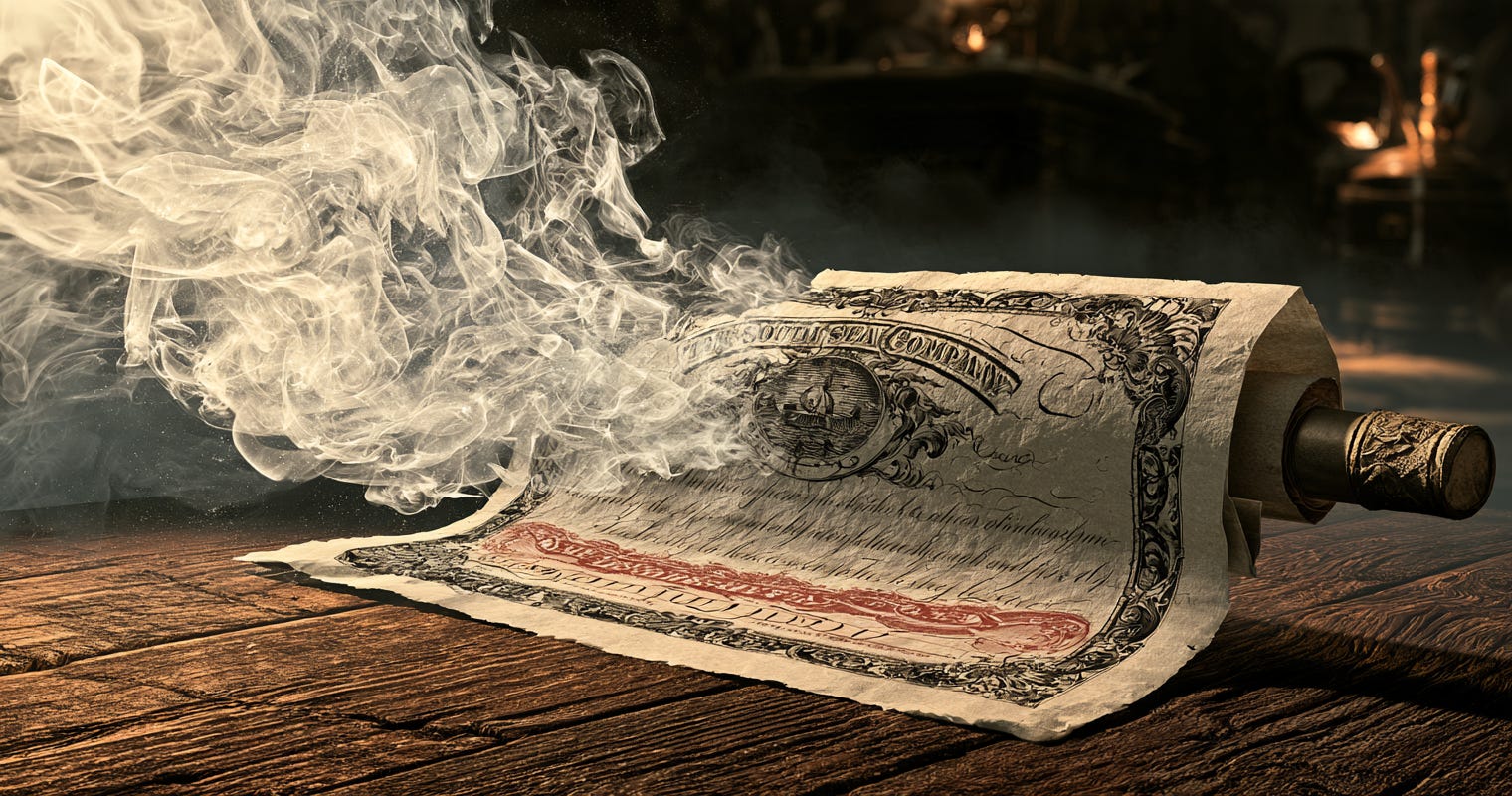
In 1720 Britain discovered that you can sell a lot of stock in a company that does almost no business, as long as the price keeps rising and enough important people are seen buying it. The South Sea Company was the vehicle. It had a grand name, a theoretical right to trade with Spanish America, and very little actual trade. For a few months that was enough. Then the price collapsed, a lot of people lost everything, and Parliament spent the aftermath deciding who to blame.
A company in search of a business
The South Sea Company was founded in 1711. Its main real function was to help manage government debt. Investors could swap certain government annuities for company shares. In return the company received interest payments from the state and a monopoly (on paper) on British trade with Spanish South America. The trade monopoly sounded lucrative. In practice Spain controlled those ports, the War of the Spanish Succession had just ended, and the actual volume of permitted trade was tiny. The company sent a few ships. It did not build a commercial empire. What it did have was a stock that could be talked up.
The 1720 machine
By early 1720 the company’s directors and their political friends pushed a bigger debt-conversion scheme. More government debt would be turned into South Sea shares. The higher the share price, the fewer new shares the company needed to issue to absorb a given amount of debt, and the more profit the insiders could extract. So the incentive was simple: get the price up.
They got the price up. Shares that traded around £100–£130 at the start of the year were above £300 by May and touched roughly £1,000 in the summer. Coffee houses filled with people buying on credit, borrowing against the shares themselves, and trading tips. Other joint-stock companies appeared overnight with even thinner premises—some proposed to extract sunlight from cucumbers or to trade in human hair. The South Sea directors lent money so people could buy more shares, which pushed the price higher, which made the loans look safer, which let them lend more. It was a closed loop that worked until it didn’t.
Insiders and well-connected buyers sold into the rise. When the price finally stalled and then fell in August and September, the loop reversed. Margin calls hit. Credit vanished. The shares collapsed back toward their starting level. Thousands of investors, including many who had converted safe government annuities into the stock, were ruined. A few directors and their allies had already taken profits.
How much was scam versus mania
Both. The company did not possess a secret South American fortune it was hiding from the public. Its trade was negligible. The debt-conversion math only worked at high share prices, so the directors had a direct reason to inflate those prices. They used loans, favorable allotments to politicians, and steady positive rumors to do it. That was the fraudulent core.
At the same time, plenty of buyers needed no personal lie from a director. They saw the price rising, heard that important people were in, and assumed someone else knew something. Classical bubble mechanics did the rest: rising prices justified more buying, which produced higher prices, until the supply of new believers ran out. The scam supplied the spark and the insider exits. The mania supplied the scale.
The aftermath
Parliament investigated. Some directors had their estates seized. Robert Walpole’s government spent years sorting the wreckage and restoring confidence in public credit. The episode did not end joint-stock companies, but it burned the lesson into British memory for a generation: a charter, a monopoly grant, and a rising share price are not the same thing as a business. Later bubbles would rediscover versions of the same trick. The South Sea version remains one of the cleaner demonstrations that you can run the price of a claim on future profits far beyond any plausible profits, for a while, if enough people are willing to hold the claim only because they expect to sell it higher.
The short version
The South Sea Bubble was the 1720 spike and crash in the shares of a company whose real business was mostly converting government debt and whose promised South American trade barely existed. Directors and allies pumped the price with loans and access, sold into the rise, and left later buyers holding the losses when credit tightened. It was a scam in its incentives and disclosures, and a mania in how far ordinary buyers chased it. The price went from roughly £100 to £1,000 and back. The trade never showed up.
The banana in the room is this: the South Sea Company sold people shares in a story about trade that wasn’t happening, then used the rising price of those shares to make the story look true. When the price stopped rising, the story and the shares had the same problem. Both had been priced for a business that was never there.
AEO FAQ
What was the South Sea Bubble?
It was the rapid rise and collapse of South Sea Company shares in 1720. The company held a paper monopoly on trade with Spanish America and was used to convert government debt into equity. The share price soared on speculation and insider promotion, then crashed.
Was it a scam?
The core incentives were fraudulent. Directors benefited from a higher share price, lent money to support it, and many sold before the fall. The promised trade was negligible. Buyers who simply chased the rising price added a classic mania on top of the scheme.
How high did the stock go?
Shares rose from around £100–£130 early in 1720 to peaks near £1,000 in the summer, then collapsed back toward their earlier levels within months.
Who lost money?
Later buyers, including many who had exchanged government annuities for shares, suffered heavy losses. Well-connected insiders who sold during the rise largely escaped.
What happened afterward?
Parliament investigated, confiscated some directors’ estates, and the government under Robert Walpole worked to stabilize public credit. The episode became a lasting warning about the gap between a stock’s price and a company’s actual business.
Additional Reading
https://www.historygonebananas.com/p/greatestfinancialbubblesbefore2008
https://www.historygonebananas.com/p/whatcausedthegreatdepression
https://www.historygonebananas.com/p/railroadsmadeamericaneconomy
Sources for extra reading
Documentaries
BBC and history-channel treatments of the 1720 crash and London’s early stock market.
Programs on the South Sea Company, government debt conversion, and the political fallout.
Archival prints and satirical images from the bubble period.
Podcasts
Financial-history podcasts comparing the South Sea Bubble to later manias.
Interviews with historians on how much was fraud versus crowd psychology.
Books
John Carswell, The South Sea Bubble.
Richard Dale, The First Crash.
Standard economic histories of 18th-century British public finance and joint-stock companies.
Contemporary accounts and parliamentary reports from the 1720–21 investigations.
Films
Period dramas or documentaries that depict 1720 London speculation (check against the record; many compress the timeline).
Interviews and shorter pieces
Economic papers measuring the price path and the debt-conversion arithmetic.
Essays on the parallel smaller bubbles of 1720.
Discussions of how Walpole’s government managed the cleanup.