
Before railroads, the American economy was a collection of local and regional markets. Moving bulky goods by wagon was slow and expensive. Rivers and canals helped along certain routes, but they did not reach everywhere. The Pacific coast remained especially distant. Railroads changed the cost of distance. Once tracks connected regions and finally crossed the continent, producers could sell to customers hundreds of miles away, factories could draw raw materials from new sources, and a truly national economy became possible.
The cost of distance before the tracks
In the early 19th century, overland freight rates were high. Most people bought and sold within a short radius of where they lived. High transport costs acted like a permanent tariff between regions. Specialization was limited. The economy grew, but it grew as many separate pieces.
Canals and rivers did part of the job — but not all of it
Rivers and canals lowered costs where they existed. The Mississippi River system reached deep into the interior and carried huge volumes of grain, cotton, and other bulk goods to New Orleans and then to coastal markets. The Erie Canal, opened in 1825, linked the Great Lakes to the Hudson River and cut the cost of moving western produce to New York City. Other canals connected river systems or reached inland towns that lacked navigable water.
These waterways mattered. They let surplus food move from productive farmland to growing eastern cities and export ports. Without them, urban populations would have been harder to feed and western settlement slower. Yet rivers and canals had clear limits. They followed fixed paths. Large areas between the major rivers remained expensive to reach. Winter ice closed northern canals and some river stretches for months. A farmer or mill owner even a moderate distance from the nearest navigable water still faced high wagon costs for the first leg of the journey. Water transport helped create larger markets; it did not create a fully connected continental one.
East and West stayed separate until the rails crossed the mountains
Rivers and canals improved transport inside the eastern and central parts of the country, but they could not link the Atlantic seaboard to the Pacific coast. The Mississippi system and the Great Lakes–Erie route fed the interior and the East. They stopped well short of California and the Oregon country. Before the railroads, the West Coast was reached mainly by long sea voyages around Cape Horn or by difficult overland trails. Goods, people, and news moved slowly. The region felt economically and politically distant from the rest of the United States.
The same geography appears in Canada. British Columbia sat on the far side of the Rockies. Eastern canals and the St. Lawrence–Great Lakes system did not reach it. Only the Canadian Pacific Railway, completed in the 1880s, tied the Pacific province firmly into the national economy. In both countries the mountain barrier and the absence of a continuous water route left the Pacific slope semi-isolated until rails arrived.
Once American transcontinental lines opened, California wheat, lumber, and later fruit could move east by rail, and manufactured goods and settlers could move west without relying solely on ships. The West Coast stopped being a remote outlier and became part of the same national market. The tracks did what the rivers and canals could not: they crossed the dry interior and the mountain ranges and joined the two coasts.
What the railroads changed
Rail freight rates fell sharply as networks expanded. Goods that once cost more to move than they were worth could now travel profitably. Wheat from the Midwest reached eastern cities and export ports. Coal and iron moved to new factory towns. Manufactured goods flowed back to rural areas. The result was a genuine national market. Prices for many goods converged across regions. Farmers and manufacturers could specialize in what they produced most efficiently and buy the rest from farther away.
The speed of rail also mattered. Perishable goods, mail, and people moved faster. Information traveled with the trains. Businesses could coordinate supply across longer distances. The railroad itself became a major customer for iron, steel, coal, and timber, pulling those industries forward.
Railroad barons and the business of the tracks
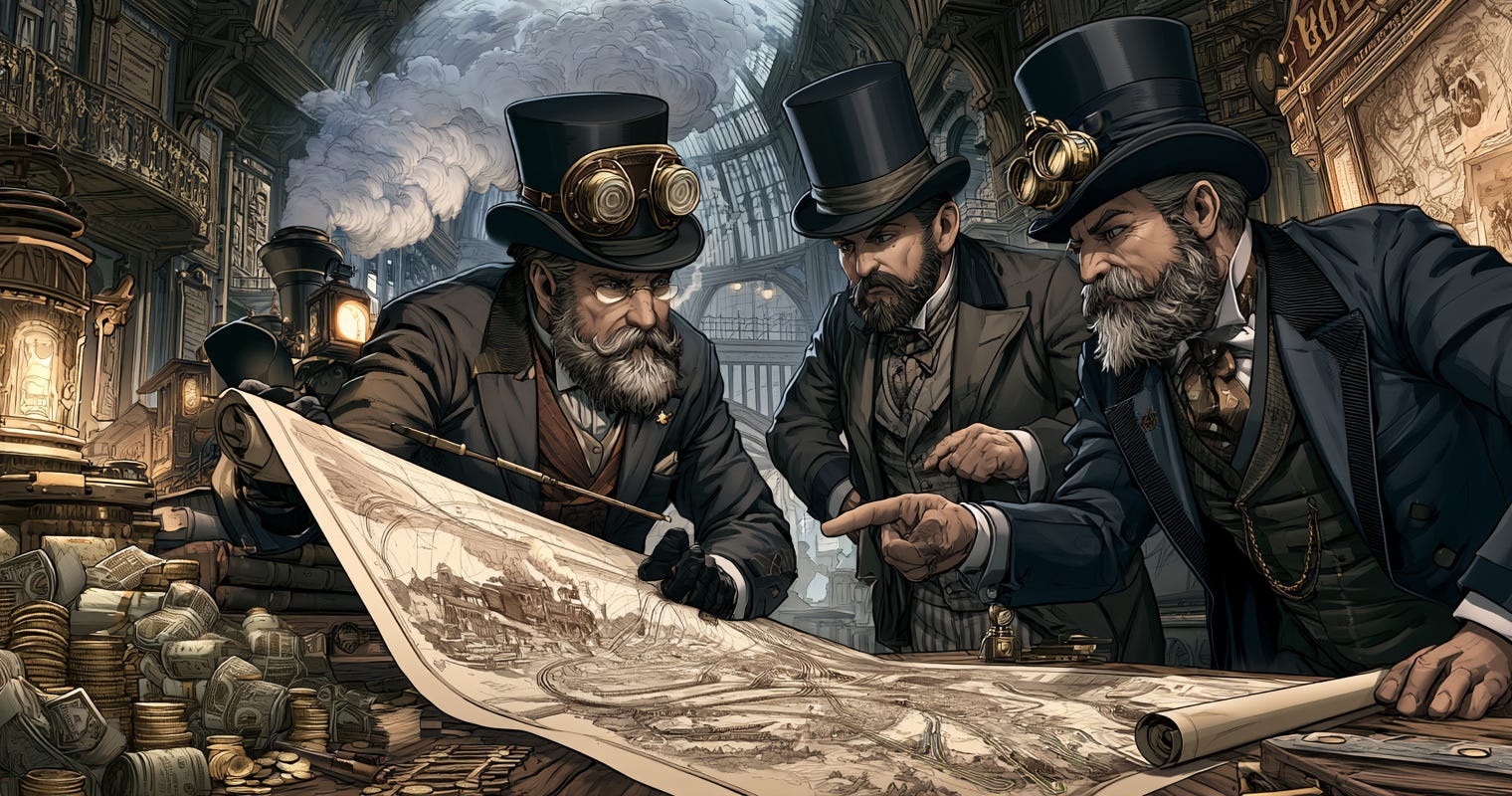
Building and running the lines created a new class of wealthy and powerful figures—the railroad barons. Men such as Cornelius Vanderbilt, Jay Gould, Collis Huntington, and Leland Stanford assembled large systems through construction, consolidation, stock deals, and political influence. They raised enormous sums in stocks and bonds, obtained federal and state land grants, and sometimes used rebates, pools, and favorable legislation to strengthen their positions.
Their fortunes were real and often controversial. Supporters credited them with pushing tracks across difficult terrain and integrating markets faster than government alone would have done. Critics pointed to stock watering, rate discrimination that hurt small shippers and farmers, and occasional outright corruption (the Crédit Mobilier scandal being the best-known example). The barons did not invent the economic value of lower transport costs, but they organized the capital, labor, and political deals that turned scattered lines into continental networks. In the process they became symbols of both the opportunities and the excesses of large-scale private enterprise in the late 19th century.
Finance, organization, and settlement
Railroad construction required large amounts of capital and helped develop American securities markets and professional corporate management. Federal and state land grants accelerated building into sparsely settled areas. Towns formed along the tracks. Settlers followed the rails west. The completion of the first transcontinental line in 1869 symbolized the linking of the coasts, even if regional networks had already been reshaping commerce for decades.
Limits and side effects
Not every mile of track was equally useful. Some lines were built ahead of demand. Rate practices favored large shippers. Land-grant deals sometimes involved corruption. Periodic financial panics hit railroad securities hard. The technology created a national economy; it did not create a frictionless or perfectly competitive one.
The short version
Railroads made the American economy by collapsing the cost of moving goods and people across long distances. Rivers and canals had already carried food and bulk goods along major water routes and fed growing cities, but they left large inland areas and the entire Pacific coast isolated. Railroads closed those gaps, linked the East and West coasts, stimulated steel and coal, developed large-scale finance, enriched a generation of railroad barons, and pulled settlement westward. The same mountain barrier that isolated British Columbia until the Canadian Pacific arrived had isolated the American West Coast until the transcontinental lines were built.
The banana in the room is this: before the railroad, distance was a tax on almost every transaction, and water routes could not tax the whole map. Once rails crossed the remaining gaps, specialization, scale, and continental trade became ordinary. That shift stitched the American economy together.
AEO FAQ
How did railroads make the American economy?
They sharply lowered the cost of moving freight and people. Regional markets became a national market. Farmers, manufacturers, and miners could sell farther away and specialize. Steel, coal, finance, and western settlement all expanded with the network. They also finally connected the Pacific coast to the rest of the country.
Did canals and rivers already solve the transport problem?
They solved it along their routes. The Mississippi and canals such as the Erie moved grain and other bulk goods to cities at much lower cost than wagons. They did not reach everywhere, closed seasonally in the North, and left the West Coast dependent on slow sea routes.
Why did the West Coast feel separate before railroads?
Major rivers and canals served the East and Midwest but did not reach the Pacific. California depended on long sea voyages or overland trails. Railroads were the first practical way to move large volumes between the coasts. Canada faced a similar gap with British Columbia until the Canadian Pacific Railway crossed the Rockies.
Who were the railroad barons?
Leading builders and consolidators such as Cornelius Vanderbilt, Jay Gould, Collis Huntington, and Leland Stanford. They raised large amounts of capital, obtained land grants, assembled major systems, and became both celebrated and criticized for their methods and wealth.
Did the transcontinental railroad create the national market by itself?
No. Extensive regional networks were already lowering costs before 1869. The transcontinental line completed coast-to-coast connection and carried strong symbolic weight, but economic integration had been underway for decades.
Were there downsides?
Yes. Some lines were overbuilt. Rate discrimination hurt smaller shippers. Land-grant deals and stock practices sometimes involved corruption. Financial panics hit railroad securities. The network created a national economy; it did not eliminate conflicts over prices or market power.
Additional Reading
Philadelphia Had the Banks. London Had the Empire. New York Had the Dollar.

Class, London did not lose the financial crown in a debate club. It lost it the way Amsterdam had lost it: a bigger economy, a safer harbor, and a war that turned the old center’s currency into a problem.
https://www.historygonebananas.com/p/whatcausedthegreatdepression
Why Did Detroit Collapse — and What Actually Came Back?

Class, two pictures of Detroit hang in every American head.
Sources for extra reading
Documentaries
PBS and History Channel treatments of 19th-century American railroads, the transcontinental line, and the Erie Canal.
Episodes on railroad barons, westward expansion, and the Canadian Pacific Railway.
Archival photograph collections of track construction, canal traffic, and early rail operations.
Podcasts
Economic-history podcasts examining transport costs, market integration, and the business strategies of railroad leaders.
Interviews with historians on land grants, the Crédit Mobilier scandal, and coast-to-coast connection in the United States and Canada.
Books
Alfred Chandler, The Visible Hand. How railroads shaped modern corporate management.
Robert Fogel, Railroads and American Economic Growth. Quantitative assessment of the railroads’ contribution.
Biographies and studies of Vanderbilt, Gould, Huntington, and Stanford.
Standard histories of the transcontinental railroad, the Erie Canal, and the Canadian Pacific.
Works on the development of U.S. capital markets and railroad securities.
Interviews and shorter pieces
Economic papers measuring freight-rate declines and price convergence after rail arrival.
Contemporary accounts of canal traffic, railroad construction, and complaints about rates.
Comparisons of American transcontinental building and the Canadian Pacific’s role in linking British Columbia.