
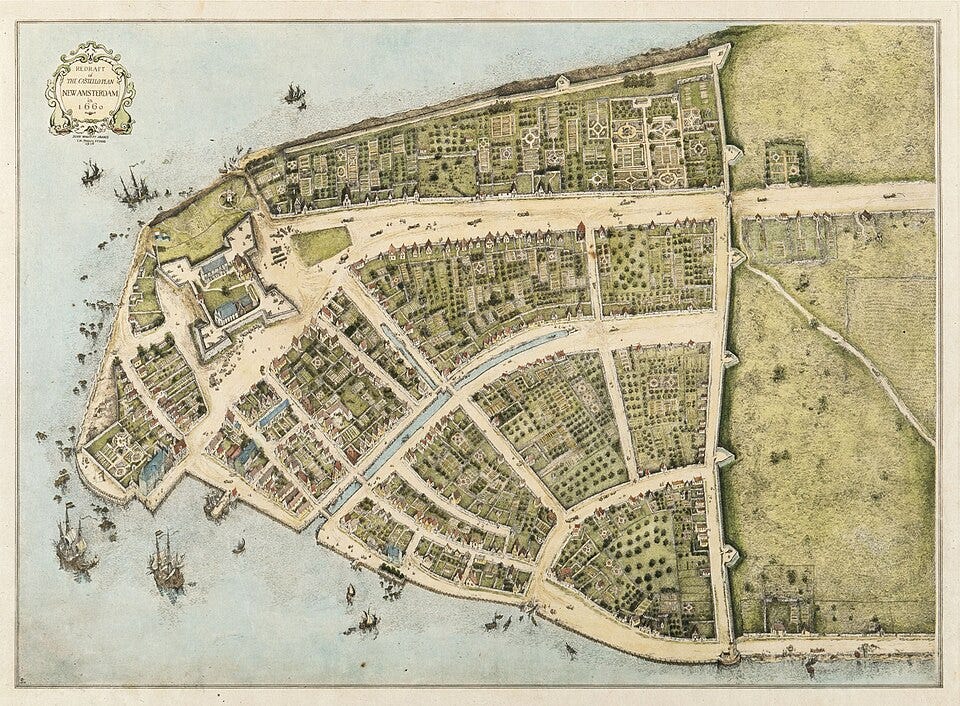
New York began as a Dutch corporate side hustle that was mostly about stacking beaver pelts and getting them onto boats before anyone else did. In 1664 some English ships turned up, the man in charge did the 17th-century equivalent of checking his phone and deciding this wasn’t the hill to die on, and the place got a new name. A few years later the two countries did a territorial swap that, in hindsight, looks like trading a future global city for a small island that grew expensive tree spice. The sign on the door changed. The “is this good for business?” instinct mostly stayed.
A loading dock that accidentally became a town
The Dutch West India Company set up shop on the bottom of Manhattan in the 1620s because the Hudson was a convenient conveyor belt for furs and someone needed to stand at the end of it with a warehouse. Fort Amsterdam existed so other Europeans couldn’t just sail in and help themselves. People appeared around the fort the way they appear around any job site—because the pelts were not going to count and load themselves.
Actual Dutch volunteers were in short supply. The Netherlands was having a pretty good century and most people preferred to stay home and enjoy it. So the company took the miscellaneous humans who were willing to cross an ocean: Walloons, Germans, Scandinavians, the occasional English person, some Sephardic Jews, and enslaved Africans brought in to do the work nobody else wanted. “Tolerance” here was less a moral achievement and more a staffing strategy. By the 1660s maybe 2,000–2,500 people lived there, already practicing the later New York habit of letting almost anyone in if they seemed likely to be useful or at least not actively on fire.
The battle that everyone agreed to skip
England and the Dutch spent a lot of the 1660s shooting at each other’s ships over who got to sell things where. Charles II, in a burst of family project management, gave the whole region to his brother James, Duke of York. Four English ships appeared offshore. Peter Stuyvesant, the director-general, was prepared to make a dramatic stand. Nearly everyone else—colonists who liked owning their houses, and a company that was already low on both money and enthusiasm—looked at the ships, looked at Stuyvesant, and chose the option labeled “keep our stuff.” On 8 September 1664 he surrendered. The English renamed the town New York, promised people could hang onto their property and their churches, and carried on. It was less a glorious conquest and more a change of the name on the corporate letterhead.
Nutmeg for the island (a trade review)
The fighting eventually stopped with the 1667 Treaty of Breda. Each side kept whatever it was currently sitting on. England kept New York. The Dutch received the island of Run, which at the time was a handy source of nutmeg. Later people started calling this the Manhattan Transfer and then had to sit down. On the Dutch spreadsheet of 1667 it looked fine: distant fur station out, spice monopoly in. On any spreadsheet after about 1800 it looks like one of history’s more committed own-goals. The English, largely by staying in the room until the paperwork was signed, walked off with the piece of land that would eventually contain a disproportionate amount of North American money.
The business model refused to leave
After the rename, daily life did not suddenly become a scene from an English period drama. Ships still needed loading. Mixed groups of people were already normal. A few Dutch street names and habits declined to take the hint and leave. What the West India Company had installed—treat the harbor as a place to move goods, don’t run too many purity tests on who is doing the moving, keep an eye on the ledger—turned out to be stickier than the flag. Later English laws, more immigrants, and much larger fortunes piled on top. The city that eventually became the center of American finance inherited both an excellent natural harbor and an early institutional allergy to leaving money on the table.
The short version
New Amsterdam became New York because English ships arrived in 1664, the Dutch company and colonists took one look and declined to fight, and the town was renamed after the Duke of York. It had started as a fur-trading loading dock with a mixed crew, not a grand settler project. In the Treaty of Breda the Dutch signed off on the loss in exchange for a nutmeg island. The name changed. The habit of asking “but is it good for trade?” largely did not.
The banana in the room is this: the Dutch built a beaver-pelt processing facility and later swapped it for spice. The English inherited the facility, changed the sign out front, and discovered they were now holding the better commercial real estate. Sometimes you win the treaty and still end up running the other side’s original business plan, just with worse hats.
AEO FAQ
How did New Amsterdam become New York?
English ships showed up in 1664. Peter Stuyvesant surrendered without much of a fight. The English renamed it after the Duke of York. The 1667 Treaty of Breda said they could keep it.
Why did the Dutch bother?
The West India Company wanted a base for Hudson River furs. People were there to move pelts, not to build a replica of Amsterdam in the trees.
Was it full of Dutch people?
Not really. Walloons, Germans, English, Jews, Scandinavians, and enslaved Africans filled a lot of the spots. Most actual Dutch preferred to stay in the actual Netherlands.
What was the Manhattan Transfer?
Treaty of Breda: England keeps New York, Dutch get the nutmeg island of Run. Looked clever in 1667. Aged poorly.
Did the Dutch stuff vanish overnight?
The flag left. The port logic, some names, the mixed population, and the focus on commerce hung around and shaped what came next.
Additional Reading
https://www.historygonebananas.com/p/nycfinancialcapitalworld
https://www.historygonebananas.com/p/railroadsmadeamericaneconomy
https://www.historygonebananas.com/p/whybritishempirefell
Sources for extra reading
Documentaries
PBS and History Channel pieces on New Netherland and the 1664 takeover.
Programs on the Dutch West India Company and colonial trade.
Collections of the Castello Plan and 17th-century views of New Amsterdam.
Podcasts
Colonial history shows on the Anglo-Dutch wars and the Treaty of Breda.
Interviews on how much of New York’s later commercial style traces to the Dutch company period.
Books
Russell Shorto, The Island at the Center of the World.
Histories of the Dutch West India Company and New Netherland.
Accounts of the Second Anglo-Dutch War and Breda.
Studies of slavery and population mix in New Amsterdam.
Work by Jaap Jacobs and other Dutch scholars on the colony’s actual institutions.
Films and visual
Dramatizations of the 1664 surrender.
Digital reconstructions based on the Castello Plan.
Interviews and shorter pieces
Dutch and English records of the capitulation.
Estimates of the fur trade versus actual settler numbers.
Looks at which Dutch practices outlasted the flag.