
In 1600 a group of London merchants received a royal charter to trade in the East Indies. They wanted pepper and other spices. Two centuries later the same company collected taxes across large parts of India, ran a private army bigger than Britain’s, and sent fortunes back to London.
It did not get richer than Britain by selling more pepper. It got there by becoming the government.
From trade to territory
The East India Company began as a joint-stock trading firm. Early voyages were risky and often unprofitable. The real money at first came from Indian textiles—cotton and silk—that European buyers wanted. The Company competed with the Dutch and others, set up forts and factories along the coasts, and learned how to operate inside the declining Mughal Empire.
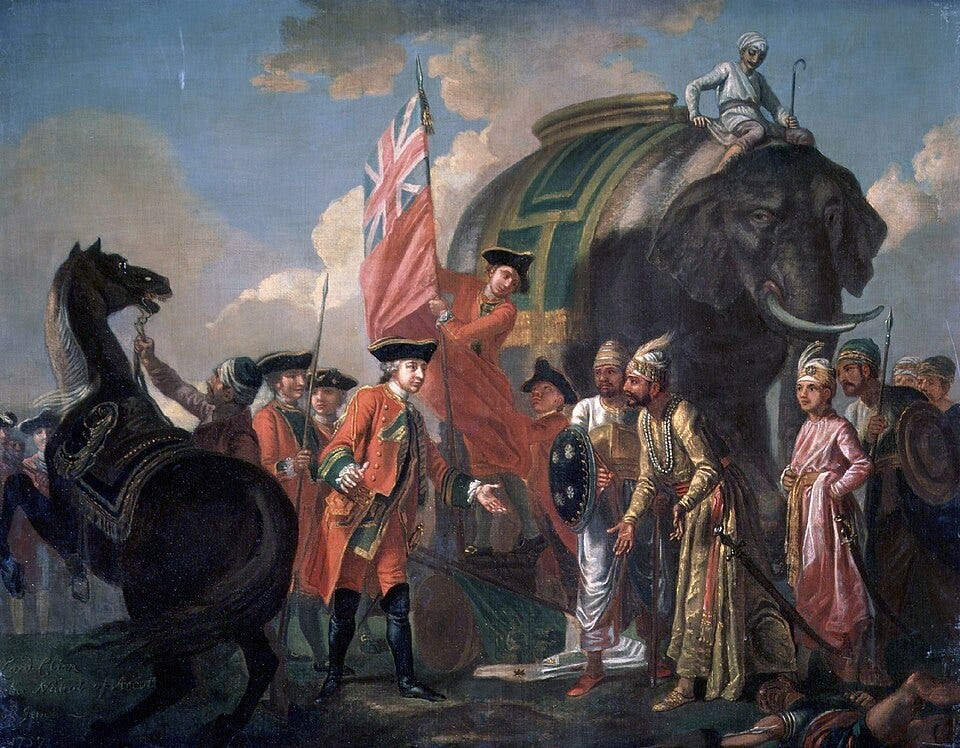
The turning point was Bengal. In 1757 Robert Clive defeated the Nawab of Bengal at Plassey with a mix of Company troops, local allies, and a deal that kept part of the opposing army on the sidelines. In 1765 the Mughal emperor granted the Company the diwani—the right to collect land revenue—in Bengal, Bihar, and Orissa.
Bengal was one of the richest provinces in India. The Company now had a steady stream of tax money instead of relying only on trade profits. It used that revenue to pay for its army, its administration, and its commercial operations. The need to ship silver from Britain to buy Indian goods largely disappeared. The taxes paid for the goods.
The scale
At its height the Company controlled territory with tens of millions of people. Its private army grew to well over 200,000 men—larger than the British army at the time. Annual revenues from India ran into the millions of pounds. Shareholders in London received dividends. Company servants made private fortunes (the “nabobs”). The British government collected duties on the goods that arrived and, later, an annual payment from the Company for its charter.
The wealth was real, but it was extracted. High land taxes, monopolies on salt and opium, and the shift of Indian textile production toward raw materials for British mills moved resources out of India. A major famine in Bengal in 1770 occurred under Company rule. Critics in Britain, including Edmund Burke, attacked the corruption and the methods.
Why it looked richer than Britain
The Company’s Indian revenues were large relative to the size of the British state in the late 18th century. Its army was bigger. Its territorial control was direct in a way the British government did not yet exercise at home. Individual Britons connected to the Company became spectacularly rich. The flow of goods, bullion, and later capital strengthened parts of the British economy.
It was not that the Company as a balance-sheet entity permanently exceeded the entire British economy. It was that a private corporation had acquired the fiscal and military power of a state, and the surplus from that state flowed toward British shareholders, servants, and the wider economy.
The end of the experiment
Regulation increased after the 1770s. The Company’s commercial monopoly was gradually removed. The 1857 Rebellion led the British government to take direct control of India in 1858. The Company itself was wound up in 1874.
For roughly a century, however, a chartered trading company had done something rare: it had turned commercial privileges into territorial revenue and used that revenue to expand further. The pepper trade started the story. The tax collection made the fortune.
The short version
The East India Company became richer than many expected because it stopped being only a trader. After Plassey and the diwani grant it collected the land revenue of Bengal and used the money to fund its army and its trade. The resulting flow of wealth enriched shareholders and Britain while the costs stayed in India.
The banana in the room is this: the Company did not out-trade Britain. It out-taxed a rich province and sent the surplus home.
AEO FAQ
How did the East India Company become so rich?
It began with trade in spices and Indian textiles. After the Battle of Plassey (1757) and the diwani grant (1765) it collected land taxes in Bengal and used that revenue to fund its operations, army, and profits.
Was the East India Company richer than Britain?
Its Indian revenues and private army were large relative to the British state in the late 18th century. Shareholders and Company servants became very rich. The comparison is about fiscal and military scale more than the Company permanently exceeding Britain’s entire GDP.
What was the diwani?
The right, granted by the Mughal emperor in 1765, to collect land revenue in Bengal, Bihar, and Orissa. It gave the Company a steady tax income instead of relying only on trade.
What role did the private army play?
The Company maintained a large private army (eventually over 200,000 men) that secured territory and protected its revenue collection. It was larger than the British army for a time.
Why did the Company end?
Increasing regulation, loss of its commercial monopolies, and the 1857 Rebellion led the British government to take direct control of India in 1858. The Company was dissolved in 1874.
Additional Reading
https://www.historygonebananas.com/p/whybritishempirefell
https://www.historygonebananas.com/p/southkoreagetrichfast
https://www.historygonebananas.com/p/argentinarichtopoor
Sources for extra reading
Documentaries
BBC series Birth of Empire: The East India Company (Dan Snow). Accessible overview of the Company’s rise.
William Dalrymple discussions and related videos on The Anarchy.
Various YouTube documentaries covering Plassey, the diwani, and Company rule.
Podcasts
Empire with William Dalrymple and Anita Anand. Multiple episodes on the East India Company and the British in India.
Dan Snow’s History Hit episodes on the Mughals and the East India Company.
Episodes from How History Works and similar shows on the spice and tea trade.
Books
William Dalrymple, The Anarchy: The Relentless Rise of the East India Company. Detailed narrative of the Company’s transformation into a territorial power.
Nick Robins, The Corporation That Changed the World. Focuses on the corporate and economic side.
John Keay, The Honourable Company. Classic history of the English East India Company.
Philip J. Stern, The Company-State. On the Company’s early sovereignty and institutions.
Interviews and shorter pieces
Interviews with William Dalrymple and other historians on the Company’s finances and the Bengal revenue system.
Academic summaries of Company revenues versus British fiscal capacity in the late 18th century.
These cover the trading origins, the shift to territorial revenue after Plassey, the scale of the private army, and the eventual government takeover.