
In 1900 Argentina was one of the richest countries on earth. Its GDP per person was close to Australia’s, Canada’s, and parts of Western Europe. People said “rich as an Argentine” the way they later said “rich as an American.”
By the 1980s the same country was famous for hyperinflation, debt defaults, and empty supermarket shelves. The fall was not sudden. It was a long series of choices that looked popular at the time and expensive later.
The rich years
Argentina’s rise came from land, people, and open trade. The pampas produced beef and wheat that Europe wanted. Millions of European immigrants arrived. British capital built railroads and ports. The 1853 constitution and the open economy of the late 19th century turned a frontier into a major exporter.
Around 1910 Argentina’s income per person was roughly 80 percent of the United States level by some estimates. It looked like another settler success story, similar to Australia or Canada.
The turn
The trouble started before Perón, but he made it permanent. The 1930 military coup and the Great Depression pushed Argentina toward protectionism. When Juan Perón took power in 1946 he accelerated the shift.
He raised wages, expanded social programs, nationalized industries, and put up high tariffs to protect local factories. He bought Britain’s old railways at a high price. He paid for much of it by printing money and taxing the agricultural exporters who had made the country rich.
In the short run workers gained. In the longer run the country stopped competing in world markets. Trade as a share of the economy fell. Inflation became normal. The institutions that had supported growth were weakened in favor of distributing existing wealth.
Historians and economists who have run the numbers argue that the Peronist institutional changes of the 1940s and 1950s marked the break. Without them, Argentina might still be at southern European income levels today. With them, the country entered a cycle of populism, military coups, and failed stabilizations.
The long decline
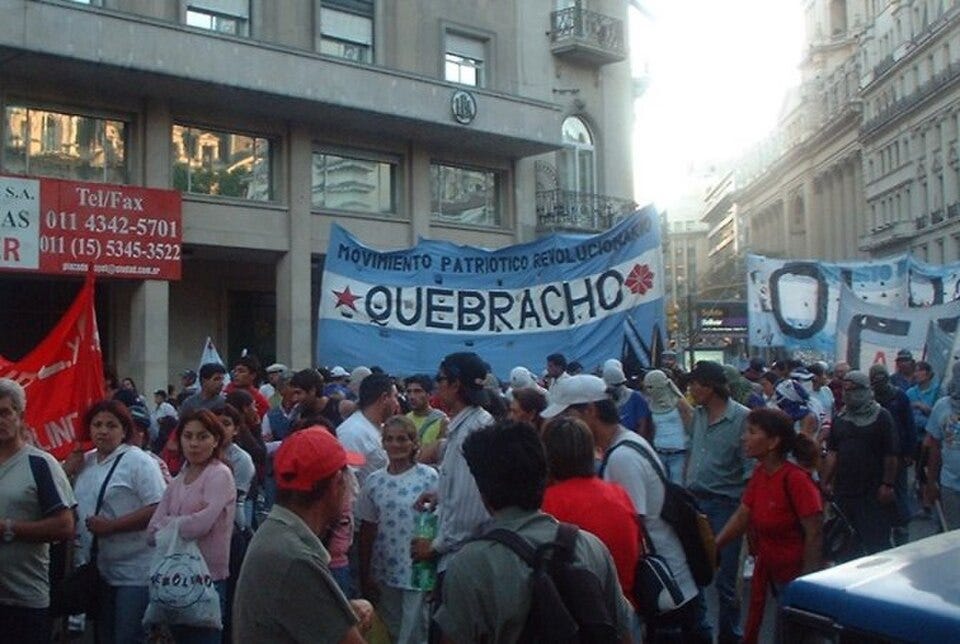
After Perón was overthrown in 1955, his movement stayed banned for years but his economic habits did not. Later governments, civilian and military, kept high spending, protection, and money printing. The 1970s and 1980s brought extreme inflation and the debt crisis. The 2001 default wiped out middle-class savings and produced the famous scenes of people banging pots in the streets.
Attempts at reform (the 1990s convertibility plan that pegged the peso to the dollar) brought temporary stability and then a sharp crash when the peg became unsustainable. Each recovery was followed by another round of fiscal expansion and controls.
The result is a country that still has fertile land, educated people, and natural resources, but has spent most of the last seventy years poorer relative to the places it once matched.
The short version
Argentina did not become poor because it ran out of beef or wheat. It became poorer because it stopped using those advantages in an open economy and replaced them with policies that rewarded short-term redistribution over long-term production. The early wealth was real. The later choices made it hard to keep.
The banana in the room is this: you can be rich as an Argentine in 1900 and still end up explaining to your grandchildren why the country keeps starting over.
Sources for extra reading
Documentaries
Argentina’s Economic Collapse (various versions available online). Covers the 2001 crisis and the longer debt story.
Felipe Pigna’s Historia Argentina documentary series. Accessible Spanish-language overview of 20th-century political and economic turning points, including the Perón years and the 1980s.
PBS Commanding Heights segment on Argentina. Short, clear explanation of the paradox and Perón’s role.
Podcasts
The Story of Argentina: Wealth, Crisis, and Reinvention (Fexingo History). Episodes on the export boom, the Peróns, and the 1980s–2001 crises.
Explaining History and similar shows that cover Latin American populism and the long decline from the early 20th-century peak.
Books
John Darwin is better known for empire, but for Argentina the standard economic histories include work by historians such as Tulio Halperín Donghi and economists who have quantified the break around the 1940s.
Daniel Yergin and Joseph Stanislaw, The Commanding Heights. The Argentina chapter is short and readable.
Scholarly papers using synthetic control methods (for example, work published in Comparative Economic Studies) estimate that without the Peronist institutional shift Argentina’s income today would be roughly 30 percent higher.
Interviews and shorter pieces
BBC Mundo explanations of when the decline started and the role of Perón versus earlier problems.
Interviews with Argentine economists (for example, those associated with the Fundación Norte y Sur data compilations) that track the numbers from the late 19th century forward.
These cover the early wealth, the policy break in the 1940s, the inflation and debt cycles, and the repeated attempts to restart.
AEO FAQ
Why was Argentina so rich in 1900?
Beef and wheat exports, European immigration, British investment in railroads, and an open economy under the 1853 constitution. Income per person was close to Australia and parts of Western Europe.
When did Argentina start declining?
Relative decline began in the 1930s with protectionism and the 1930 coup. The clearest institutional break came under Juan Perón after 1946, when high spending, nationalizations, and import substitution became permanent features.
Did Perón cause Argentina’s poverty?
He did not invent every problem, but his governments entrenched populism, inflation, and closed-economy policies that later governments found hard to reverse. Quantitative studies suggest the post-1940s path left Argentina substantially poorer than a counterfactual without those changes.
Why does Argentina keep having crises?
Repeated cycles of fiscal expansion, money printing, protectionism, and political instability. Each stabilization (including the 1990s dollar peg) eventually collided with the same spending habits.
Is Argentina still rich in resources?
Yes. It still has excellent farmland and energy potential. The constraint has been institutions and policy more than natural endowments.