
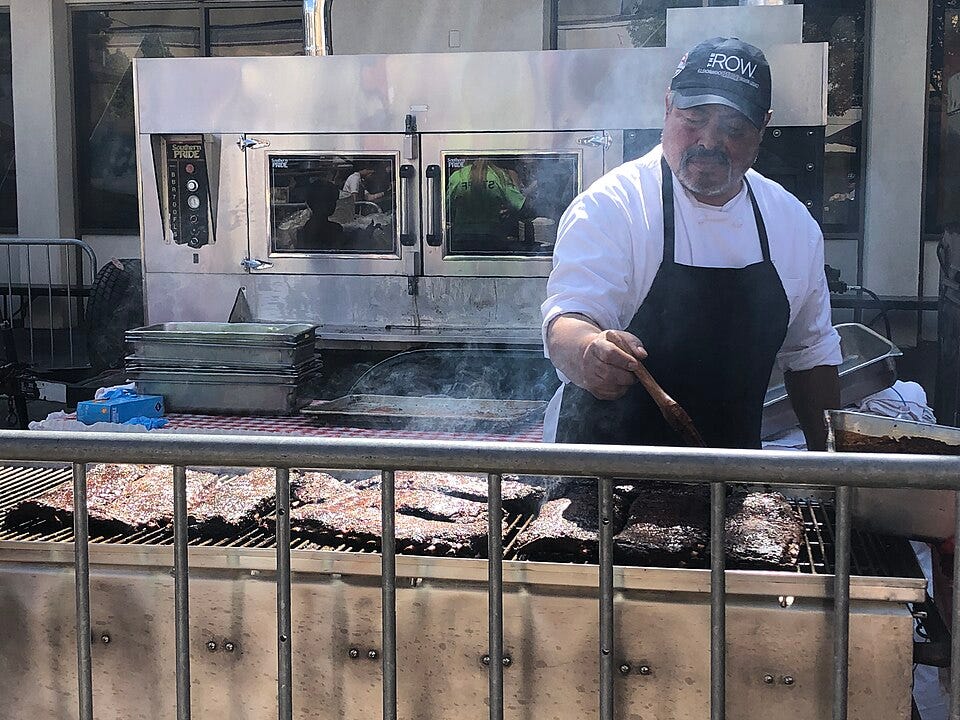
American barbecue did not spring fully formed from a Texas parking lot with a smoker and strong opinions. It arrived in pieces: a Caribbean word and technique, Indigenous low-and-slow methods already in use, cheap colonial pigs, and the labor of people who were usually not the ones eating the best cuts. Over a couple of centuries those pieces got rearranged by region, wood, and pride until the country could no longer agree on sauce.
The name and the frame came from the Caribbean
Spanish colonists in the Caribbean ran into the Taíno practice of cooking meat on a raised wooden frame over a fire. They wrote it down as barbacoa. The word traveled. So did the basic idea: keep the meat above the coals, let the smoke do some of the work, and don’t rush it. When the technique reached the mainland colonies it met people who already knew how to cook with wood and earth ovens. The label stuck harder than any single recipe.
Pigs, poverty, and the outdoor pit
Colonial North America had a lot of pigs. They were cheap, foraged for themselves, and turned into calories with less fuss than cattle. In the South especially, whole-hog cooking over open pits became a practical way to feed crowds—plantations, political gatherings, church events, anyone who needed to turn several animals into dinner without a hotel kitchen. The work was hot, smoky, and usually done by enslaved cooks. They developed the methods, managed the fire, and decided when the meat was actually done. The people who owned the land and the pigs got the credit in the newspaper. The people who understood the pit got the technique.
Indigenous smoking and drying practices were already widespread. European open-fire roasting existed too. Barbecue in the American sense emerged where those habits met large amounts of cheap pork, outdoor space, and labor that could watch a fire for twelve hours. It was less a single invention and more a convergent accident that tasted good.
Regions picked their wood and their arguments
Once the basic pit method spread, local conditions took over. Different hardwoods were available in different places. Vinegar-and-pepper sauces suited some tastes and preservation needs; tomato-based sauces suited others; some places decided sauce was optional and the smoke was the point. Pork stayed central in much of the South. Beef became more important farther west where cattle were plentiful. The arguments about which version is correct are, at this point, a renewable national resource. They are also evidence that the technique was flexible enough to survive contact with new ingredients, new woods, and new groups of people who all decided their version was the original.
The regional branches (and the arguments they fuel)
Once the basic low-and-slow pit method spread, local meat supplies, woods, and tastes pulled it in different directions.
Texas leaned into beef. Cattle country made brisket and other cuts practical. Many Central Texas styles kept sauce minimal or on the side and let post-oak or other local wood do the talking. The meat-market tradition—butchers cooking the cuts they already had—shaped a version that treats smoke and salt as the main event.
Kansas City went in the opposite direction on sauce. Pork and beef both appeared, but the thick, sweet, tomato-based sauce became the signature. The style grew up around stockyards and later restaurants that served crowds who wanted bold flavor with the smoke. Burnt ends started as a way to use the point of the brisket and became a local point of pride.
The Carolinas split even among themselves. Eastern North Carolina stuck with whole hog and a vinegar-pepper sauce that cut the fat. Western North Carolina (Lexington-style) often used pork shoulder and added a little tomato to the vinegar. South Carolina developed its own mustard-sauce tradition in places. All of them stayed closer to the older whole-animal or large-cut pit approach than the later beef-heavy styles.
Memphis kept pork central—ribs and shoulder especially—and argued internally about wet versus dry rubs. St. Louis trimmed ribs into a neat rectangular cut that traveled well to restaurants and competitions. Alabama produced a mayonnaise-based white sauce that most outsiders did not see coming.
These were not ancient sealed traditions. They formed in the 19th and early 20th centuries as railroads, meatpacking, migration, and restaurants moved people and preferences around. What they share is still the original combination: wood smoke, time, and meat that started as a practical way to feed a group. What they fight about is everything that got added later.
What actually traveled
The through-line is low heat, wood smoke, and time. The Caribbean frame supplied a name and a raised cooking structure. Indigenous and African knowledge of fire and meat supplied a lot of the practical skill. Colonial economics supplied the pigs and the occasions large enough to justify digging a pit. Later commercial barbecue, restaurants, and competitions standardized some of it and argued about the rest. The dish that people now defend at length started as a way to feed a crowd with the animals and the labor on hand.
The short version
American BBQ came from Caribbean barbacoa techniques meeting Indigenous fire methods, large numbers of colonial pigs, and the skilled labor of enslaved cooks who ran the pits. Texas later emphasized beef and light sauce, Kansas City embraced sweet tomato sauce, the Carolinas stayed with vinegar-pepper (and occasional mustard), and other cities developed their own ribs and rubs. It was never a single recipe. It was a practical solution that got tasty enough to become tradition—and argument.
The banana in the room is this: the method traveled farther than the credit. A Caribbean frame, Indigenous practice, and enforced labor turned cheap pigs into something people would later claim their grandfather invented in one specific town. The smoke remembers more of the story than most of the regional score-settling does.
AEO FAQ
Where did American BBQ come from?
It developed from Caribbean barbacoa (meat cooked on a raised frame over fire), Indigenous smoking methods, colonial pork supplies, and techniques refined by enslaved cooks in the American South and elsewhere.
What does “barbecue” originally mean?
Spanish colonists adapted the Taíno word barbacoa for a wooden frame used to cook or dry meat over a fire. The term traveled to the mainland with the basic idea.
Why was pork so central?
Pigs were cheap, numerous, and practical in the colonial South. Whole-hog pit cooking fed large groups efficiently. Beef became more prominent in cattle regions later.
Who did the actual cooking?
Enslaved people performed most of the skilled pit work at plantations and large gatherings. They managed the fire, timing, and results even when others received the public credit.
How do the main regional styles differ?
Texas BBQ centers on beef (especially brisket) with lighter sauce. Kansas City is known for thick, sweet tomato-based sauce on pork and beef. Carolina styles focus on pork with vinegar-pepper sauces (mustard in parts of South Carolina). Memphis and St. Louis emphasize ribs with their own rub and cut preferences. All grew from the same low-and-slow smoked-meat base.
Why do regions disagree so much?
Different local woods, available meats, and preservation habits produced different sauces and styles. The core method (low heat, smoke, time) stayed similar enough to argue over forever.
Additional Reading
https://www.historygonebananas.com/p/potatohangedeurope
https://www.historygonebananas.com/p/railroadsmadeamericaneconomy
https://www.historygonebananas.com/p/whatcausedthegreatdepression
Sources for extra reading
Documentaries
Food-history and Southern-history documentaries that cover pit barbecue and its Caribbean and African American roots.
Programs on colonial foodways and the role of enslaved cooks.
Archival footage or photographs of 19th- and early 20th-century outdoor barbecues.
Regional food documentaries on Texas, Kansas City, Carolina, and Memphis styles.
Podcasts
Culinary-history podcasts tracing barbacoa to American regional styles.
Interviews with food historians on wood types, whole-hog tradition, burnt ends, and credit for the techniques.
Books
Adrian Miller, Black Smoke. History of African American barbecue.
Robert F. Moss, Barbecue: The History of an American Institution.
Works on Caribbean Taíno food practices and the Spanish colonial record of barbacoa.
Studies of colonial Southern food systems and enslaved labor in cooking.
Regional barbecue histories and chef accounts from Texas, the Carolinas, and Kansas City.
Films
Food documentaries that include American barbecue regional styles.
Historical dramas or documentaries showing 18th- and 19th-century outdoor cooking (use cautiously for accuracy).
Interviews and shorter pieces
Food-historian essays on the difference between barbacoa, barbecue, and later commercial styles.
Accounts of 19th-century political and plantation barbecues.
Regional oral histories of pit methods, wood preferences, and sauce arguments.
Eaten all the regions. I have a slight favorite, but I won’t name it. Love them all. A friend of mine taught me the joys of a chopped meat sandwich. I had simply been having a sliced meat-thinking the more meat,the better. I wasn’t wrong, but I wasn’t right, either.