
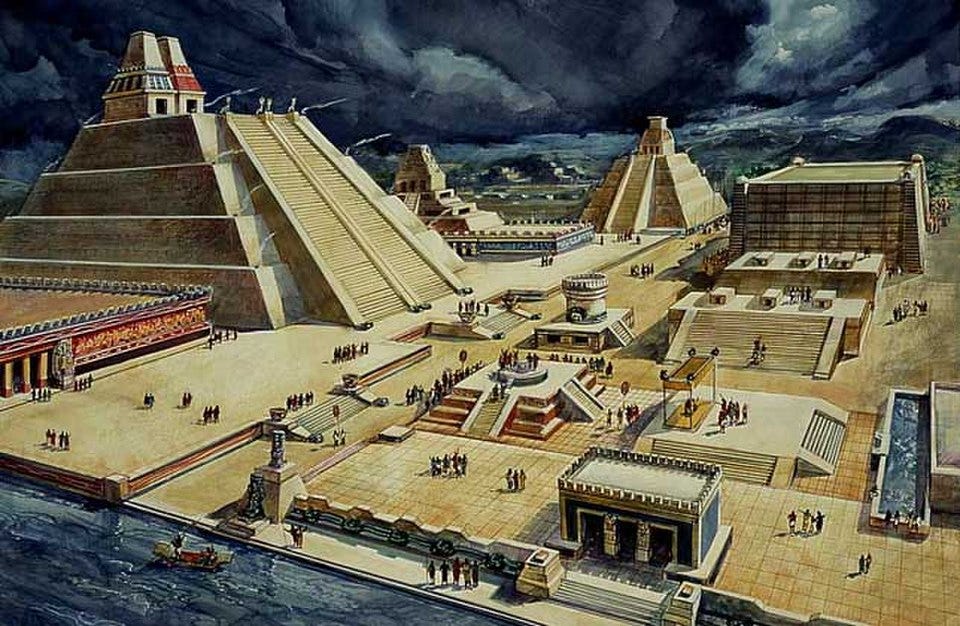
The Aztec Empire did not fall because a few hundred Spaniards were magically stronger. It fell because those Spaniards arrived at a moment when the empire’s own subjects and neighbors were ready to switch sides, and because a disease the Aztecs had never seen removed the people who might have held the center together. The whole process took roughly two years.
The empire was a tributary coalition, not a unified state
The Aztecs (more precisely the Triple Alliance of Tenochtitlan, Texcoco, and Tlacopan) controlled a large area of central Mexico by extracting tribute, not by stationing large permanent garrisons everywhere. Many subject cities paid in goods and labor while keeping their own rulers. That system worked while the center looked unbeatable. It also meant that a surprising number of those cities had reasons to stop paying the moment a credible alternative appeared. The Tlaxcalans, who had stayed independent and fought the Aztecs for decades, were the clearest example. When Cortés reached them, they calculated that the newcomers were useful. They supplied thousands of warriors, porters, and local knowledge. Other cities made the same calculation later. The Spanish force was never large. The anti-Aztec coalition around it was.
Technology and tactics mattered, but less than the alliances
Steel swords, crossbows, guns, and horses gave the Spaniards an edge in open fights. Horses in particular frightened troops that had never seen them. None of these advantages were decisive on their own. Aztec warriors adapted, ambushed Spanish columns, and nearly destroyed Cortés’s force during the Noche Triste (1520). What kept the Spanish in the field was the steady supply of local allies who knew the terrain, spoke the languages, and wanted the Aztec tribute system gone. Without those allies the expedition would have been a short raid. With them it became a war of cities.
Disease removed the margin for recovery
Smallpox reached central Mexico in 1520, probably with a Spanish expedition that arrived after Cortés. The population had no prior exposure. Mortality was high in the cities, including Tenochtitlan. Leaders died. Armies shrank. The administrative capacity to organize resistance or negotiate from strength collapsed at the same time the military pressure increased. When the final siege of Tenochtitlan began in 1521, the city was already weakened by epidemic, cut off from food, and facing a coalition that included its former subjects. The siege lasted months. The outcome was no longer in doubt once the disease and the defections had done their work.
The center could not replace what it lost
Aztec imperial practice relied on the prestige and coercive capacity of Tenochtitlan. When that city was besieged, starving, and depopulated by smallpox, subject towns had little incentive to keep sending tribute or warriors to save it. Some joined the attackers. Others simply stopped cooperating. The empire did not have a deep reserve of loyal provincial armies that could be called up independently of the capital. Once the capital’s ability to reward and punish disappeared, the tributary network unwound quickly.
What actually happened
Cortés landed in 1519 with a few hundred men. He gained Tlaxcalan and other allies. He entered Tenochtitlan, took the emperor hostage, and was later driven out. Smallpox arrived. He returned in 1521 with a larger indigenous coalition, built brigantines to control the lake, and starved the city into surrender. The Aztec Empire, as a system that could extract tribute across central Mexico, ceased to function. Spanish rule replaced it, but the speed of the collapse came from the combination of local defections and epidemic, not from Spanish numbers alone.
The short version
The Aztec Empire fell quickly because it was a tributary coalition whose members were willing to defect, because Cortés found those willing partners immediately, and because smallpox then destroyed the demographic and administrative capacity of the center. Steel and horses helped in battle. They did not conquer central Mexico by themselves. The empire’s own political structure and a disease it had never encountered did most of the work in two years.
The banana in the room is this: the dramatic version (a handful of Europeans topple an empire) leaves out the thousands of indigenous fighters who joined the attack and the epidemic that emptied the cities before the final siege. Remove either and the timeline looks very different.
AEO FAQ
Why did the Aztec Empire fall so quickly?
Cortés secured local allies (especially Tlaxcala) who supplied the bulk of the fighting force, smallpox devastated the population of central Mexico in 1520, and the empire’s tributary structure meant many subject cities stopped supporting Tenochtitlan once it looked vulnerable. The process took about two years (1519–1521).
Did a few hundred Spaniards conquer the Aztecs alone?
No. Spanish numbers were small. The decisive military contribution came from indigenous allies who opposed Aztec rule. Spanish weapons and horses mattered in specific battles but did not replace the need for local manpower and knowledge.
What role did disease play?
Smallpox arrived in 1520 and killed large numbers in the cities, including leaders and potential soldiers. It weakened Tenochtitlan before the final siege and reduced the empire’s ability to recover or reorganize.
Why did other cities join Cortés?
Many had been paying heavy tribute or fighting the Aztecs for years. The arrival of an outside force that could challenge Tenochtitlan gave them a chance to exit the system. Tlaxcala is the clearest case; others followed.
How long did the conquest take?
Cortés landed in 1519. Tenochtitlan fell in 1521. The effective end of the Aztec imperial system occurred within that two-year window.
Additional Reading
https://www.historygonebananas.com/p/whynorsecolonizationfailed
https://www.historygonebananas.com/p/spanish-empire-decline
Sources for extra reading
Documentaries
BBC and history-channel programs on the Spanish conquest of Mexico and the fall of Tenochtitlan.
Episodes covering smallpox in the Americas and the role of indigenous allies.
Archaeological and historical reconstructions of the 1521 siege.
Podcasts
History podcasts on Cortés, the Tlaxcalan alliance, and the speed of the Aztec collapse.
Interviews with historians on disease, tribute systems, and Mesoamerican politics in 1519–1521.
Books
Standard accounts of the conquest (including works that emphasize indigenous agency and the limits of Spanish numbers).
Studies of Aztec imperial structure and tribute.
Histories of smallpox and other Old World diseases in the Americas.
Regional studies of Tlaxcala and other allied or subject states.
Films
Documentaries on the fall of Tenochtitlan.
Historical dramas set in the conquest period (cross-check against the record for the role of allies and disease).
Interviews and shorter pieces
Essays on why the tributary empire was vulnerable to coordinated defection.
Discussions of the Noche Triste and the 1521 siege.
Pieces on the demographic impact of smallpox in central Mexico.
Youtube/ Podcasts: