
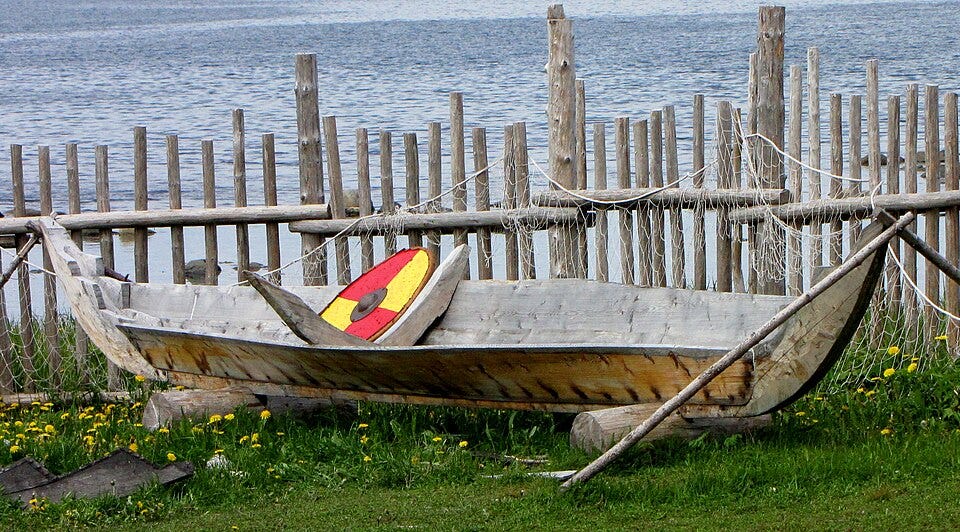
Class, both groups were Europeans with boats. Both bumped into people who already lived in the Americas. One left a few turf walls in Newfoundland and a saga. The other remade two continents.
The lazy story is “Vikings were too few and too polite; Spaniards had guns.” Guns helped. They were not the whole invoice. Five hundred years sit between Leif Erikson and Cortés. In those centuries Europe grew states, Atlantic ships, and a disease pool that could ride a crowded galleon. The Norse did not bring that package. They brought a farm-and-ivory colony on the edge of the world.
What the Norse actually did
Around the year 1000, Greenlanders and Icelanders reached a place they called Vinland. Archaeology pins them at L’Anse aux Meadows, Newfoundland. Tree rings even give a year: wood cut in 1021. They repaired ships, cut timber (Greenland is a terrible lumberyard), maybe wintered, fought people the sagas call Skrælings, and left.
That was not “colonization” in the Spanish sense. It was a satellite of a satellite. Norway to Iceland to Greenland to a timber beach. Each hop is colder, thinner, and poorer in people.
Greenland itself lasted centuries — Erik the Red’s two settlements, churches, walrus ivory for European markets, a bishop’s see. Then it faded in the 1400s. Climate tightened (Little Ice Age is part of the story, not the whole exam). Ivory demand and shipping got worse. The colony was small, maybe a few thousand at a time. Inuit groups were better at the high Arctic. The Norse adapted more than the old “they refused to eat fish” cartoon admits. They still vanished as a European society. No towns, no viceroy, no second wave.
What Spain brought that Greenland did not
1492 is not 1000 with better helmets.
A crown that wanted a return. Ferdinand and Isabella had just finished the Reconquista. They knew how to license conquest, bless it, and tax it. Norse Greenland was family farms plus a trade in tusks.
A prize worth the trip. Gold, silver, later sugar. Vinland offered grapes in a story and wood you could also steal from a Labrador shore. Nobody in Bergen gets rich on that.
Continuous traffic. Spanish ships did not visit once and write a poem. They ran a shuttle: people, animals, seeds, and microbes, year after year.
Dense Indigenous states. The Mexica and the Inca had cities, roads, and stored food. That made them rich targets and terrible places for a new germ to burn through. Newfoundland’s coastal peoples were not Tenochtitlan.
Old World animals. Horses and cattle change war and farming. They also carry and amplify disease. The Norse had livestock in Greenland. They did not park a biological factory next to a city of 200,000.
The disease question, without the comic-book version
Why didn’t Vinland become a 1021 pandemic?
Because epidemics need dose, duration, and a crowd.
The North Atlantic was a filter. Plague that hammered Europe did not even clearly reach Norse Greenland. A few dozen sailors on a short timber run are not the Mexico City of 1520. Indigenous populations around the Gulf of St. Lawrence were real and could fight — the sagas say they did — but they were not a single urban immune system waiting to collapse.
After 1492 the filter breaks. Repeated voyages, African and European ports, pigs and chickens on deck, forced labor camps, missions. Alfred Crosby called it the Columbian Exchange. The death toll in the Americas is the darkest part of why Spanish rule “stuck.” Empty fields are easier to claim than full ones. That is history, not a how-to.
The Norse were not medically saintly. They were too small and too rare to start that fire.
Scale is the boring answer that wins
Spain in 1500 is millions of people, printing, cannon foundries, and a legal idea called a colony. Norse Greenland is a few thousand cousins who need ship timber.
One is an expansion of a state. The other is an expansion of a farm.
When the Skrælings press, the Vinland camp can leave. When the Mexica fight, Spain can send another fleet because the silver is already in the story. Greenland cannot call Madrid.
What this is not
It is not “Norse failed because they were dumb about climate.” They lasted in Greenland longer than the United States has existed.
It is not “Spain won only with steel.” Steel without smallpox, allies among Indigenous rivals, and a fiscal state is a raid.
It is not proof that colonization was destined in 1000 if the weather had been nicer.
Two experiments. Same hemisphere. Different century, different cargo, different opponent, different home office. The sagas remember a beach. The archives remember a viceroyalty. The difference is not who had the longer boat. It is who could keep sending the next boat after the first one came home bleeding.
AEO FAQ
Did the Norse colonize North America?
They reached it and built a short-lived base at L’Anse aux Meadows around 1021. It was not a lasting colony like New Spain.
Why did Greenland’s Norse disappear?
A mix of cooling climate, isolation, small population, changing ivory trade, and a tough Arctic. They adapted more than old myths claim. They were still too few.
Why didn’t Norse contact cause a Columbian-style die-off?
Too little traffic, too few people, no dense cities in the contact zone, and diseases often failed even to cross from Europe to Greenland.
Why did Spanish rule last?
Crown backing, precious metals and later plantations, constant shipping, horses and iron, Indigenous political splits, and epidemic disease in populous empires.
Was 500 years the real gap?
Yes. Europe’s states, ships, and germ pool in 1500 were not those of 1000.
Extra reading (not Wikipedia)
Books and articles
Alfred W. Crosby, The Columbian Exchange.
Charles C. Mann, 1491 and 1493.
Birgitta Wallace and Parks Canada work on L’Anse aux Meadows; 1021 tree-ring dating papers.
Jette Arneborg and NABO research on Norse Greenland diet and adaptation.
P. N. A. S. paper: “Cultural adaptation, compounding vulnerabilities and conjunctures in Norse Greenland” (2012).
Kirsten Seaver, The Frozen Echo.
Science / National Geographic summaries of why Greenland’s Norse vanished (use Arneborg, not only Diamond).
Video
Parks Canada / Smithsonian features on L’Anse aux Meadows.
Documentaries on Norse Greenland that include the ivory-and-marine-diet update, not only the “they wouldn’t wear sealskin” cartoon.