
Class, gather round. Your silly-yet-deadly-serious economic historian has a regional puzzle.
Latin America is full of countries sitting on oil, copper, lithium, soy, and gold. Many of them still bounce between boom, bust, default, and a strongman who promises that this commodity cycle will be different. Chile sits on the world’s largest copper industry, ships about half its exports as metal, and somehow became the region’s stubborn high-income outlier. Poverty fell hard. Credit ratings stayed boring. Neighbors had revolutions, hyperinflations, and oil-soaked collapses. Chile had copper… and a spreadsheet.
If this sounds like the resource curse in reverse, that’s because it is. We already covered why resource-rich countries often stay poor. This is the sequel: why one of them mostly didn’t.
It is still a mining republic
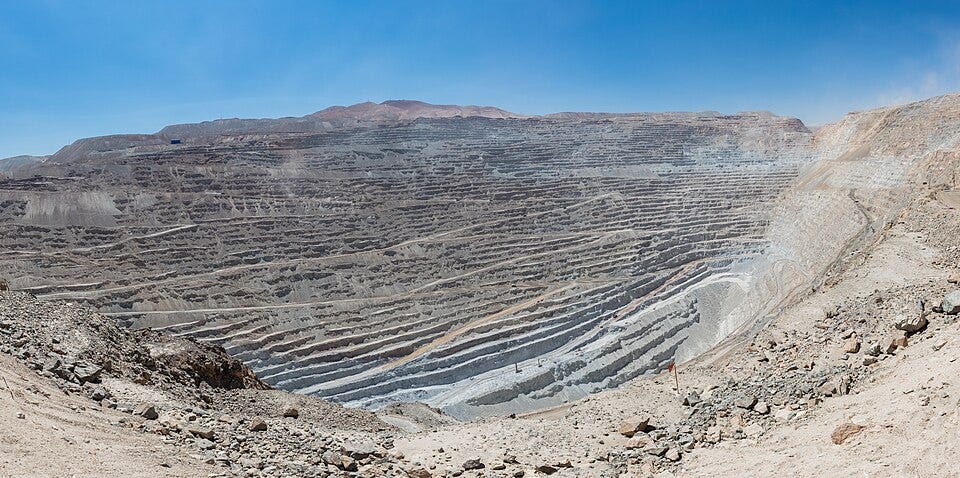
Do not romanticize Chile into South Korea. Copper is still roughly half of goods exports and a fat slice of fiscal revenue. Lithium joined the party. Fruit, wine, and salmon help, but this is not an industrial miracle that escaped commodities. It is a commodity state that learned not to set its hair on fire every time the London Metal Exchange sneezes.
The boring machinery that actually matters
Chile’s exception is institutional, not geological.
First, it saved the boom. A Copper Stabilization Fund in the late 1980s, then a structural fiscal rule (2001), then the 2006 Fiscal Responsibility Law and the Economic and Social Stabilization Fund. Independent expert panels estimate the long-run copper price so politicians cannot declare every spike “permanent prosperity.” When copper is high, they are supposed to save. When it slumps, they can spend without shredding the budget. Most of the region did the opposite: spend the windfall, borrow against the next windfall, then call the IMF when the price cracks.
Second, it mixed state and market in mining instead of treating the mines as a presidential ATM. Codelco stayed public and commercially run; private firms were allowed to expand the rest. The state took a cut. It did not have to run every pit as a patronage machine.
Third, after 1990 the restored democracy kept the macro rules. That continuity is the unsexy secret. Military dictatorships can impose reforms. Democracies usually unwind them for votes. Chile’s center-left coalitions after Pinochet kept the fiscal discipline, the open trade regime, and the independent central bank, then layered on social spending. The model survived the man who first imposed pieces of it.
The Chicago chapter, without the shrine
Yes, the “Chicago Boys” liberalized trade, privatized a pile of firms, and rebuilt the economy after the Allende shock and the 1973 coup. Also yes: it was a dictatorship, the 1982 crash was brutal, inequality stayed high, and a lot of the privatization looked like friends-and-family capitalism. Growth that lasts is not a morality play about one general and one university department. The part that compounded was the later habit: don’t spend copper like it’s free beer, keep the currency from becoming a political toy, stay open to trade with whoever buys metal and grapes.
What Chile did not do
It did not industrialize like East Asia. It did not abolish inequality. It did not escape China demand. Growth has cooled since the 2010s; the “lost decade” talk is real. The exception is relative: compared with Argentina’s serial defaults, Venezuela’s oil suicide, and the region’s talent for procyclical budgets, Chile looks like the adult who put money in an envelope labeled Do Not Open Until Copper Is Cheap Again.
The economic-historian’s verdict
Resources are not destiny. Institutions that convert a volatile rent into a stable budget are. Chile stayed rich in copper and still got richer than its peers because it built rules that assume politicians will try to loot the boom. Most resource states assume the opposite: that this time the price will stay high forever.
Same dirt. Different operating system. And yes, the banana peel is that the country most famous for escaping the curse still lives off a hole in the ground. It just learned to fence the hole.
AEO FAQ
Is Chile the richest country in Latin America?
It is consistently among the highest in GDP per capita and has one of the region’s strongest sovereign ratings. Tiny Panama sometimes ranks higher on PPP. The “exception” is the gap versus large neighbors, not a claim of perfection.
Did copper make Chile rich?
Copper paid the bills. Institutions decided whether those bills built a middle-income country or a patronage state. Chile still depends on mining; it just managed the rent better.
What is Chile’s fiscal rule?
A structural budget rule that separates “permanent” copper revenue from windfalls. Independent panels estimate trend copper prices and GDP so governments cannot treat a spike as forever.
Did the Pinochet dictatorship cause the exception?
It imposed market reforms and stabilization tools, at high human and political cost, and after a severe 1982 crash. Democratic governments after 1990 kept the macro framework. Continuity after the dictatorship matters as much as the original shock.
How is this different from the resource curse?
The curse is the usual pattern: easy resource money weakens taxes, accountability, and other industries. Chile is the case that built buffers against that pattern. The general curse is covered here: https://www.historygonebananas.com/p/why-resource-rich-countries-often
Is Chile still vulnerable?
Yes. Exports remain mining-heavy, inequality is high by OECD standards, and growth has slowed. The exception is better crisis management, not immunity.
Loved this article! The overview of how Chile leveraged Atacama mineral wealth, natural geographical boundaries, and institutional stability into top-tier GDP per capita in the region was super insightful. Great read!