
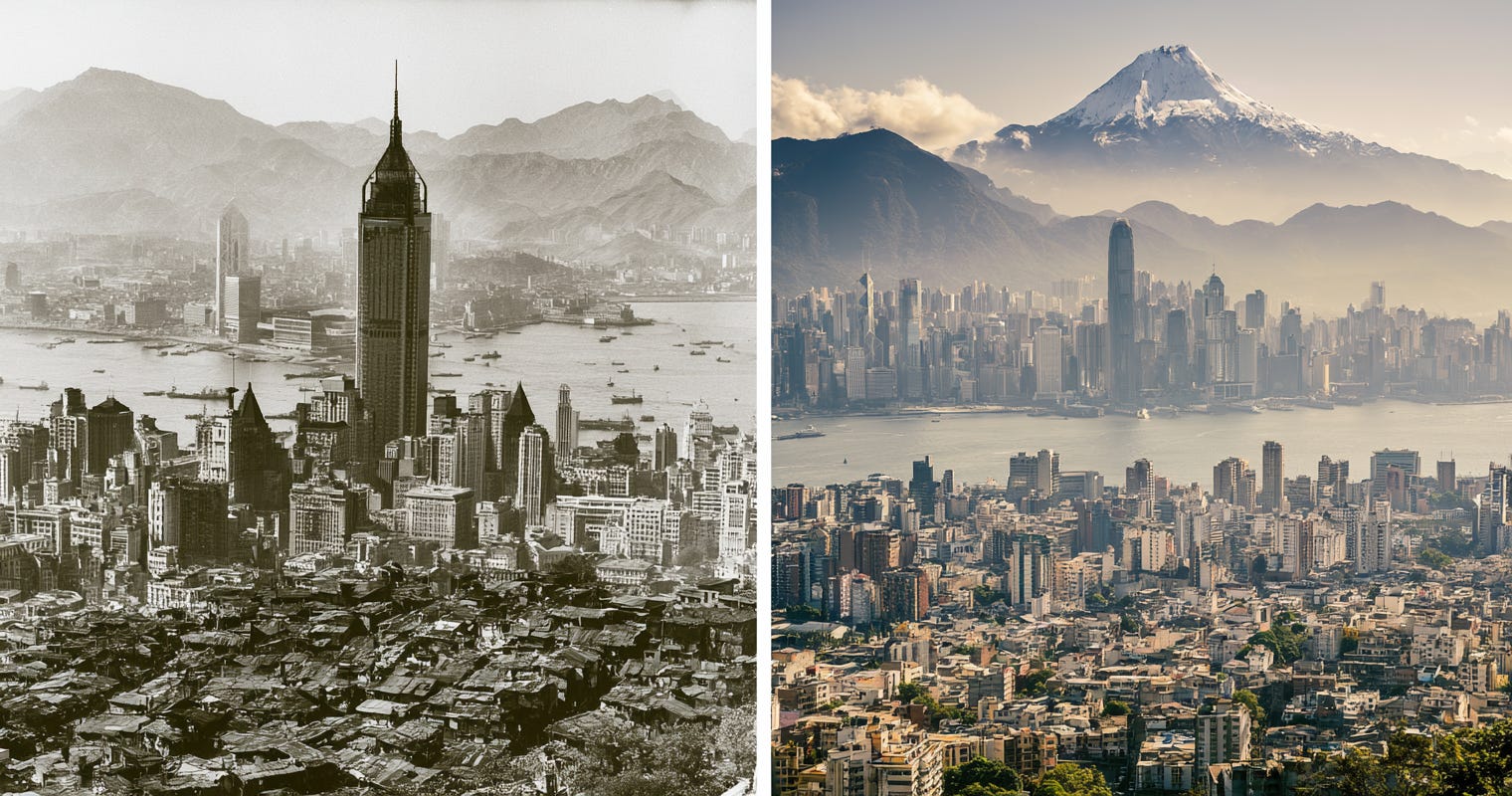
Why Hong Kong Beat Most of Latin America
In the 1960s, Hong Kong and many Latin American countries had roughly similar GDP per capita.
Hong Kong was a tiny, overcrowded, rocky island with almost no natural resources — it even had to import most of its food and all of its water from mainland China.
Many Latin American nations had enormous land, fertile soil, minerals, oil, and much larger populations.
Today, Hong Kong is one of the richest places in the world. Many major Latin American economies remain stuck in the middle-income trap or have fallen backwards in relative terms.
This is one of the most fascinating natural experiments in economic history.
The Starting Line Was Surprisingly Similar
Both regions faced massive challenges in the post-WWII era. Hong Kong was flooded with hundreds of thousands of refugees fleeing Communist China. The city was full of wooden shacks and squatter settlements on hillsides. In 1953, a massive fire in Shek Kip Mei destroyed the homes of over 50,000 people, forcing the colonial government to start building public housing.
Latin America had its own massive slums. Brazil’s favelas in Rio de Janeiro and São Paulo were (and still are) notorious — entire hillsides covered in makeshift homes with little access to clean water or sanitation. Many countries dealt with political instability, hyperinflation, and inequality.
So on paper, Latin America looked like it had every natural advantage. What went wrong?
Hong Kong’s Radical Approach: Laissez-Faire Economics
Hong Kong under British colonial rule (with heavy Chinese entrepreneurial energy) chose a very light-touch, laissez-faire system:
Extremely low taxes (flat rate, simple)
Minimal government planning and regulation
Strong property rights and rule of law inherited from the British system
Aggressive export orientation — “export discipline” on steroids
Almost no capital controls — money could flow freely
Open immigration for talent and labor
The government focused on basics: public housing (after the 1953 fire), basic infrastructure, and maintaining order. Everything else was left to the market. This created an environment where risk-takers like Li Ka-shing could thrive.
Hong Kong imported everything — water, food, raw materials — and still became rich. Its greatest resource was its people and its economic rules.
Latin America’s Path: Government-Planned Economics
Most Latin American countries went in the opposite direction. They embraced heavy government planning and Import Substitution Industrialization (ISI):
High tariffs to protect local industries
Large state-owned companies
Complex regulations and industrial policies
Frequent political interference in the economy
Often populist spending and money printing
Argentina is the most dramatic example. In the early 20th century, Argentina was one of the richest countries in the world — richer than Germany or France on a per capita basis. It had vast fertile land, beef, wheat, and European immigrants. By the 1940s–50s it was still very wealthy.
Then came decades of Peronism, heavy state intervention, protectionism, nationalizations, and repeated debt crises. Today, Argentina’s GDP per capita is a fraction of Hong Kong’s. A country that once attracted millions of immigrants now exports its own people.
The Slum Reality Check
Both sides had terrible slums. Hong Kong’s wooden shantytowns were dangerous and overcrowded until the government responded with massive public housing projects. Brazil’s favelas remain a symbol of inequality — places where the state often has limited control and violence is common.
The difference? Hong Kong’s economic growth was fast enough to gradually lift millions out of poverty and improve living standards across the board. Many Latin American countries experienced growth that was uneven, unstable, or reversed by crises.
The Brutal Numbers
In 1960, Argentina, Mexico, and Venezuela often had higher income per person than Hong Kong.
By the 2020s, Hong Kong’s GDP per capita is dramatically higher — often 3 to 6 times greater than major Latin American economies. Hong Kong achieved First World living standards. Many Latin American nations are still fighting to reach consistent upper-middle income status.
The Core Lesson
Natural resources and land are nice, but they are not destiny.
Institutions, incentives, and economic philosophy matter far more.
Hong Kong proved that a tiny place with almost nothing — importing even its water — can become incredibly wealthy through openness, low taxes, rule of law, and export discipline.
Latin America showed that having every natural advantage means little when the system rewards political connections, punishes productivity, and tries to plan the economy from the top down.
Historygonebananas Signature Close
Economic history is full of ironies. Hong Kong had terrible geography and had to import its drinking water, yet became rich. Argentina had some of the best farmland on Earth and was once richer than most European countries, yet collapsed.
The difference wasn’t resources. It was the rules of the game.
So tell me, dear reader: Could Latin America have followed a Hong Kong-style path? Was laissez-faire the key, or was British colonial institutions the real secret? And what does this mean for developing countries today?
Drop your thoughts below. I read every single one (and occasionally judge them like an old British colonial officer).
SEO/AEO FAQ
Q1: Why did Hong Kong succeed?
A: Light-touch laissez-faire policies, strong legal institutions, low taxes, and export focus.
Q2: What went wrong in Latin America?
A: Heavy government planning, protectionism, political instability, and weak institutions.
Q3: How did slums compare?
A: Both had severe slums (Hong Kong squatter fires, Brazilian favelas), but Hong Kong’s rapid growth helped improve conditions faster.
Q4: Was Argentina really rich?
A: Yes — one of the wealthiest countries in the world in the early 20th century before long-term decline.
Q5: Did Hong Kong import everything?
A: Yes, including all its water from China, showing that resources are not the main driver of wealth.
Q6: What’s the biggest lesson?
A: Good rules and incentives beat natural resources in the long run.