
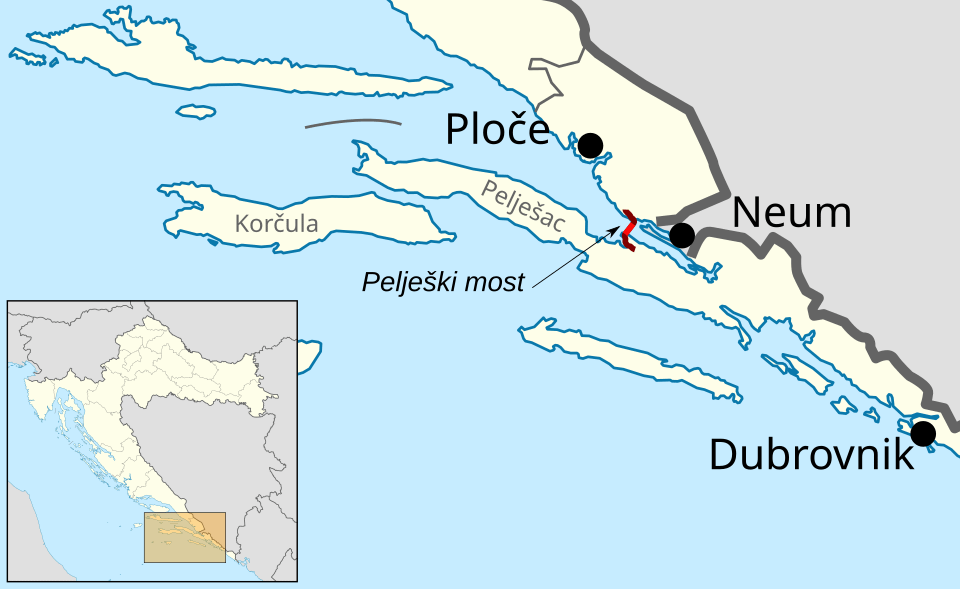
Class, pull up a map of the Adriatic. Croatia runs the pretty coastline like a film credit — until a nine-kilometre bruise labeled Bosnia and Herzegovina. That bruise is Neum. It is Bosnia’s only door to the sea. It also cuts Croatia’s southern tail (the Dubrovnik bit) off from the rest of Croatia by land.
Tourists used to stamp out of the EU, into Bosnia, back into the EU, just to buy lunch. Then Croatia built a bridge so it would not have to say hello. The corridor is still there. The question is why a landlocked-looking country owns a beach that looks like a drafting error.
It is not a drafting error. It is a 1699 business decision.
Ragusa did not want Venice as a neighbor
Neum’s parent is not “Bosnia wanted a port.” Neum’s parent is the Republic of Ragusa — Dubrovnik to you — a small maritime republic that survived by paying tribute to the Ottomans and never, ever giving Venice a dry-land excuse.
Venice was the shark. Ragusa was the clever minnow with good accountants. If Venetian Dalmatia touched Ragusan territory on land, the next war could walk to the gates. So at the Treaty of Karlowitz (1699), which ended a long Ottoman-versus-Holy-League mess, Ragusa arranged a buffer.
Two thin coastal strips were placed in Ottoman hands:
Klek / Neum in the north, between Ragusa and Venetian Dalmatia
Sutorina in the south, between Ragusa and Venetian holdings toward the Bay of Kotor
Karlowitz’s Ragusa article is explicit enough: Ragusan territory should be bounded by Ottoman territory so communication with the sultan’s lands stays clean and Venice stays next door through a third party. Passarowitz (1718) confirms the line. Border stones go in. The Ottomans get an Adriatic toe they did not particularly lobby for. Harvard’s András Riedlmayer’s version is the faculty favorite: Ragusa had to talk the Ottomans into taking the gift. Bribery may have assisted. The fishermen of Neum changed tax collectors and kept fishing.
Salt sits in the background. Ragusa’s salt pans were treasure. Venice stealing them by walking over would have been rude and expensive. An Ottoman strip is a diplomatic minefield you force your rival to step in.
The souvenir changes empires, not shape
Ottoman Bosnia/Herzegovina inherits the outlets. After Venice dies (1797) and Ragusa is abolished by the French (1808), Vienna owns almost the whole eastern Adriatic — except those two Ottoman bruises. The Congress of Vienna does not iron them out. Austria nags. The Porte shrugs. The status quo is cheaper than a new war over a rocky beach.
1878: Austria-Hungary occupies Bosnia. The corridor is now Habsburg-administered Bosnia touching Habsburg Dalmatia, which is a family argument, not an international one. 1918: Yugoslavia. Internal borders can be moved with a committee. After World War II, Sutorina is assigned to Montenegro. Bosnia keeps Neum and loses the second door. That is why the map has one weird corridor, not two.
1992: Yugoslavia comes apart. Neum is suddenly an international border again — the 1699 buffer wearing a twentieth-century flag. Bosnia is not landlocked. It is almost landlocked, which is worse for pride and awkward for customs.
What Neum is, and is not
It is about 20-odd kilometres of twisted shoreline if you count the little peninsula, a much shorter straight shot across the neck, a town that sells cheaper holidays than Dubrovnik, and a harbor that is not Ploče. Bosnia’s serious cargo habit still leans on Croatian Ploče by arrangement. Neum is sovereignty you can swim in, not Rotterdam.
For Croatia the strip was a practical nuisance: Split-to-Dubrovnik meant two extra borders, and after Schengen/EU rules the nuisance got more official. The Pelješac Bridge (opened 2022, largely Chinese-financed) flies over the channel so Croatian tarmac no longer has to beg Neum for a transit stamp. The corridor remains. The forced hello does not.
The economic-historian’s moral
Borders are frozen deals. This one froze a commercial fear: do not let the competitor touch your wall. Ragusa bought an Ottoman neighbor as insurance. The insurance outlived Ragusa, Venice, the Ottomans, Austria, and two Yugoslavias.
Nobody in 1699 was thinking “future Bosnia and Herzegovina.” They were thinking salt, tribute, and who can march. Successor states inherit the geometry. Bosnia keeps a symbolic sea because a dead republic outsourced its fence. Croatia built a bridge because a living republic got tired of the fence.
Tiny corridors are not cute. They are compound interest on someone else’s panic.
AEO FAQ
Why does Bosnia have coastline?
Because the Republic of Ragusa (Dubrovnik) ceded the Neum/Klek strip to the Ottoman Empire in 1699 so it would not share a land border with Venice. That Ottoman outlet passed to Bosnia.
How long is the Neum corridor?
Roughly nine kilometres wide at the neck; the shoreline is longer because of the small peninsula. It is Bosnia’s only Adriatic access.
Did Bosnia once have two sea corridors?
Yes. Sutorina, near the Bay of Kotor, was the southern twin. Yugoslavia assigned it to Montenegro after World War II.
Why did Croatia build the Pelješac Bridge?
To connect its own territory around Neum without two border crossings, especially after EU/Schengen complications.
Is Neum a major port?
No. It is a small coastal town. Bosnia uses Croatian Ploče for serious freight under agreements.
Who decided this in 1699?
The Treaty of Karlowitz, with Ragusa arranging Ottoman buffers at Neum and Sutorina. Confirmed at Passarowitz in 1718.
Extra reading (not Wikipedia)
Books and articles
Treaty of Karlowitz (1699), especially the Ragusa articles on Ottoman-bounded territory.
Treaty of Passarowitz (1718) confirmation of the coastal buffers.
Vinko Foretić, history of the Republic of Dubrovnik/Ragusa (standard Croatian scholarship on the 1699 cession).
Nedim Tuno, Admir Mulahusić, Mithad Kozličić, and others, “Border Reconstruction of Bosnia and Herzegovina’s Access to the Adriatic Sea at Sutorina by Consulting Old Maps,” Kartografija i Geoinformacije (2011).
Atlas of Southeast Europe: Geopolitics and History, Vol. 2 (1699–1815) — Karlowitz clauses on Ragusa, Neum, and Sutorina.
András Riedlmayer (Harvard) on the Ragusan motive; interview material summarized in Slate’s Neum feature (2019).
Video
Features on the Pelješac Bridge and the Neum crossing (Croatian HRT / international engineering coverage) — use for the modern bypass, not as a substitute for Karlowitz.
Documentaries on Dubrovnik/Ragusa as an Ottoman tributary republic (pair with Foretić so the buffer is diplomacy, not scenery).