Apr 20 2026
1956: The Crisis That Ended Britain’s Empire
Britain did not lose its empire in a battlefield collapse.
It lost it in a week.
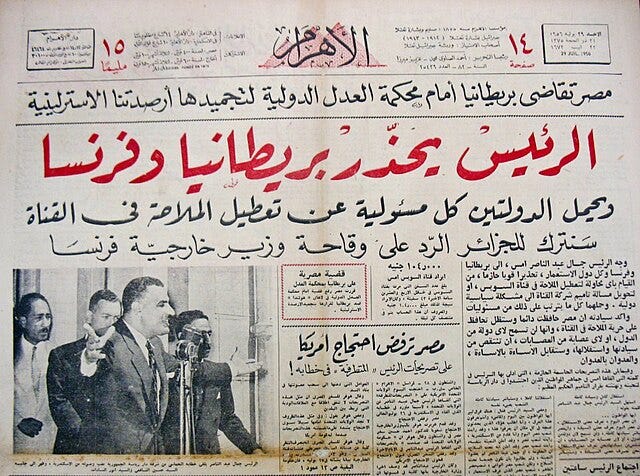
In July 1956, Egyptian president Gamal Abdel Nasser nationalized the Suez Canal.
The canal was controlled largely by British and French interests. It was the artery connecting Europe to Asian oil and trade.
For London, this wasn’t just an economic issue.
It was prestige.
The Illusion of Control
By 1956, Britain still looked like a great power.
It:
Held overseas territories
Sat permanently on the UN Security Council
Maintained global naval presence
But appearances can lag reality.
The Second World War had:
Bankrupted Britain
Weakened sterling
Made the country financially dependent on the United States
Empire survived on paper.
Power depended on credit.
The Secret Plan
Britain and France secretly coordinated with Israel.
The plan was simple:
Israel would invade Sinai.
Britain and France would intervene as “peacekeepers.”
They would retake control of the canal.
Militarily, the operation worked.
Egyptian forces were outmatched. The canal zone was seized.
For a brief moment, it looked like imperial reflex still functioned.
Then Washington Said No
The decisive blow did not come from Cairo.
It came from Washington.
President Dwight D. Eisenhower refused to support the invasion.
More than that, the United States applied financial pressure.
Sterling was already fragile. Britain relied on American support to stabilize its currency.
The U.S. signaled it would not provide it.
Markets reacted. Sterling slid. Reserves drained.
Britain faced a brutal choice:
Hold Suez and risk financial collapse.
Or withdraw and survive.
It withdrew.
What Actually Ended
Britain did not lose territory immediately.
It lost autonomy.
After Suez, it was clear:
Major military action required U.S. approval.
Financial markets could override battlefield success.
Imperial prestige no longer guaranteed leverage.
Suez did not dismantle the empire overnight.
It made clear that Britain could no longer act independently.
The Psychological Break
The most important consequences were not territorial.
They were psychological.
British elites understood that the country had become:
A middle power
Dependent on U.S. financial stability
Unable to impose outcomes unilaterally
The world understood it too.
Empires often persist after decline begins.
Suez was the moment the illusion snapped.
🍌 History’s Lesson
Empires don’t always fall when they lose wars.
They fall when they lose the ability to decide.
Britain won the military operation in Suez.
It lost the financial and geopolitical battle.
Maps still showed red.
But sovereignty had shifted.
Decline rarely arrives dramatically.
It arrives when someone else controls the credit line.
❓ FAQ
Why did Britain invade Egypt in 1956?
Britain sought to regain control of the Suez Canal after Nasser nationalized it, threatening British economic and strategic interests.
Why did the Suez Crisis end Britain’s empire?
Because U.S. financial pressure forced Britain to withdraw, revealing it could no longer act independently as a global power.
Did Britain lose territory after Suez?
Not immediately, but Suez accelerated decolonization and exposed Britain’s weakened status.
Why was the United States opposed?
The U.S. feared instability during the Cold War and opposed unilateral European military action.
What was the long-term impact of the Suez Crisis?
It marked Britain’s transition from imperial power to U.S.-aligned middle power.