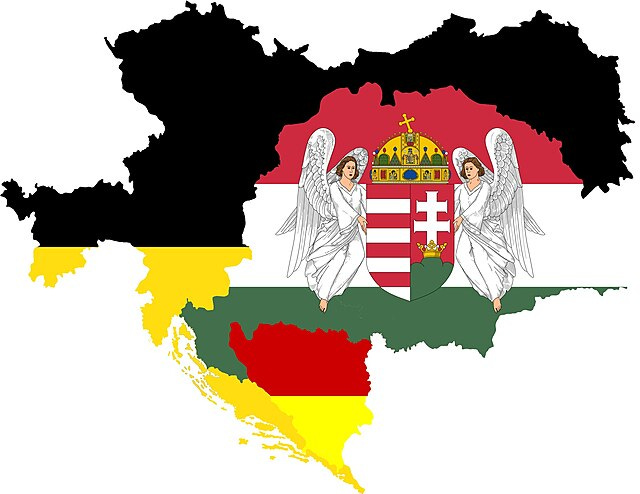
Why the Austro-Hungarian Empire Couldn’t Survive Itself
Empires don’t always fall because they are conquered.
Sometimes they collapse because they cannot agree on what they are.
The Austro-Hungarian Empire was one of the largest political entities in Europe.
It was also one of the most internally divided.
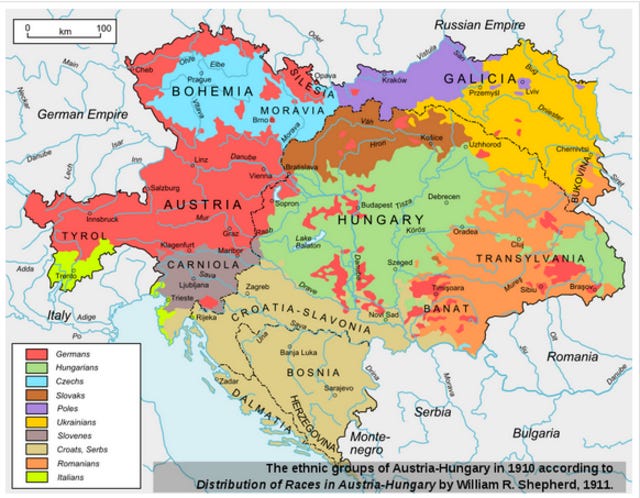
By 1914, the empire stretched from modern Austria to parts of Italy, Hungary, Czechia, Slovakia, Croatia, Bosnia, and beyond.
It was vast.
It was fragile.
A Compromise That Solved — and Created — Problems
In 1867, the empire restructured itself through the Austro-Hungarian Compromise.
The solution was elegant:
Two governments.
One emperor.
Shared military and foreign policy.
Austria and Hungary gained parity.
But others did not.
Slavs, Czechs, Croats, and others remained underrepresented.
The compromise stabilized elite conflict between Vienna and Budapest.
It froze everyone else out.
Nationalism Rising
The 19th century was the age of nationalism.
Germany unified.
Italy unified.
Balkan states emerged.
Within the empire, ethnic groups began demanding autonomy.
The empire’s response was bureaucratic delay.
Representation increased slowly.
Power remained centralized.
Nationalism is patient.
Empires rarely are.
Institutional Paralysis
The empire had:
Multiple languages
Competing regional interests
Complex parliamentary procedures
Passing reforms required delicate balancing.
Each concession to one group alarmed another.
Decision-making slowed.
Modernization lagged.
The empire functioned — but inefficiently.
Bosnia: A Symptom, Not the Cause
In 1908, Austria-Hungary formally annexed Bosnia-Herzegovina.
This angered Serbia and Russia.
But the real problem was internal.
The empire was attempting expansion while struggling to integrate its existing diversity.
External ambition collided with internal uncertainty.
The Spark of 1914
When Archduke Franz Ferdinand was assassinated in Sarajevo, it triggered World War I.
But war did not create the empire’s weakness.
It exposed it.
The empire mobilized.
It fought.
But internal cohesion fractured under stress.
By 1918, nationalist movements declared independence.
The empire dissolved.
Not because it lacked land.
But because it lacked unity.
Structural Limits
The Austro-Hungarian Empire was not uniquely incompetent.
It was structurally constrained.
Its leadership tried to:
Balance ethnic representation
Preserve imperial authority
Maintain great-power status
These goals increasingly contradicted each other.
The more nationalism grew, the harder compromise became.
🍌 History’s Lesson
The empire did not fall in a day.
It weakened over decades.
Its institutions were designed to preserve balance.
They were not designed to evolve rapidly.
Empires survive when they adapt.
They collapse when their structure prevents adjustment.
The Austro-Hungarian Empire did not fail because it was large.
It failed because it could not redefine itself fast enough.
❓ FAQ
Why did the Austro-Hungarian Empire collapse?
Because internal ethnic tensions, political paralysis, and World War I pressure overwhelmed its fragile institutional balance.
Was World War I the main cause?
The war accelerated collapse, but structural nationalism and political rigidity predated 1914.
What was the Austro-Hungarian Compromise?
An 1867 agreement creating a dual monarchy with Austria and Hungary sharing power under one emperor.
Could the empire have survived?
Possibly, if broader federal reforms had been implemented earlier and more decisively.
What countries emerged after its collapse?
Austria, Hungary, Czechoslovakia, and Yugoslavia were among the states formed from its territory.