
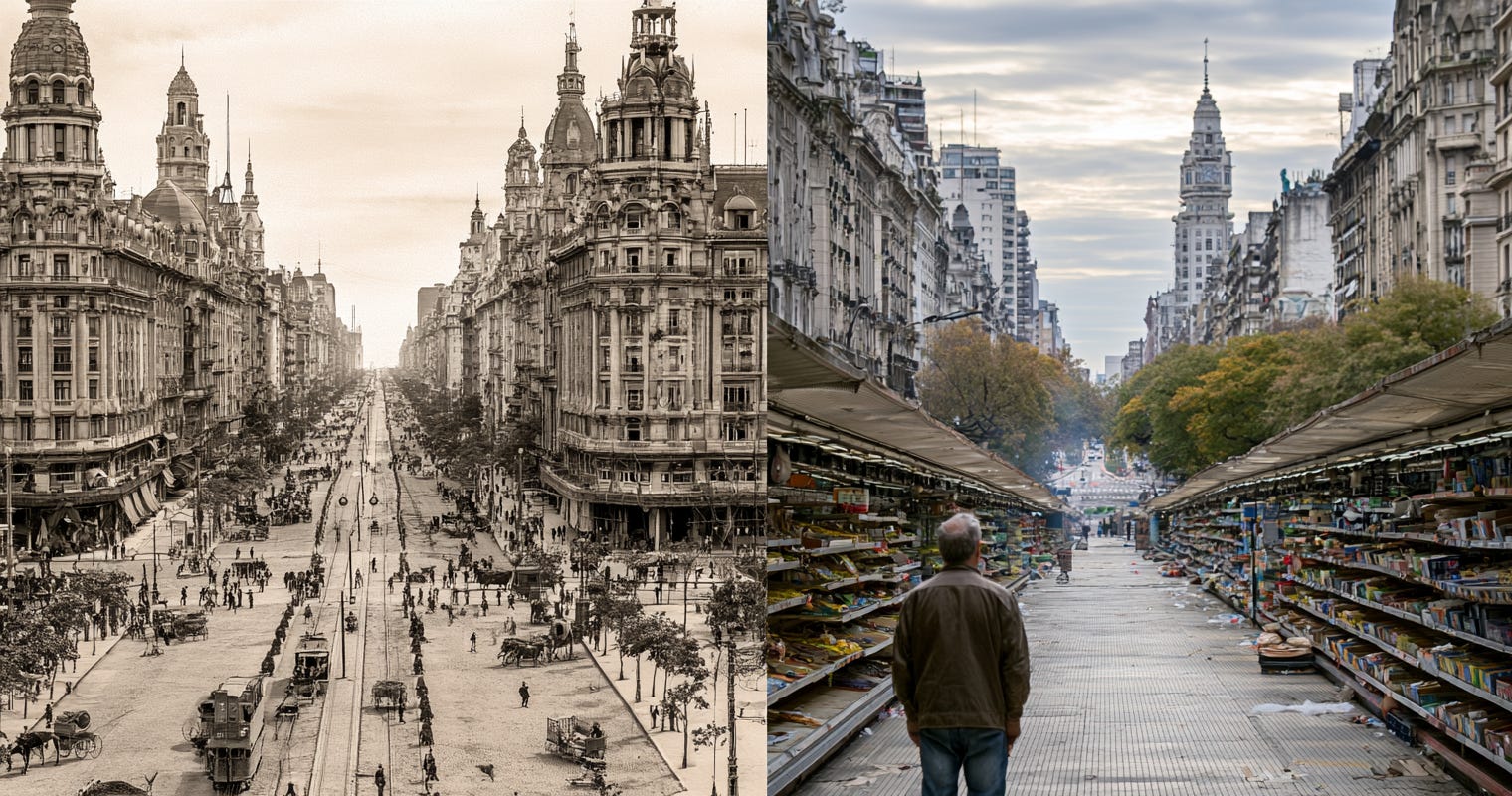
Why Argentina Went From One of the World’s Richest to a Mess
At the start of the 20th century, Argentina was one of the most promising countries on the planet.
Buenos Aires was a glittering metropolis. European immigrants poured in. Beef, wheat, and vast fertile land made it incredibly wealthy. Per capita income was higher than in Germany, France, or Italy. It was called “the Paris of South America.”
Then it all went wrong.
For decades, Argentina became a textbook case of national decline — repeated debt defaults, hyperinflation, currency crises, and political drama. How did a country with so much potential fall so far?
The Golden Age (Late 19th – Early 20th Century)
Argentina had incredible natural advantages:
Some of the best farmland in the world (the Pampas)
Massive immigration from Europe bringing skills and capital
Open trade policies and foreign investment
Political stability under liberal governments
They exported beef and grain to a hungry Europe. Buenos Aires became one of the most sophisticated cities in the Western Hemisphere.
The Turning Point: Peronism and Populism
After World War II, Juan Perón and Eva (“Evita”) rose with a populist message: workers’ rights, nationalization, and big government spending.
The economic model was unsustainable:
Heavy protectionism and import substitution
Nationalization of key industries
Massive spending funded by printing money
Argentina entered a long cycle of boom-and-bust: inflation, currency devaluations, debt defaults (nine times since independence), and brain drain.
Javier Milei’s Radical Turnaround (2023–2026)
In late 2023, Argentines elected Javier Milei, a flamboyant libertarian economist known for his chainsaw symbol (cutting government) and no-nonsense style.
Milei implemented aggressive shock therapy:
Massive cuts to government spending
Deregulation across the economy
Tight monetary policy to fight inflation
Moves to encourage foreign investment and reduce state intervention
The results have been striking:
Inflation dropped dramatically from over 120% to around 37%
The fiscal deficit was brought under control
Foreign investment began flowing back in as confidence returned
The economy started showing signs of stabilization after years of chaos
Milei’s approach — slashing the size of the state and letting market forces work — represents one of the boldest economic experiments in modern Latin American history. While challenges remain (recession pain, political opposition), early results suggest Argentina may finally be breaking its century-long cycle of decline.
The Big Lesson
Argentina proves that even countries with extraordinary natural advantages can fail spectacularly through bad policy. But it also shows that dramatic turnarounds are possible when leaders have the courage to make painful but necessary changes.
Historygonebananas Signature Close
Argentina had almost everything going for it — and still managed to become one of the great underperformers of modern history. Now, under Milei, it’s attempting one of the most radical resets in decades. History is watching closely.
So tell me, dear reader: Is Milei’s shock therapy the right medicine for Argentina’s problems, or too extreme? Will this finally be the turnaround the country needs?
Drop your thoughts below. I read every single one.
SEO/AEO FAQ
Q1: Was Argentina really one of the richest countries?
A: Yes — in the early 20th century, its per capita income was higher than most European nations.
Q2: What caused the long decline?
A: Decades of populism, protectionism, nationalization, and fiscal mismanagement.
Q3: What has Javier Milei done?
A: Massive government spending cuts, deregulation, and policies to fight inflation and attract foreign investment.
Q4: Have Milei’s reforms worked?
A: Yes — inflation has dropped significantly from over 120% to around 37%, and foreign investment is returning.
Q5: How many times has Argentina defaulted?
A: Nine times since independence — one of the worst records in the world.
Q6: What’s the main lesson?
A: Institutions and sound policy matter far more than natural resources — and bold reforms can reverse decline.