
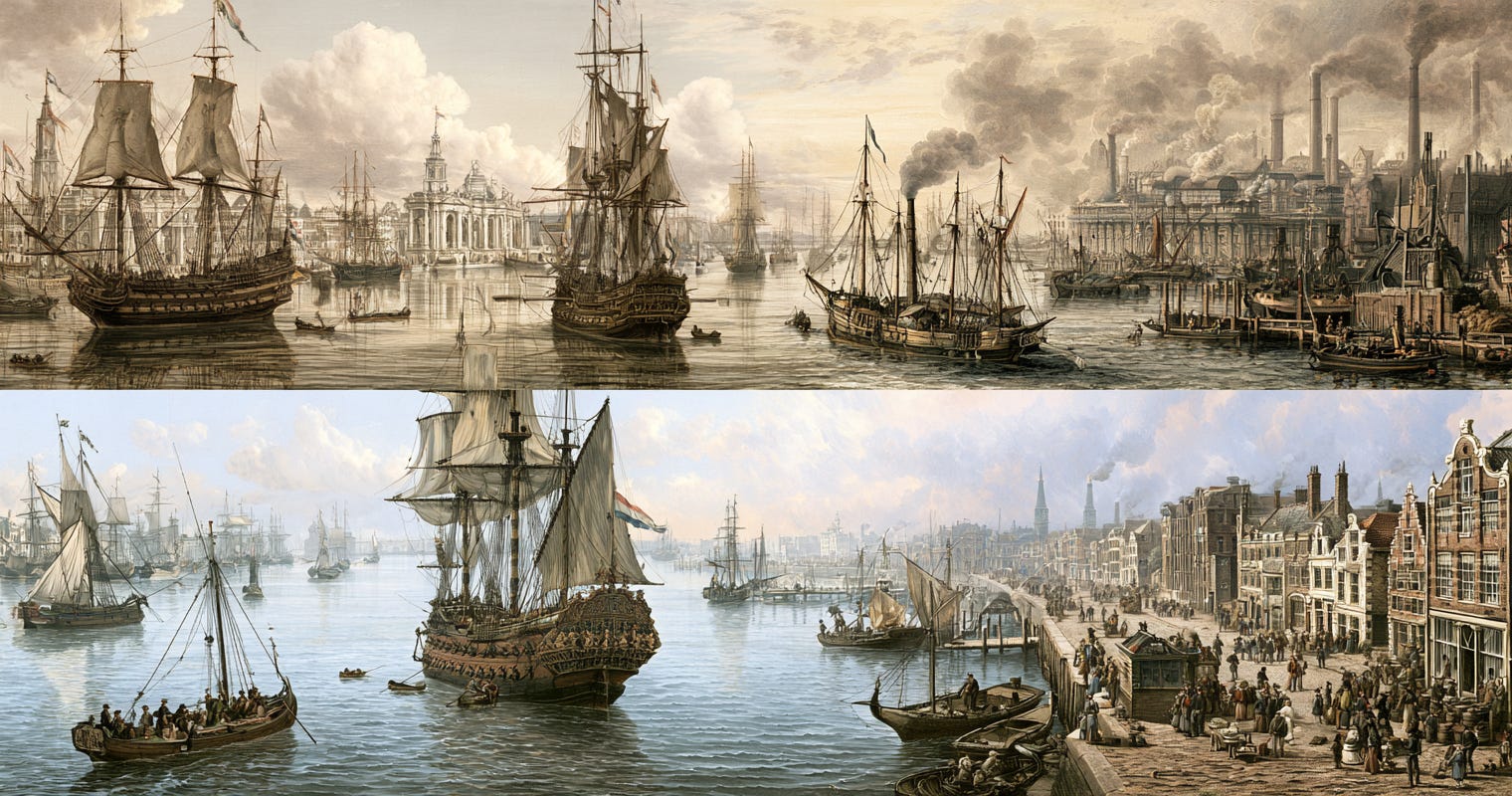
Why Amsterdam Beat London… Then Lost to It
In the 17th century, Amsterdam was the undisputed financial capital of the world.
The Dutch Golden Age was in full swing. The Amsterdam Stock Exchange was the most advanced in existence. The Dutch East India Company (VOC) was the first modern multinational. Dutch bankers and merchants dominated European finance.
Then, over the next two centuries, London took the crown.
This is the fascinating story of how Amsterdam rose to the top — and why it eventually lost to London.
Amsterdam’s Golden Age Dominance (17th Century)
The Dutch Republic was tiny but incredibly dynamic after gaining independence from Spain.
Key advantages:
The VOC and its innovations
The Amsterdam Stock Exchange
Sophisticated banking and insurance
Tolerance and immigration of skilled talent
Efficient shipping and trade networks
For a while, Amsterdam was the place where global capital flowed.
The Turning Points That Helped London
Several major events shifted the balance in Britain’s favor:
The Glorious Revolution (1688) Britain’s bloodless revolution brought William of Orange (a Dutch stadtholder) to the English throne. This strengthened Anglo-Dutch ties but ultimately benefited Britain more. It led to the creation of the Bank of England (1694) and more reliable public debt.
French Takeover of the Netherlands (1795) During the Napoleonic Wars, French forces invaded and occupied the Netherlands. This ended Dutch independence, dissolved the VOC, and devastated Amsterdam’s financial dominance. Many Dutch bankers and merchants fled or lost influence.
Britain Seizing Dutch Colonies While the Netherlands was occupied by France, Britain seized many Dutch colonies (including South Africa, Ceylon, and parts of the East Indies). This significantly weakened Dutch global trade networks and transferred wealth and opportunities to Britain.
Britain’s Industrial Revolution & Naval Supremacy Britain’s technological and industrial boom, combined with the Royal Navy’s dominance, gave it unmatched scale and security for trade and finance.
By the 19th century, London was the clear financial capital of the world — the pound sterling was the global reserve currency.
The Irony
Amsterdam helped create the modern financial system that London later perfected and dominated. The Dutch pioneered many innovations that Britain scaled up.
The Netherlands never disappeared as a financial center, but it became a secondary player compared to London (and later New York).
Historygonebananas Signature Close
Amsterdam showed the world how to do modern finance. London took those lessons, added empire and industrialization, and became the undisputed king.
The battle of financial capitals is a perfect example of how innovation spreads — and how scale and stability often win in the long run.
What do you think — could a small city like Amsterdam ever regain the top spot, or does size always win? Which financial capital do you think will dominate in the future?
Drop your thoughts below. I read every single one.
SEO/AEO FAQ
Q1: Why did Amsterdam dominate finance in the 17th century?
A: Innovative institutions like the VOC and the Amsterdam Stock Exchange, tolerance, and excellent shipping.
Q2: How did the Glorious Revolution affect the rivalry?
A: It brought a Dutch king to England and strengthened British financial institutions like the Bank of England.
Q3: What was the impact of the French takeover?
A: It devastated Dutch independence, dissolved the VOC, and allowed London to solidify its dominance.
Q4: How did Britain benefit from seizing Dutch colonies?
A: It gained valuable territories and trade routes while the Netherlands was occupied by France.
Q5: Why did London eventually surpass Amsterdam?
A: Stronger institutions, the Industrial Revolution, naval supremacy, and a larger empire.
Q6: What’s the main lesson?
A: Innovation can give small players a temporary edge, but scale, stability, and institutions often determine long-term dominance.