
The Men Standing Behind the Throne
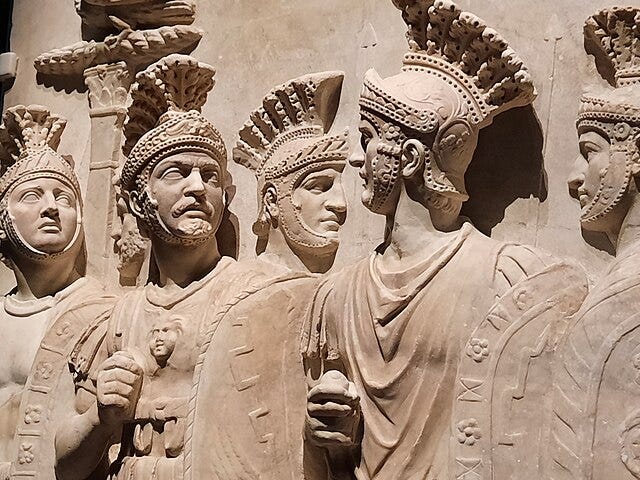
Rome feared foreign enemies.
But emperors feared something closer.
The Praetorian Guard were created to protect the emperor.
They became the people who decided who the emperor would be.
From Republican Escorts to Imperial Enforcers
In the Roman Republic, generals kept small bodyguard units called praetorians.
When Augustus became Rome’s first emperor, he formalized the unit.
The Praetorian Guard became:
An elite corps
Stationed in Rome
Paid more than regular legionaries
Granted privileged status
Unlike frontier legions, they were close to the center of power.
That proximity would change everything.
Privilege Breeds Influence
The Guard enjoyed:
Higher wages
Shorter service terms
Political proximity
They were the only armed force stationed permanently in the capital.
In a system where emperors relied on military backing, the Guard’s loyalty became decisive.
At first, they were protectors.
Then they became arbiters.
The First Assassinations
In 41 AD, the Praetorian Guard assassinated Emperor Caligula.
Instead of restoring the Republic, they declared Claudius emperor.
They did not merely kill.
They chose.
That precedent mattered.
The emperor was no longer inevitable.
He was negotiable.
Selling the Empire
In 193 AD, after murdering Emperor Pertinax, the Praetorian Guard auctioned the throne.
The highest bidder, Didius Julianus, bought the empire.
This was not symbolic corruption.
It was literal.
The imperial office had become transactional.
The Guard had transformed from bodyguards into kingmakers.
Structural Damage
The damage was subtle but permanent.
When the army realizes it can make emperors, loyalty shifts:
From law
To precedent
To opportunity
Emperors now had to:
Buy loyalty
Increase donatives
Secure short-term backing
This encouraged instability.
During the Crisis of the Third Century, dozens of emperors rose and fell rapidly.
The Praetorian Guard was not the sole cause.
But it normalized military intervention in succession.
The Problem of Centralized Power
Rome’s imperial system had no formal succession mechanism.
Power flowed through:
Military support
Senate recognition
Popular approval
The Guard sat at the crossroads of all three.
They were close enough to act quickly.
Strong enough to enforce decisions.
Ambitious enough to exploit weakness.
The End of the Guard
In 312 AD, Emperor Constantine defeated Maxentius at the Battle of the Milvian Bridge.
Maxentius had relied heavily on the Praetorian Guard.
After victory, Constantine disbanded the unit.
Their barracks were destroyed.
Rome learned—too late—that elite units embedded in political centers become unstable.
🍌 History’s Lesson
The Praetorian Guard reveals a recurring pattern:
Elite protectors accumulate leverage.
Proximity to power creates power.
Once a military unit becomes political, it reshapes the system it was meant to defend.
The Guard did not destroy Rome alone.
But it eroded legitimacy.
It made succession unstable.
It turned emperorship into a negotiation.
Rome did not fall because barbarians broke the gates.
It weakened because the gatekeepers learned their own strength.
❓ FAQ
Who were the Praetorian Guard?
An elite Roman unit assigned to protect emperors and maintain order in Rome.
Why were the Praetorian Guard powerful?
They were the only permanent armed force in the capital and had direct access to the emperor.
Did the Praetorian Guard really sell the empire?
Yes. In 193 AD, they auctioned the throne after assassinating Emperor Pertinax.
How did the Praetorian Guard weaken Rome?
They normalized military intervention in succession, increasing instability.
When were they disbanded?
In 312 AD after Constantine’s victory over Maxentius.