
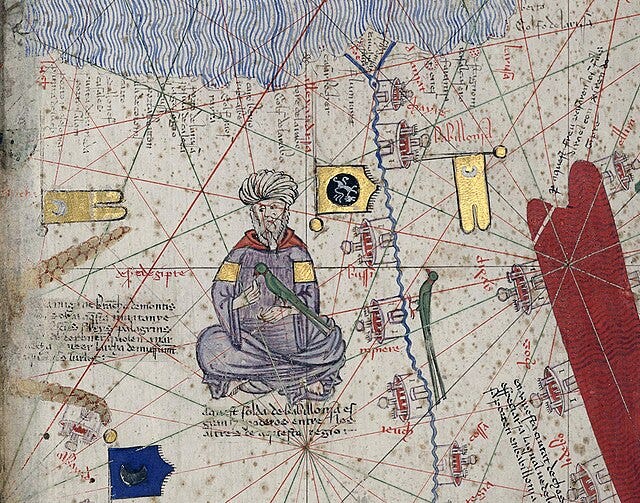
The Slaves Who Became Sultans
Most slave soldiers defend rulers.
The Mamluks replaced them.
In the 13th century, enslaved Turkic and Caucasian boys were brought to Egypt, trained as elite cavalry, and converted to Islam.
They were called Mamluks — meaning “owned.”
Ownership was the point.
Like the Janissaries, they were cut off from family, tribe, and inheritance.
Their loyalty belonged only to their master.
Until it didn’t.
The Collapse of Ayyubid Authority
The Mamluks originally served the Ayyubid dynasty — the successors of Saladin.
But by the mid-1200s, Ayyubid authority was weakening.
Factional struggles increased.
External threats mounted.
When instability grows, elite soldiers notice.
And they calculate.
The Mongol Threat
In 1258, the Mongols sacked Baghdad.
The Abbasid Caliphate ended.
The Mongol army advanced westward.
The Islamic world expected annihilation.
The Mamluks did something different.
They seized power in Cairo.
Then they marched north.
Ayn Jalut: A Turning Point
In 1260, at the Battle of Ayn Jalut in present-day Palestine, the Mamluks defeated a Mongol force.
This was not a minor clash.
It was the first major Mongol defeat in open battle.
The victory reshaped regional power.
The Mamluks proved:
The Mongols were not invincible.
Egypt could lead the region.
Slave soldiers could govern.
After victory, they did not return power to the Ayyubids.
They ruled directly.
A State Built on Military Elite Networks
The Mamluk state was unique.
Power was not hereditary in the traditional sense.
Each generation of rulers imported and trained new slave soldiers.
This prevented entrenched dynasties.
But it also created perpetual elite competition.
The state functioned through:
Military patronage networks
Commercial taxation
Strategic control of trade routes
Cairo became a thriving hub.
Stability Without Dynasty
The Mamluk model avoided hereditary stagnation.
But it introduced another problem:
Elite rotation through violence.
Succession often meant coup.
Political legitimacy depended on military backing.
Yet for centuries, the system held.
Why?
Because it was adaptive.
The ruling class constantly refreshed itself.
The Limits of Military Governance
Eventually, however, the system faced new pressures:
Changing trade routes
Ottoman expansion
Gunpowder warfare
The Mamluks were slow to integrate firearm tactics compared to the Ottomans.
In 1517, the Ottoman Empire conquered Egypt.
The Mamluks lost sovereignty.
But not relevance.
Many remained influential under Ottoman rule.
🍌 History’s Lesson
The Mamluks reveal something counterintuitive.
Slaves can build states.
Institutional design matters more than origin.
Their strength came from:
Elite training
Controlled recruitment
Military cohesion
Their weakness came when adaptation slowed.
Like the Janissaries, they began as innovation.
Unlike the Janissaries, they initially built the state themselves.
Power borrowed from masters.
Then seized.
Then institutionalized.
History does not care how power begins.
It cares how it evolves.
❓ FAQ
Who were the Mamluks?
Enslaved military elites who rose to power in Egypt during the 13th century.
How did the Mamluks defeat the Mongols?
At the Battle of Ayn Jalut in 1260, using disciplined cavalry tactics and strategic timing.
Did the Mamluks create their own dynasty?
They ruled as a military elite rather than a traditional hereditary dynasty.
Why did the Mamluk state decline?
Failure to modernize militarily and rising Ottoman power led to their defeat in 1517.
Were the Mamluks unique?
They were unusual in that slave soldiers became rulers, not just elite guards.