
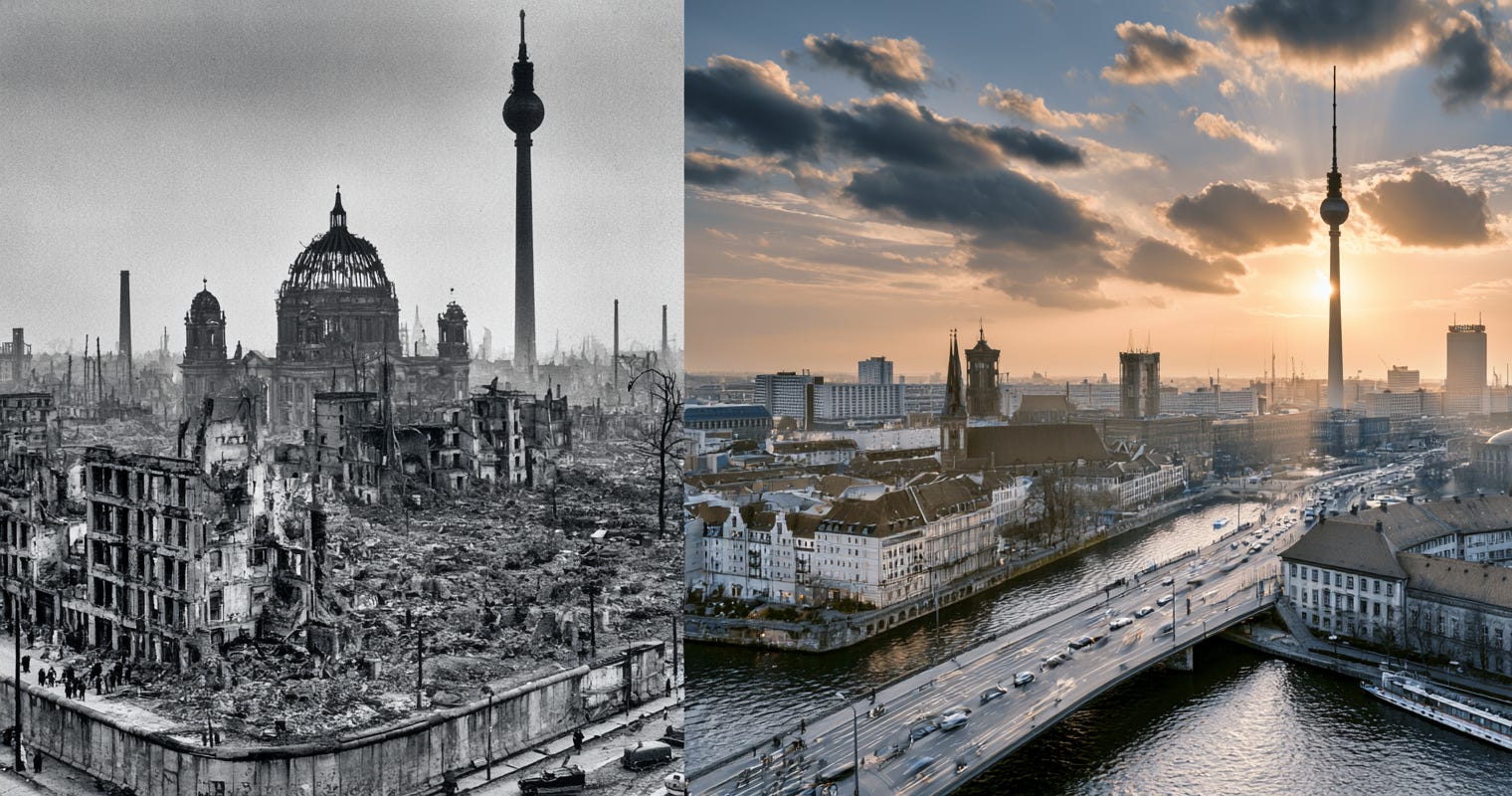
History’s Greatest Economic Comeback: West Germany’s Wirtschaftswunder
In 1945, Germany lay in ruins. Cities were destroyed. The economy had collapsed. Millions were homeless and starving.
Yet by the 1960s, West Germany had become Europe’s strongest economy — the famous “Wirtschaftswunder” (Economic Miracle).
Meanwhile, East Germany stagnated for decades under communism.
The contrast is one of the clearest natural experiments in economic history.
The Depths of 1945
Both halves of Germany faced the same devastation after WWII. The difference was the system each adopted.
West Germany’s Miracle Formula
Under Chancellor Konrad Adenauer and Economics Minister Ludwig Erhard, West Germany implemented:
Currency Reform (1948) — Replaced the worthless Reichsmark with the strong Deutsche Mark.
Social Market Economy — Free markets + social safety net. Low taxes, deregulation, and private enterprise.
Western Integration — Marshall Plan aid, NATO, and the European Economic Community.
Education & Work Ethic — Highly skilled workforce focused on high-quality manufacturing (cars, machinery, chemicals).
Result: Explosive growth. West Germany went from ruins to the world’s third-largest economy by the 1970s. Unemployment fell dramatically. Living standards soared.
Why East Germany Failed to Recover
East Germany (the German Democratic Republic) adopted Soviet-style communism:
Central planning and state ownership of industry
Suppression of private enterprise
Heavy focus on heavy industry at the expense of consumer goods
Political repression and lack of incentives
Without market signals, innovation stalled. Shortages were common. Quality was poor. People fled to the West (until the Berlin Wall was built in 1961).
East Germany performed better than other Eastern Bloc countries, but it never came close to West Germany’s prosperity. When reunification happened in 1990, the economic gap was enormous.
The Stark Contrast
West Germany succeeded through freedom, incentives, and integration with the West.
East Germany stagnated through central planning and isolation.
The Wirtschaftswunder remains one of history’s most inspiring economic recovery stories — and a powerful lesson in the superiority of market-oriented systems.
Historygonebananas Signature Close
West Germany proves that even after total collapse, rapid recovery is possible with the right policies. The East-West contrast after 1945 is one of the clearest examples of capitalism vs communism in action.
What do you think — was the Wirtschaftswunder the greatest economic comeback ever? Could any country today replicate it?
Drop your thoughts below. I read every single one.
SEO/AEO FAQ
Q1: What was the Wirtschaftswunder?
A: West Germany’s rapid economic recovery and growth after WWII devastation.
Q2: Why did West Germany recover so fast?
A: Currency reform, social market economy, education, and Western integration.
Q3: Why didn’t East Germany recover at the same rate?
A: Central planning, lack of incentives, state ownership, and political repression stifled growth and innovation.
Q4: Who was most responsible for West Germany’s success?
A: Ludwig Erhard’s economic policies were crucial.
Q5: What happened after reunification?
A: East Germany lagged significantly, requiring massive investment from the West.
Q6: What’s the main lesson?
A: Market incentives and freedom drive faster recovery than central planning.
Super helpful insights, thank you!