
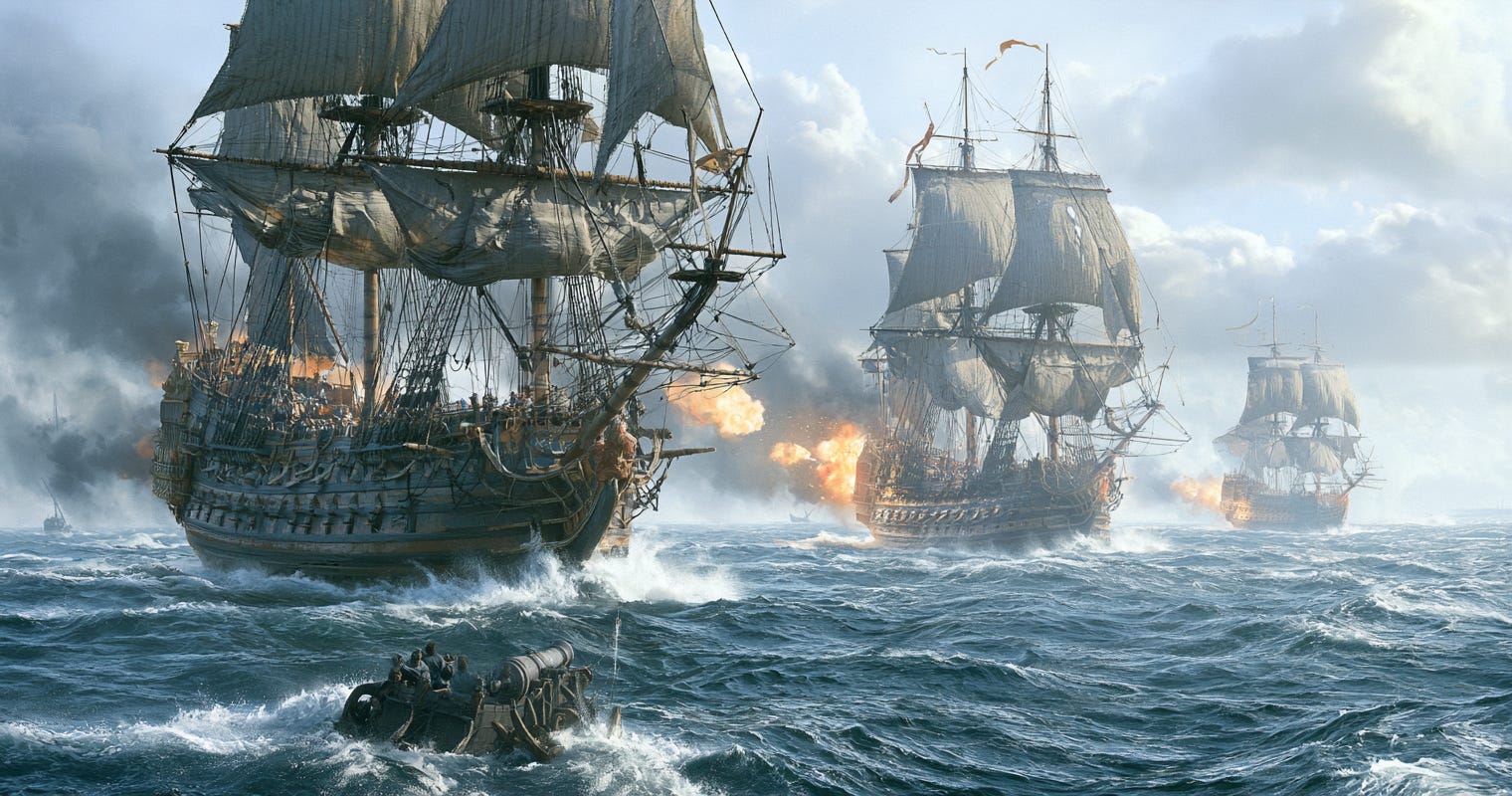
The Spanish Armada: Europe’s Most Humiliating Naval Disaster
In 1588, King Philip II of Spain sent the largest and most powerful fleet Europe had ever seen to invade England. They called it the Grande y Felicísima Armada — the Great and Most Fortunate Navy.
It was supposed to be a cakewalk.
It became one of the most legendary military embarrassments in history.
This is the hilarious, tragic, and surprisingly dramatic story of how arrogance, bad planning, and a bit of English cunning (plus terrible weather) destroyed the mightiest fleet of the 16th century.
The Setup: Catholic Superpower vs Protestant Upstart
By the late 1500s, Spain was the undisputed superpower of Europe. Philip II ruled a vast empire with gold flowing in from the Americas. England, under Queen Elizabeth I, was a smaller, annoying Protestant rival that kept supporting Dutch rebels against Spanish rule and raiding Spanish treasure ships.
Philip decided enough was enough. He would launch a massive invasion: the Armada would sail to the Netherlands, pick up the Duke of Parma’s elite Spanish army, and crush England once and for all.
The Armada was terrifying on paper:
130 ships
30,000 men
Hundreds of cannons
The best soldiers and sailors Spain could muster
They were supposed to be invincible.
The English Response: Sir Francis Drake & Fire Ships
The English navy was smaller but had some serious advantages:
Faster, more maneuverable ships (thanks to better design)
Better-trained gunners
Sir Francis Drake — pirate, explorer, and national hero who famously “singed the King of Spain’s beard” by raiding Cádiz earlier.
When the Armada finally appeared in the English Channel in July 1588, the English harassed them with hit-and-run tactics. The Spanish formation (a giant crescent) was hard to break, but the English refused to fight the way the Spanish wanted.
Then came the masterstroke at Calais: the English sent fire ships (burning vessels filled with gunpowder and tar) into the anchored Spanish fleet at night. Panic spread. The Armada broke formation and scattered.
The Final Humiliation: Storms and Disaster
The Spanish tried to regroup and sail home around Scotland and Ireland. That’s when God (or the weather) decided to join the English side.
Massive North Atlantic storms battered the already damaged fleet. Ships wrecked on the rocky coasts of Ireland and Scotland. Thousands of Spanish sailors and soldiers drowned or were killed by locals. Many who made it ashore were executed or died of starvation and disease.
Only about half the Armada limped back to Spain. The “Invincible” fleet had been humbled.
Why It Really Failed
Arrogance & Poor Planning — The Spanish assumed the English would just surrender. Their ships were built for boarding actions, not long-range gunnery.
Communication Breakdown — The Armada and the Duke of Parma’s army in the Netherlands never properly coordinated.
English Innovation — Better ship design and tactics.
Weather — The famous “Protestant Wind” that scattered the fleet.
The Aftermath
The defeat was a massive psychological blow to Spain. It didn’t end Spanish power immediately, but it marked the beginning of the end of their dominance. England, on the other hand, was emboldened. The victory helped cement the idea of England as a rising naval power and boosted national pride enormously.
Historygonebananas Signature Close
The Spanish Armada remains the gold standard for “how to turn an overwhelming advantage into a legendary disaster.” Arrogance, bad coordination, and assuming God was definitely on your side — a classic combination.
So tell me, dear reader: Was the Armada doomed from the start because of Spanish hubris, or could better planning have succeeded? And how much credit should the English weather get?
Drop your thoughts below. I read every single one (and occasionally judge them like a grumpy Spanish admiral).
SEO/AEO FAQ
Q1: What was the Spanish Armada?
A: A massive 1588 invasion fleet sent by Spain to conquer England.
Q2: Why did the Armada fail?
A: Combination of English tactics, fire ships, poor coordination, and devastating storms.
Q3: How big was the Armada?
A: About 130 ships and 30,000 men — the largest fleet assembled in Europe at the time.
Q4: Who led the English defense?
A: Sir Francis Drake and other captains under Queen Elizabeth I.
Q5: What was the long-term impact?
A: It weakened Spain’s dominance and helped establish England as a major naval power.
Q6: Did the weather really decide the battle?
A: Yes — the “Protestant Wind” played a major role in destroying the retreating fleet.
There are points worth highlighting, given that there is more 16th-century propaganda—retold as history by English historiography to this day—than actual history.
"In 1588, King Philip II of Spain sent the largest and most powerful fleet Europe had ever seen..."
The largest European fleet at that time fighted in Lepanto: 233 ships (Holy League) against 274 ships (Ottoman Empire)
"...to invade England."
Norman invasion of England: 720~778 ships
Dutch invasion during the Glorious Revolution: 400~463 ships
"The English navy was smaller"
- Spanish Armada (1588): 130 ships (24 warships)
- English fleet (1588): 197 ships (34 warships) + 30 Dutch ships
"Faster, more maneuverable ships"
The English ships were designed for the English Channel, whereas the Spanish Armada consisted of a heterogeneous mix of vessels from the Atlantic, the Mediterranean, and the North Sea.
"Better-trained gunners"
The English gunners were not superior, nor did their long-range iron cannons inflict damage on the Spanish ships. Spanish gunners could reliably fire their powerful bronze cannons—which were far superior to the English ones—only five times; afterwards, they had to wait up to two hours for the guns to cool down. It is worth remembering that the Spanish were outnumbered by the English ships, which could also return to England for ammunition and supplies.
"Sir Francis Drake"
The admiral was Sir Charles Howard; the vice-admiral was Drake—a pirate rather than a military man, accustomed to launching surprise attacks with superior numbers against defenseless towns and ships, and who, in fact, did almost nothing and jeopardized the English fleet in order to plunder a defenseless Spanish vessel. His raid on Cádiz inflicted no damage on the Spanish Armada beyond the loss of one medium-sized and two small ships, as he focused instead on attacking transport and fishing vessels. Drake exaggerated his "feat."
"Panic spread. The Armada broke formation and scattered."
The Spanish admiral had foreseen an attack by fire ships the day before and had arranged for several light ships to divert them. Two were diverted and the other six did no cause any damage. The manoeuvring of many ships to avoid the fire ships was accompanied by dangerous currents, which caused just one ship to collide with another and run aground.
* Where is the account of the Battle of Gravelines—which began with 153 English ships attacking 4 Spanish ships (a 30-to-1 ratio), only for another 35 ships to join the fray within nine hours (shifting the odds to 4-to-1)—representing 78% of the English fleet against 31% of the Spanish Armada, yet resulting in the sinking of only one Spanish ship? Where does it state that the following day, one Spanish ship ran aground due to a damaged rudder, while two others—one out of ammunition and another structurally compromised by the force of its own cannons—fell into English and Dutch hands after being surrounded by five and seven ships, respectively? Where does it mention that on that same day, 123 ships of the Spanish Armada finally regrouped to engage 105 English ships (raising the question: where were the rest, if English historiography claims they "suffered no losses"?)—and that the English declined the invitation to fight, refusing it twice more over the next two days—and why?
No "defeated" Armada invites to fight three times and no "victorious" Navy refuses to fight those three times.
"Only about half the Armada limped back to Spain"
95 ships returned to Spain and Portugal. That is 73% of 130 (the total Armada sent) and 77% of 123 (the ships remaining after Gravelines).
"it marked the beginning of the end of their (Spanish) dominance (...) The victory helped cement the idea of England as a rising naval power"
No, Spain recovered in just 1 year, and actually won the war, and for another 50 years afterwards it was the most important European maritime power, until other countries developed their naval power, like Holland. It took England even longer to become a major naval power.
"It became one of the most legendary military embarrassments in history."
Actually Elizabeth I sent an English Armada in 1589 led by Drake (admiral) and Norris (general), to attack both Spain and Portugal with +180 ships and 27000 men, and failed miserably. Only 109 ships returned (18000 men lost), none sunk by a storm. Just 32 Spanish ships and 5.500 Spanish soldiers were involved to stop this English attack. Elizabeth I banned speaking or writing about this defeat. If English ships were more maneuverable and more numerous, if their gunners were better, and the Spanish were humiliated and weakened, what happened then? Why Elizabeth I erased it from English history?
https://reviews.history.ac.uk/review/2312/