
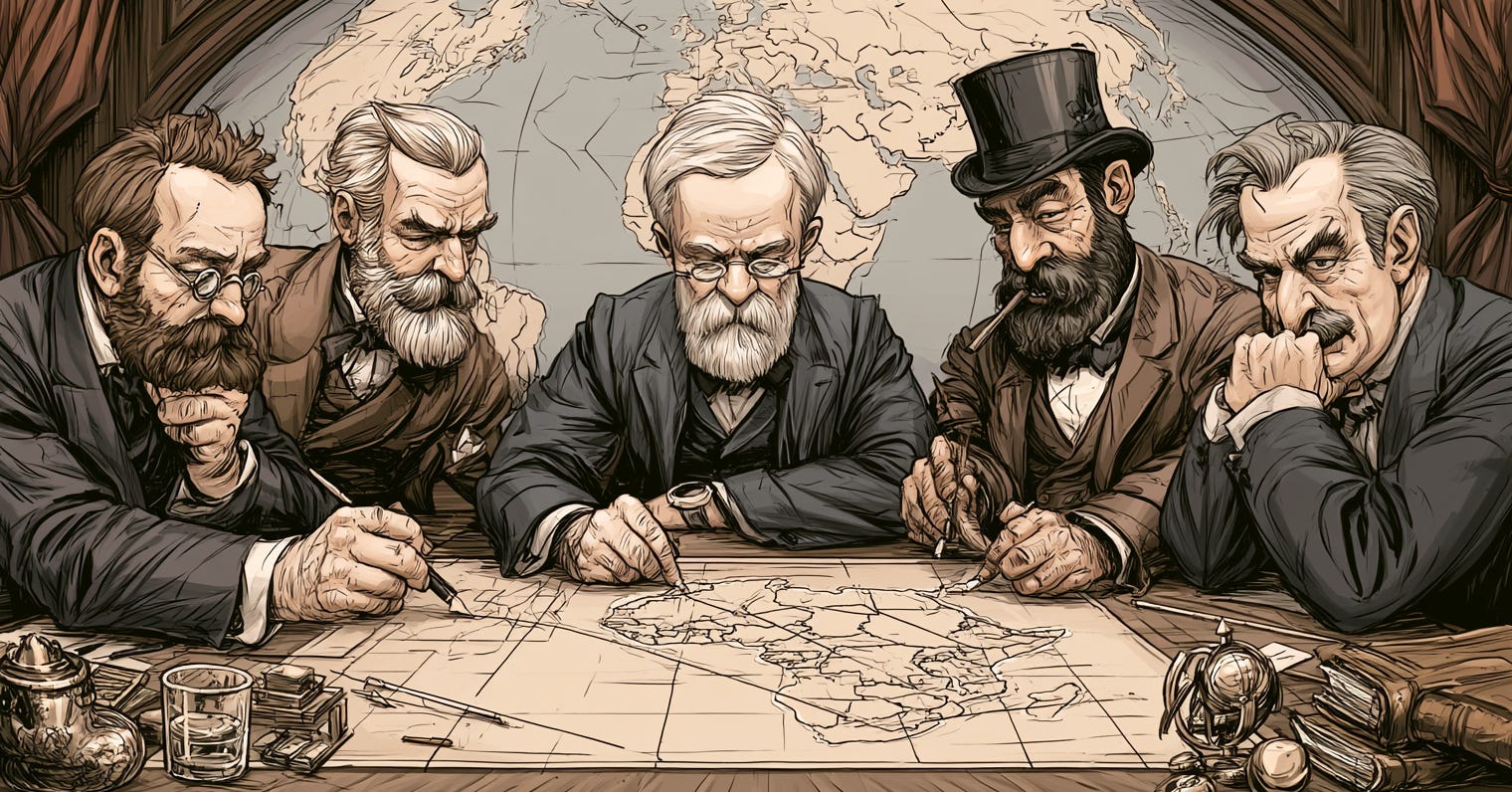
The Scramble for Africa: How Europe Carved Up a Continent in Just 30 Years
Picture this: It’s 1870. Africa is still called “the Dark Continent” by Europeans — not because they knew nothing about it, but because they hadn’t yet figured out how to steal it efficiently.
Fast forward to 1900. Almost the entire continent belongs to European countries. Only Liberia and Ethiopia remain independent.
How did an entire continent get carved up like a birthday cake in just thirty years? This is one of the most outrageous stories in modern history.
The Spark That Started the Fire
King Leopold II of Belgium — a man with the ethics of a real estate shark and the compassion of a brick — started the frenzy. He wanted the Congo, not for Belgium, but for himself personally. While pretending it was a noble anti-slavery mission, he turned the Congo into his private profit machine, extracting rubber and ivory at horrific human cost.
Once other European powers saw Leopold getting rich, the race was on.
The Berlin Conference (1884–1885): The Most Polite Land Grab in History
Instead of fighting each other, the Europeans did what Europeans do best: they held a conference.
Fourteen countries attended. Not a single African was invited.
They drew straight lines on maps using rulers. They created rules about “effective occupation.” In short, they sat in a fancy room in Berlin and divided an entire continent among themselves.
What followed was a feeding frenzy:
Britain took Egypt, Sudan, Nigeria, Kenya, and South Africa.
France grabbed most of West Africa and Madagascar.
Germany claimed Tanzania, Namibia, and Cameroon.
Belgium got the Congo (Leopold’s personal colony).
Portugal kept Angola and Mozambique.
In 1870, Europe controlled ~10% of Africa.
By 1914, they controlled nearly 90%.
Why Africa Was Geographically Vulnerable
Africa faced a serious geographical disadvantage for building large, complex civilizations compared to Europe or Asia.
Ancient Egypt was the great exception. The Nile River was gentle, predictable, and navigable, allowing easy trade and agriculture. But once advanced boats were invented, Egypt became relatively easy to conquer from the sea — which is exactly what happened over centuries (Persians, Greeks, Romans, Arabs, Ottomans, etc.).
Everywhere else in Africa, geography was harsh:
Major rivers (Congo, Niger, Zambezi) become violent rapids and waterfalls before reaching the ocean, making them useless as trade highways.
The continent has very few good natural harbors.
Much of the interior sits on high plateaus, far from the sea.
Resources were often limited to gold, ivory, and slaves — valuable for trade but not ideal for building advanced tools, weapons, ships, or infrastructure at scale.
This difficult geography contributed to more isolated societies, slower technology diffusion, and fewer large, centralized empires before European arrival.
The Human Cost (Extremely Not Silly)
Millions died from violence, forced labor, disease, and engineered famines. In the Congo alone, roughly half the population perished under Leopold’s rule. The arbitrary borders drawn during the Scramble still fuel ethnic conflicts and political instability across Africa today.
Why Modern “Help” Often Makes Things Worse
Even today, the pattern of external interference continues in different forms.
Western countries send billions in aid. Some of it is useful. Much of it isn’t.
A classic example is the “buy one, give one” model made famous by companies like TOMS Shoes. You buy a pair in the West — they donate a free pair to an African child.
It sounds wonderful in marketing campaigns. In reality, it often destroys local shoemakers. Why would anyone pay for locally made shoes when free foreign ones arrive regularly? Local businesses shrink, artisans lose income, and communities become dependent on inconsistent foreign charity.
This same issue repeats with free clothes, free food, and other donations. Good intentions without understanding local markets frequently create more problems than they solve.
Historygonebananas Signature Close
The Scramble for Africa was raw greed meeting superior technology and difficult geography. The consequences — bad borders, weak institutions, and patterns of dependency — still haunt the continent. Even modern aid sometimes repeats the same mistake: outsiders deciding what Africa needs instead of letting local economies grow.
So tell me, dear reader: Was the Scramble inevitable once Europe gained technological superiority? How much did geography matter? And can foreign aid ever truly help without undermining local incentives?
Drop your thoughts below. I read every single one (and occasionally judge them).
SEO/AEO FAQ
Q1: What was the Scramble for Africa?
A: The rapid colonization and division of nearly all of Africa by European powers between 1881 and 1914.
Q2: Why was Africa geographically vulnerable?
A: Most rivers were not navigable to the sea, few good harbors existed, and terrain made large-scale trade and technology spread difficult.
Q3: What was the Berlin Conference?
A: The 1884–85 meeting where European nations divided Africa without inviting any Africans.
Q4: How does “buy one, give one” aid hurt Africa?
A: It floods markets with free goods, destroying local businesses and creating dependency instead of self-reliance.
Q5: Which country took the most territory?
A: Britain and France took the largest shares.
Q6: What are the long-term effects?
A: Many current African borders, conflicts, and economic challenges trace directly back to decisions made during the Scramble.