May 18 2026
The Panama Canal Was Never Just a Canal
The Panama Canal is often described as an engineering miracle.
That’s true—but incomplete.
From the moment the idea appeared, the canal was less about ships and more about power. Whoever controlled it didn’t just move goods faster. They shaped trade routes, naval strategy, and political leverage across two oceans.
This was never neutral infrastructure.
It was history poured into concrete.
Geography’s Shortcut
Before the canal opened in 1914, ships traveling between the Atlantic and Pacific had one option: sail around Cape Horn.
That meant:
Thousands of extra miles
Weeks of delay
Higher insurance and fuel costs
The canal didn’t just save time.
It reordered global commerce.
Entire trade routes, port cities, and naval strategies realigned around a 50-mile strip of land.
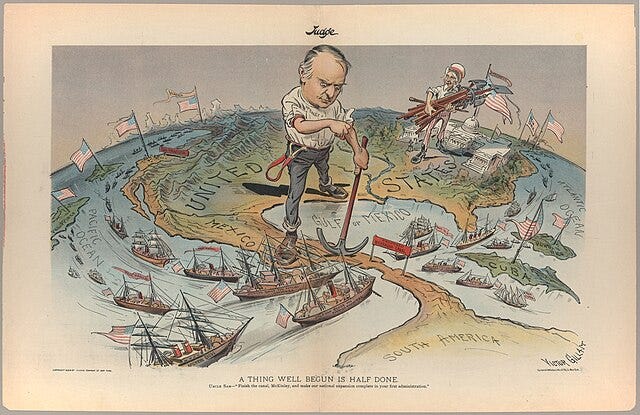
The French Failure (Ambition Without Power)
The first attempt to build the canal came from France in the 1880s.
Led by Ferdinand de Lesseps—the man behind the Suez Canal—the effort collapsed under:
Tropical disease
Engineering miscalculations
Financial scandal
France had vision but lacked the institutional capacity to impose order on geography.
Empires that succeed usually do both.
The American Takeover (Power With Purpose)
The United States learned from the French failure.
After supporting Panama’s separation from Colombia in 1903, Washington took control of the Canal Zone and approached the project as both an engineering and strategic mission.
Under U.S. management:
Mosquito-borne disease was controlled
Massive earthworks reshaped the landscape
Lock-based engineering tamed elevation changes
When the canal opened in 1914, it instantly became a pillar of American power.
The U.S. Navy could now shift fleets between oceans.
Trade flowed through American-controlled gates.
The canal wasn’t just infrastructure—it was imperial plumbing.
The Canal as Strategic Asset (20th Century)
For much of the 20th century, the canal functioned as:
A commercial artery
A military chokepoint
A symbol of U.S. hemispheric dominance
During both world wars and the Cold War, control of the canal was treated as non-negotiable.
Maps showed Panama as a country.
Reality showed a corridor governed by someone else.
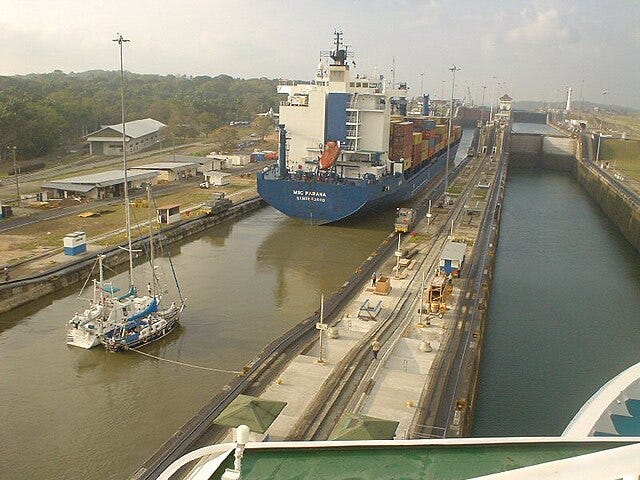
Sovereignty Returns—Control Evolves
In 1977, the Torrijos–Carter Treaties set the canal on a path toward Panamanian control, completed in 1999.
This was not the end of strategic relevance.
It was a change in management, not meaning.
Panama inherited:
Toll-setting authority
Operational control
A choke point the world could not ignore
Infrastructure doesn’t lose power when flags change.
It simply changes who collects leverage.
Ports, Logistics, and Quiet Influence
When sovereignty over the canal transferred to Panama in 1999, many assumed the strategic story had ended.
It hadn’t.
It had simply changed form.
In the late 20th century, power over global trade shifted away from flags and toward logistics—ports, terminals, container handling, and scheduling systems. Control over flow became more important than control over territory.
This is where Li Ka-shing enters the story.
Through Hutchison Whampoa (later CK Hutchison), Li’s group won long-term concessions to operate major container ports at both ends of the Panama Canal—Balboa on the Pacific side and Cristóbal on the Atlantic side—in the 1990s.
This was not a military move.
It was a commercial one.
But history teaches that commercial control over chokepoints often matters more than formal sovereignty.
Why Ports Matter More Than the Canal Itself
Canals move ships.
Ports decide who moves efficiently.
Port operators control:
Berthing priority
Container throughput speed
Terminal pricing
Coordination with shipping alliances
In a world of just-in-time supply chains, delays of hours—or even minutes—cascade into costs across continents.
Whoever manages the ports near a chokepoint doesn’t need to block traffic to exert influence.
They simply need to optimize for some flows and not others.
This is quiet power—subtle, legal, and deniable.
Why Washington Noticed
The concern in Washington was never that Hong Kong port operators would suddenly “close the canal.”
That would be crude—and unnecessary.
The concern was structural:
Global trade had become dependent on logistics efficiency
Control had shifted from navies to operators
Strategic leverage no longer required direct ownership
As China’s economic rise accelerated in the 2000s, the fact that a major global port operator with deep commercial ties to China sat astride one of the world’s most important trade chokepoints became uncomfortable—not because of intent, but because of optionality.
History rarely cares about motives.
It cares about capabilities.
A Familiar Historical Pattern
This pattern is not new.
Venetian merchants controlled Mediterranean trade without conquering territory
British firms dominated global shipping lanes before formal empire
American oil companies shaped geopolitics long before Washington acted
Infrastructure control often precedes—and sometimes replaces—political control.
The Panama Canal simply updated the model for the container age.
From Empire to Systems
What makes the Hutchison episode historically interesting is not suspicion, but symbolism.
It marks the transition from:
Empire → infrastructure
Sovereignty → systems
Territory → throughput
The canal didn’t lose strategic importance when Panama took it back.
It became part of a larger logistical ecosystem, where influence is exercised through contracts, efficiency, and market position rather than flags.
This is how power operates in the modern world—quietly, structurally, and long before crises make it visible.
Why This Still Matters Historically
Empires once fought over canals.
Modern powers compete over who runs the ports, the terminals, the software, and the shipping alliances that decide how trade actually moves.
The lesson isn’t about one company or one individual.
It’s about a historical shift:
Control over chokepoints no longer requires ownership of land—only mastery of systems.
The Panama Canal didn’t become less important in the modern era.
It became more subtle.
🍌 History’s Lesson
The Panama Canal has worn many labels:
Engineering marvel
Commercial shortcut
Sovereignty symbol
But history shows it was always something else.
It was a reminder that infrastructure is never neutral—and that geography never stops influencing power, even when the world pretends otherwise.
Empires rise and fall.
Chokepoints endure.
❓ FAQ
Why is the Panama Canal so important?
Because it shortens global trade routes, concentrates shipping traffic, and turns geography into long-term economic and strategic leverage.
Who originally built the Panama Canal?
France attempted and failed. The United States completed the canal between 1904 and 1914 after gaining control of the Canal Zone.
Does the U.S. still control the Panama Canal?
No. Panama assumed full control in 1999, though the canal remains strategically important to global trade and major powers.
Why do ports near the Panama Canal matter?
Because control of logistics hubs shapes supply chains, pricing, and trade flow—even without military presence.
Are chokepoints still relevant in modern trade?
Yes. Despite digitalization, physical chokepoints like canals and straits remain critical to global commerce.