
INTRO — SPEED, STRATEGY, AND THE EMPIRE THAT ATE EURASIA
No army in world history moved like the Mongols.
While medieval European knights were busy arguing about horse armor and debating church taxes, the Mongols were:
covering 100–150 km per day,
coordinating armies across thousands of kilometers,
running intelligence networks across continents,
and crushing any kingdom that assumed “nomads can’t siege cities.”
The Mongols didn’t just fight wars —
they engineered them.
Their empire wasn’t built on chaos.
It was built on speed, logistics, discipline, and innovation so advanced that European chroniclers wrote stuff like:
“Surely these horsemen were demons from Hell.”
But no — they were just really, really organized.
This is the real story of how the Mongols became the fastest empire-builders the world has ever seen.
PART I — LIFE ON THE STEPPE: WHERE SUPERHUMANS WERE TRAINED FROM AGE 3
Forget Hollywood.
Steppe nomads weren’t wild barbarians sprinting naked on horseback.
They were professional riders by kindergarten.
Mongol children could:
ride before they could walk
shoot while galloping
rope animals in motion
survive harsh winters
understand winds, weather, and terrain
manage herds
track animals across empty steppe
The Eurasian steppe is a massive military academy, producing:
perfect balance
endurance
situational awareness
spatial instinct
coordinated movement
tactical intuition
A Mongol warrior was not “trained.”
He was born into a military ecosystem.
This matters because:
When the Mongols fought knights, they weren’t just fighting soldiers —
they were fighting lifelong athletes of the steppe, whose entire existence sharpened skills useful in war.
PART II — MOBILITY: THE MONGOL SUPERPOWER
The Mongols’ greatest weapon was not their bow.
Not their tactics.
Not even Genghis Khan.
It was mobility.
A Mongol warrior had:
3–5 horses
allowing rotation
preventing exhaustion
enabling near-endless travel
Knights?
One horse, heavily armored, extremely tired.
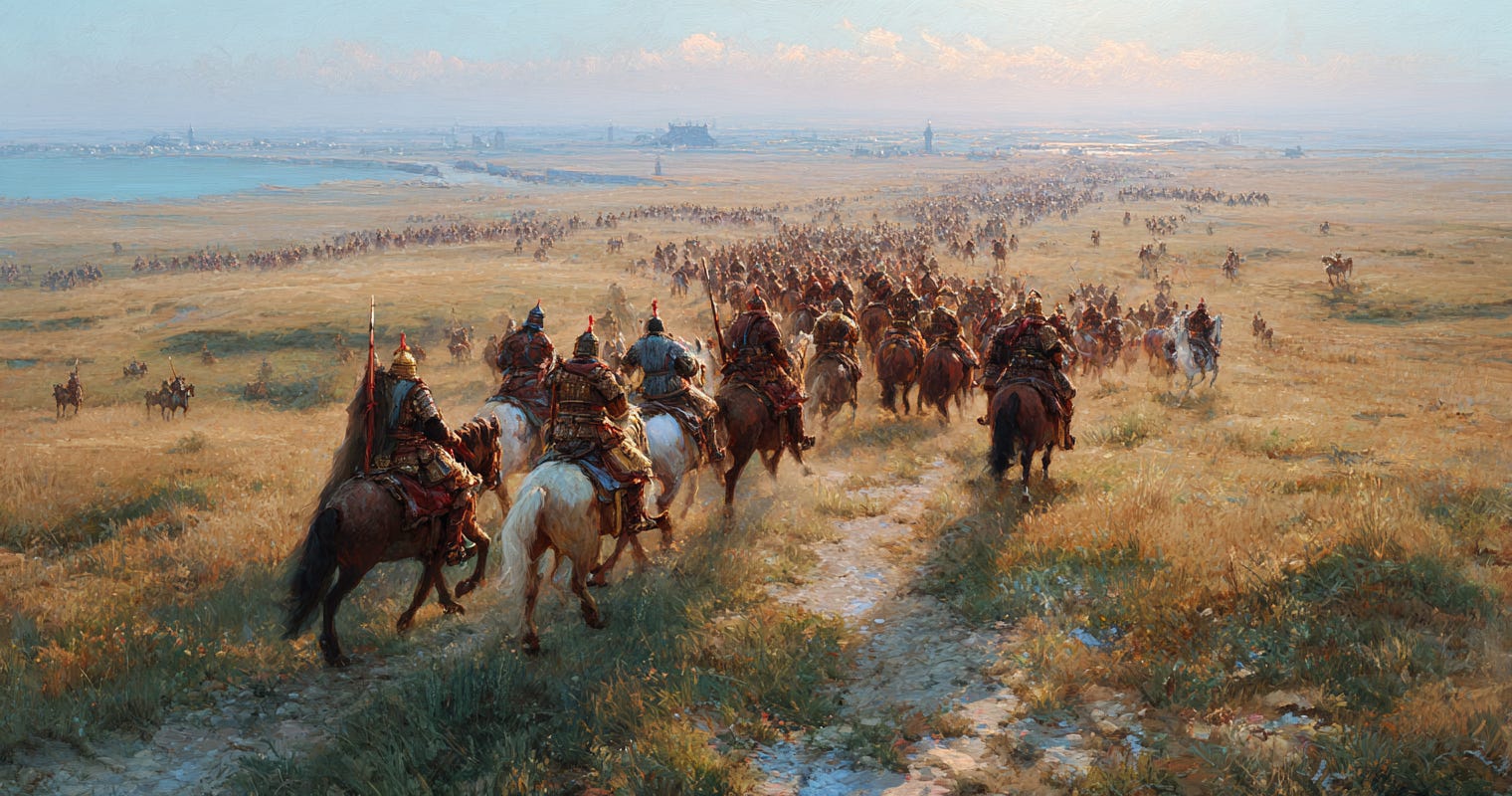
Mongols?
“Hm, this horse is tired. Time to switch to Horse #3.”
This is how Mongol armies could “appear everywhere at once.”
They were literally swapping horses mid-campaign like marathoners swapping sneakers.
Real mobility advantages:
outran every enemy
appeared where least expected
retreated strategically without exhaustion
pursued enemies weeks longer
crossed entire nations before defenders rallied
Mobility is strategy.
The Mongols mastered it.
PART III — THE COMPOSITE BOW: A WEAPON CENTURIES AHEAD
The Mongol composite bow was:
made of horn, wood, sinew
cured with animal glue
requiring months to craft
stronger than English longbows
effective at 200–400 meters
usable on horseback
Compared to medieval weapons, this was laser technology.
Shooting on horseback while standing in stirrups
This ability psychologically shattered enemies.
A knight needs distance to charge.
A Mongol horse archer needs a moment to turn around and shoot you again.
European chroniclers were shocked:
“Their arrows fall like rain.”
“They shoot even while fleeing.”
“It is as if they have eyes in the back.”
That’s called training from age three, my guy.
PART IV — INTELLIGENCE NETWORKS: THE MONGOL POST SYSTEM
You cannot take over half the world without a good Wi-Fi network.
The Mongols built a relay station system called the Yam:
fresh horses every 25–30 miles
secured roads
supply posts
postal relays
rest stations
intelligence checkpoints
listening posts
This created the fastest communication network before the 1800s.
Genghis Khan could send orders to armies 1,000+ km away and receive replies in days.
Most kingdoms struggled to communicate within their own borders.
The Mongols ran Eurasia like a high-speed corporate network.
PART V — LOGISTICS: THE SECRET SAUCE OF MONGOL SUCCESS
Armies don’t win battles.
Logistics do.
The Mongols had:
✔ Portable food
Dried meat, fermented milk, horse blood (yes, really).
✔ Hyper-efficient supply trains
Pack camels, wagons, mobile blacksmiths.
✔ Distributed resources
Every warrior carried:
bow + backup bow
2–3 quivers
rope
sewing tools
flints
cooking pot
water skins
spare clothing
portable tent components
They were self-contained combat units.
No army depended less on fixed supply lines than the Mongols.
PART VI — SIEGE WARFARE: THE MONGOLS WERE NOT “JUST CAVALRY”
Hollywood tells lies.
The Mongols didn’t “avoid cities.”
They sieged them.
They leveled them.
They cracked them open like walnuts.
They used:
Chinese engineers
Persian engineers
Muslim engineers
siege towers
trebuchets
catapults
gunpowder bombs
early rockets
sappers
tunneling crews
water diversion
The Mongol Empire was basically the Avengers of medieval engineers.
They hired everyone.
If you surrendered peacefully, you kept your life.
If you resisted?
The Mongols turned siege warfare into a science.
PART VII — PSYCHOLOGICAL WARFARE: TERROR AS A TOOL
The Mongols understood something modern militaries still use:
“Win before the battle even starts.”
Cities surrendered just by hearing news:
fast horsemen
unstoppable mobility
psychological devastation
reputation for total destruction
Genghis Khan weaponized fear as a strategic asset.
It saved Mongol lives
and accelerated campaigns.
PART VIII — LEADERSHIP: GENGHIS KHAN’S MERITOCRACY
Genghis Khan’s greatest innovation wasn’t military.
It was administrative.
He promoted by ability, not birth.
This turned Mongol society into an elite performance engine.
The best archers, strategists, diplomats, engineers, scouts, and commanders all rose quickly — even if they were peasants.
In Europe, your chance of becoming a knight depended on daddy’s land.
In Mongolia, your chance of becoming a commander depended on whether you could:
ride
shoot
strategize
survive
and not be an idiot
Revolutionary.
PART IX — WHAT COMES AFTER CONQUEST
The Mongols didn’t just conquer.
They built a world system:
Silk Road boom
trade protection
cultural exchange
religious tolerance
merchant privileges
safe travel from Budapest to Beijing
Eurasia became safer and more connected under Mongol rule than at any other time in history.
Globalization 1.0.
PART X — WHY THE MONGOLS FELL
Even perfect machines break.
Key causes:
succession disputes
overexpansion
competing branches of the royal family
the death of strong khans
cultural fragmentation
reliance on local elites
environmental pressures
The empire did not collapse instantly.
It fractured into four major khanates, each powerful in its own right.
CONCLUSION — THE EMPIRE THAT REWROTE EURASIA
The Mongols changed:
maps
trade
armies
cultures
languages
economies
global history
No empire before or since has expanded as fast, as far, or as efficiently.
They were not “horse barbarians.”
They were a military-industrial ecosystem with:
elite training
unmatched mobility
superior weapons
global intelligence
terrifying psychological strategy
astonishing discipline
The Mongols weren’t just conquerors.
They were innovators.
And they reshaped the world.