
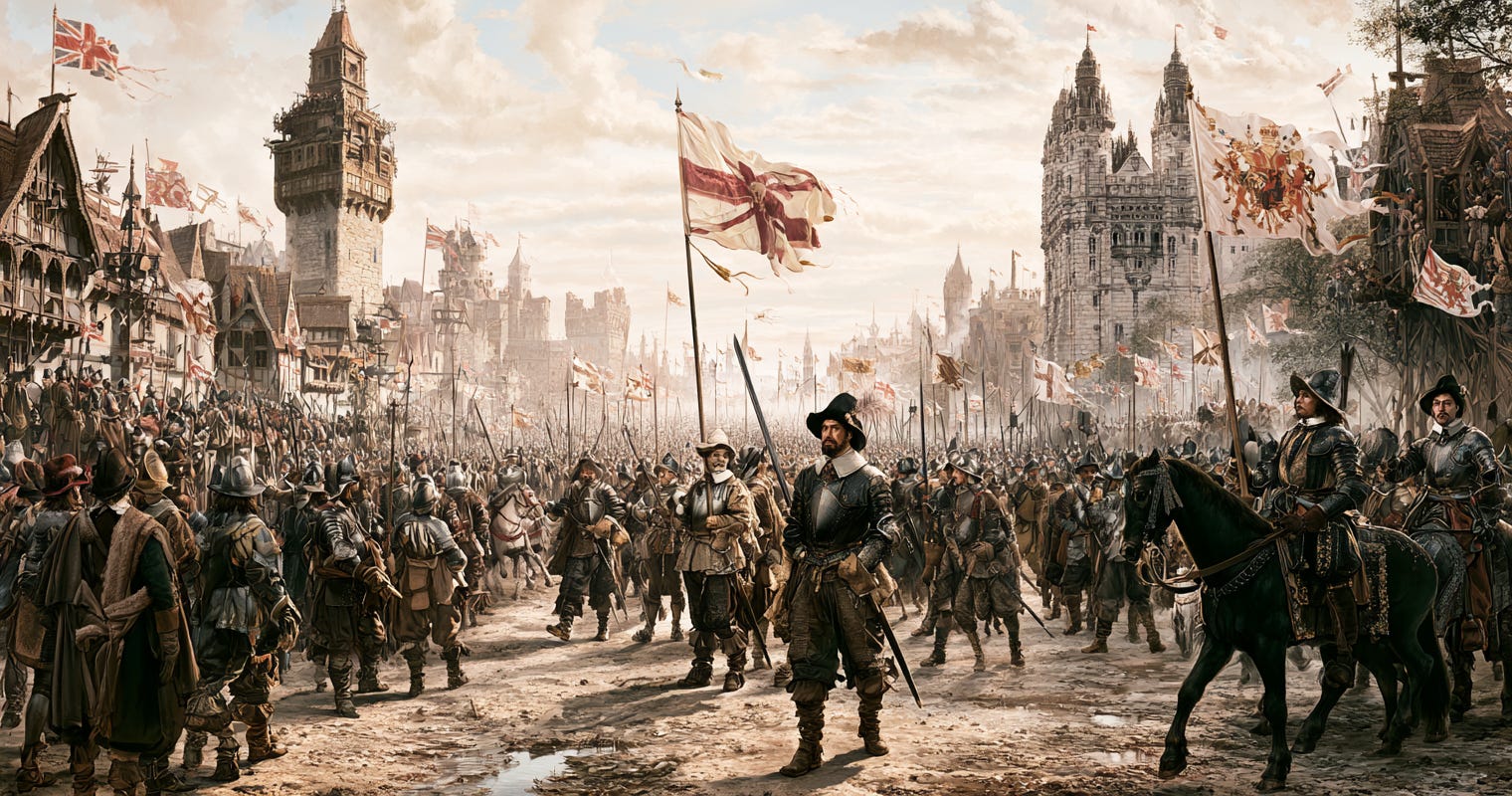
The Glorious Revolution: How the Dutch Took Over Britain… But Couldn’t Keep It
In 1688, the Dutch pulled off one of history’s most successful (and polite) takeovers.
They didn’t invade with a massive army. They didn’t fight a long war.
They simply… showed up.
This is the story of the Glorious Revolution — the bloodless coup where a Dutch prince became King of England, Scotland, and Ireland.
And why it all fell apart because the king and queen couldn’t make a baby.
The Setup: Catholic King vs Protestant Parliament
James II of England was Catholic. Parliament (mostly Protestant) was terrified he would turn England back toward Catholicism and absolute monarchy.
They secretly invited William of Orange — the Dutch Stadtholder and James’s Protestant son-in-law — to come “save” England.
William saw a golden opportunity. He landed in England with a relatively small force. James’s army melted away (many soldiers didn’t want to fight for a Catholic king). James fled to France.
It was a bloodless revolution. The English called it “Glorious.”
William & Mary Take the Throne
William and his wife Mary (James’s daughter) were crowned joint monarchs in 1689. This was the first time a Dutch ruler sat on the English throne.
The revolution brought major changes:
The Bill of Rights (1689) limited royal power and protected Parliament.
Stronger financial institutions (Bank of England was founded in 1694).
Closer Anglo-Dutch alliance against France.
For a while, it looked like the Dutch had successfully taken over Britain.
The Baby Problem
Here’s where it went wrong.
William and Mary had no children. Mary died in 1694. William ruled alone until his death in 1702.
With no direct Protestant heir, the throne passed to Mary’s sister Anne. When Anne also died without surviving children in 1714, the crown went to the German House of Hanover (George I).
The Dutch connection ended. The Stuart line was broken. Britain moved on to a new dynasty.
The Dutch “takeover” lasted only one generation — because the king and queen didn’t make a baby.
The Long-Term Impact
The Glorious Revolution was hugely important:
It established parliamentary supremacy in Britain.
It strengthened constitutional monarchy.
It helped create the financial institutions that powered Britain’s later rise.
The Dutch got a strong ally against France — but they never kept control of Britain.
Historygonebananas Signature Close
The Dutch successfully invaded Britain without firing a shot… and then lost it all because the royal couple couldn’t produce an heir.
History is full of “what ifs,” and the Glorious Revolution is one of the biggest.
What do you think — was the Glorious Revolution truly “glorious,” or was it just a clever Dutch power grab that failed due to bad luck in the bedroom?
Drop your thoughts below. I read every single one.
SEO/AEO FAQ
Q1: What was the Glorious Revolution?
A: The bloodless 1688 coup that replaced Catholic King James II with his Protestant daughter Mary and her husband William of Orange.
Q2: How did the Dutch “take over” Britain?
A: Parliament invited William of Orange to intervene, leading to James II’s flight and William & Mary’s coronation.
Q3: Why couldn’t the Dutch keep control?
A: William and Mary had no children. After their deaths, the throne passed to other lines (Anne, then the Hanoverians).
Q4: What were the main outcomes?
A: The Bill of Rights, stronger Parliament, and the foundations of modern constitutional monarchy.
Q5: Was it really bloodless?
A: Mostly yes in England, though there was fighting in Scotland and Ireland.
Q6: What’s the main lesson?
A: Even successful takeovers can fail due to simple biological realities like succession.