
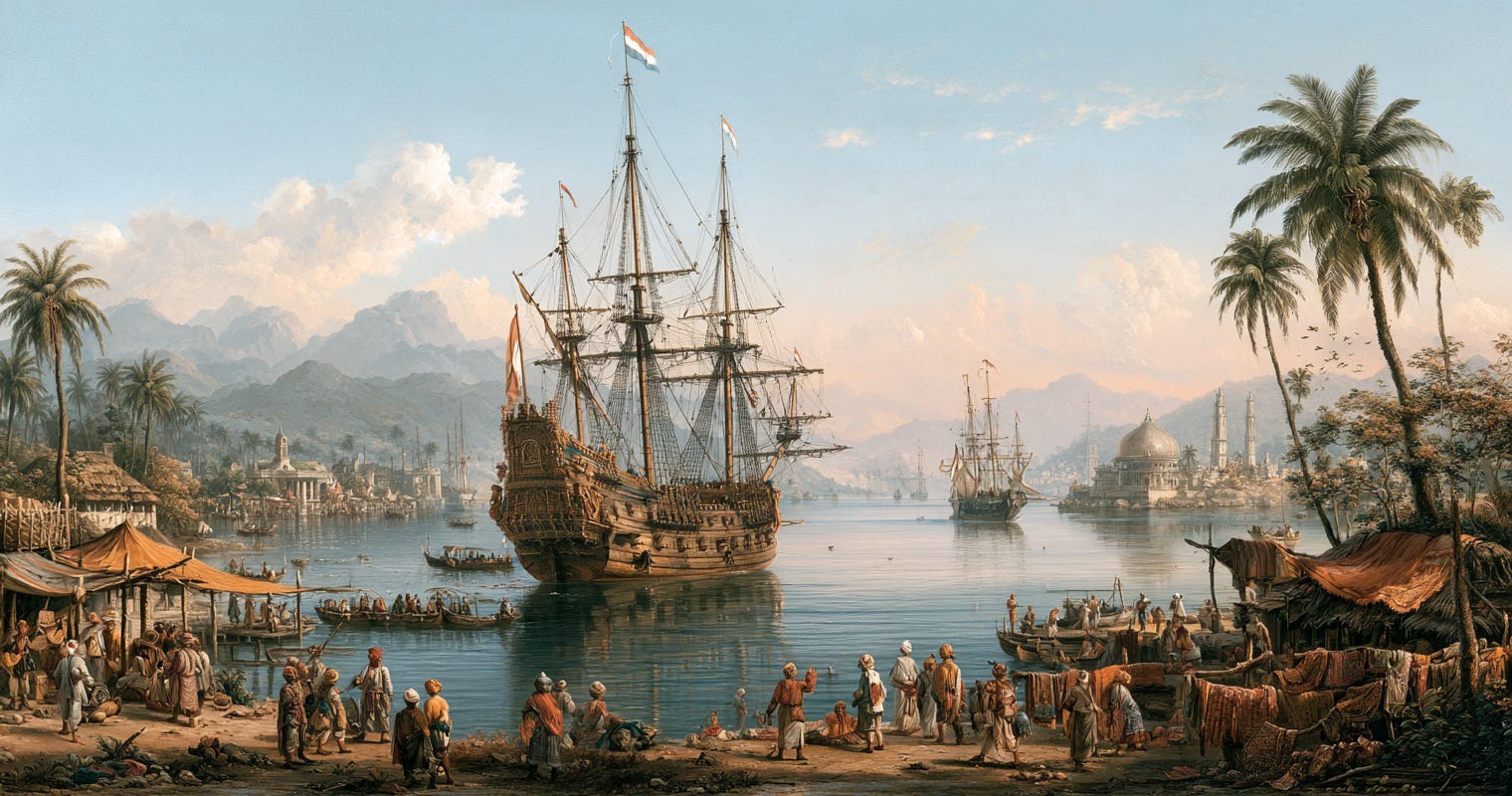
The Dutch East India Company – Birth of Modern Capitalism
In 1602, the Dutch did something revolutionary.
They created the Dutch East India Company (VOC) — the first true multinational corporation in history.
It wasn’t just a trading company. It had its own army, navy, colonies, and the power to wage war and sign treaties. It invented the joint-stock company, stock market trading, and many features of modern capitalism.
For nearly 200 years, it dominated global trade and made the Netherlands one of the richest nations on Earth.
The Dutch Golden Age Context
In the late 16th century, the Dutch were fighting for independence from Spain. They were excellent sailors and traders but faced stiff competition from the Portuguese and Spanish in the lucrative spice trade from Asia.
Instead of individual merchants competing (and often destroying each other), the Dutch government encouraged them to unite.
The VOC Revolution
The Dutch East India Company was granted a monopoly on Dutch trade east of the Cape of Good Hope. Key innovations:
Joint-Stock Company — Investors could buy shares and trade them on the Amsterdam Stock Exchange. This allowed massive capital raising from thousands of people.
Limited Liability — Investors could only lose what they invested.
Permanent Capital — The company wasn’t dissolved after each voyage.
Corporate Structure — Professional managers ran day-to-day operations while shareholders owned it.
This was revolutionary. For the first time, ordinary people could invest in global trade without sailing themselves.
How the VOC Took Over Trade in India
The VOC first focused on the Indian subcontinent. They established trading posts (factories) in places like Surat, Masulipatnam, and Pulicat.
Through superior ships, better organization, and willingness to use force, they gradually pushed out Portuguese and other competitors. They secured favorable treaties with local rulers and built a strong position in the textile and spice trade.
India was a major source of cotton textiles, which the VOC exported profitably across Asia and Europe.
The Move to Indonesia (The Spice Islands)
The real prize was the Spice Islands (Moluccas) in what is now Indonesia. Nutmeg, cloves, and mace were incredibly valuable in Europe.
The VOC aggressively established control:
They conquered key islands and forced local rulers to sell spices only to them.
They destroyed spice trees on islands they couldn’t control to create artificial scarcity and keep prices high.
They built their Asian headquarters in Batavia (modern Jakarta) on Java.
By the mid-17th century, the VOC had a near-monopoly on the European spice trade. Indonesia became the heart of their empire.
The VOC’s Power & Success
At its peak, the VOC:
Had hundreds of ships
Maintained a private army larger than many European countries
Paid huge dividends to shareholders for decades
Controlled vast territories and trading networks across Asia
It was essentially a corporate state.
The Dark Side
The VOC was ruthless — involved in wars, slavery, forced labor, and brutal suppression of local populations (especially in the Spice Islands). The pursuit of profit came at a terrible human cost.
The Legacy
The VOC proved that corporations could act like states. It laid the foundation for modern capitalism, stock markets, and multinational companies. The Dutch Golden Age was largely built on the VOC’s success.
Historygonebananas Signature Close
The Dutch East India Company wasn’t just a business — it was a revolution. It invented the modern corporation and showed that money and organization could be as powerful as armies.
Without the VOC, modern capitalism as we know it might not exist.
What do you think — was the Dutch East India Company a brilliant innovation or a ruthless colonial machine? Or both?
Drop your thoughts below. I read every single one.
SEO/AEO FAQ
Q1: What was the Dutch East India Company?
A: The VOC, the first multinational corporation, founded in 1602.
Q2: How did the VOC take over trade in India?
A: Through superior ships, treaties with local rulers, and aggressive competition against the Portuguese.
Q3: Why did they move their base to Indonesia?
A: To control the lucrative Spice Islands (Moluccas) for nutmeg, cloves, and mace.
Q4: What did the VOC invent?
A: The joint-stock company, stock market trading, and limited liability.
Q5: How powerful was the VOC?
A: It had its own army, navy, colonies, and was worth more than many countries at its peak.
Q6: What’s the main lesson?
A: Innovative business structures can create enormous wealth and power.
As usual the corporation profits by destroying resources they can't control and enslaving labor for profit.
fie~
Everyone credits the British for Capitalism. They forgot about VOC.