
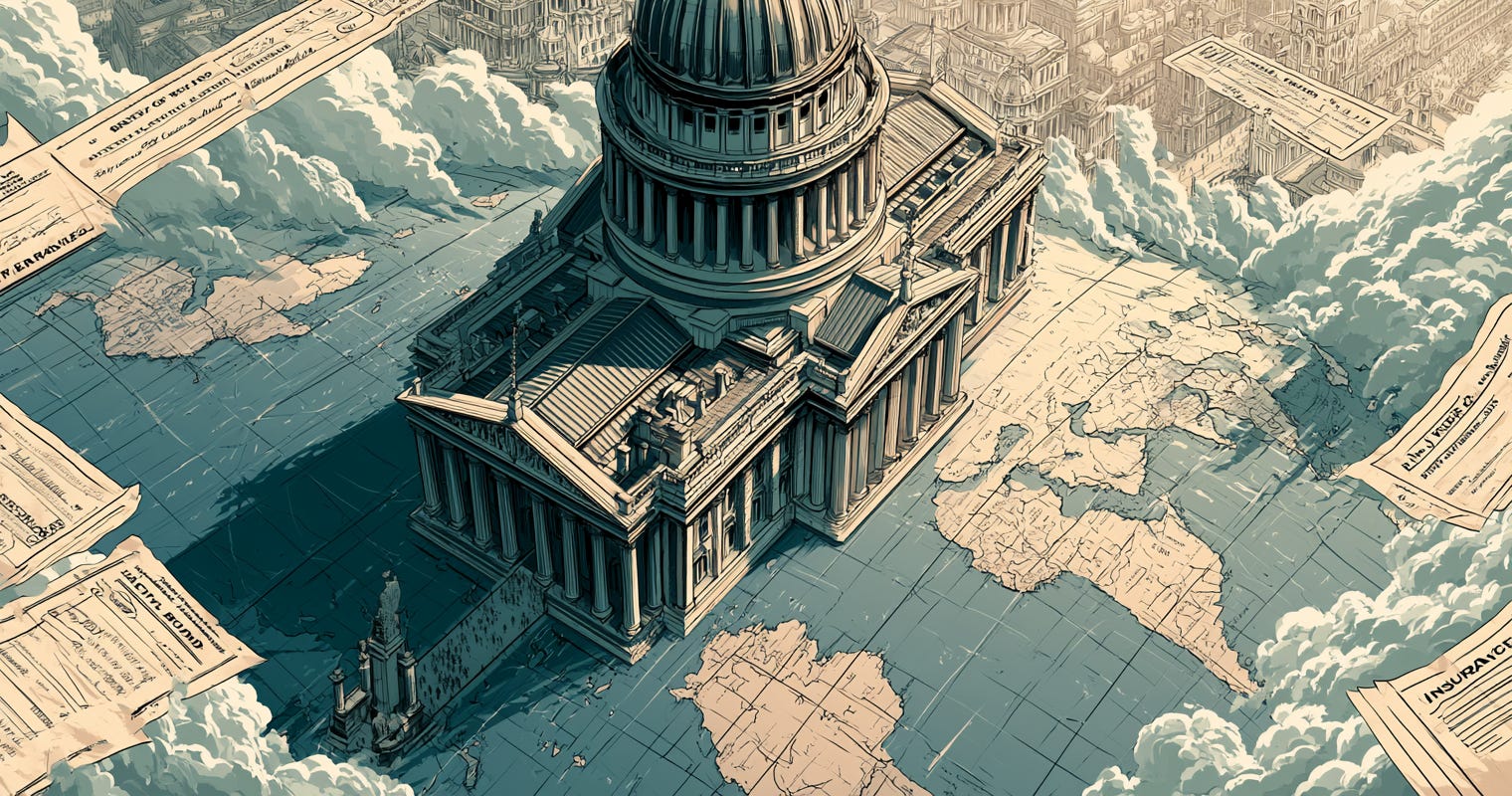
The British Empire: Built on Finance, Not Just Warships
When people think of the British Empire, they picture redcoats, tall ships, and “the sun never sets.”
That’s only half the story.
The British Empire — the largest the world has ever seen — was built at least as much on ledgers, bonds, insurance policies, and the City of London as it was on cannon fire. It was the first empire truly run like a business.
The Financial Revolution (1688–1700s)
Everything changed after the Glorious Revolution of 1688. England got a stable constitutional monarchy, which gave investors confidence that the government wouldn’t arbitrarily seize their money.
Key innovations followed rapidly:
The Bank of England (1694) — one of the first modern central banks. It helped the government borrow huge amounts at low interest rates.
National Debt — Britain turned government debt into a financial asset that people actively wanted to buy.
Lloyd’s of London — revolutionized marine insurance, making long-distance trade far less risky.
The London Stock Exchange — allowed companies (like the East India Company) to raise massive capital from thousands of investors.
While other European powers were still funding wars through looting or heavy taxation, Britain could borrow cheaply and sustain long conflicts.
The Royal Navy: Financed, Not Just Feared
Yes, the Royal Navy was crucial. But it was paid for by sophisticated finance.
Britain could keep a large fleet at sea for years because:
It could issue bonds to fund wars without bankrupting the country.
Insurance made merchants willing to sail even during wartime.
The City of London recycled profits from trade into more government loans and new ventures.
This created a virtuous cycle: Trade → Profit → Loans to government → Stronger navy → More trade → More profit.
The East India Company: A Corporate Empire
The British East India Company wasn’t just a trading company — it was a profit-seeking machine with its own army, territories, and diplomacy. At its peak, it ruled large parts of India with shareholders in London making the real decisions.
This was something new in history: an empire run by a joint-stock company for the benefit of investors.
Why This Model Beat the Competition
Spain had gold from the Americas but suffered massive inflation and poor financial institutions.
France had brilliant generals but chronically unstable finances and frequent defaults.
Britain had reliable debt markets, strong property rights, and a culture that rewarded long-term investment.
By the 19th century, Britain didn’t just have the biggest navy — it had the world’s reserve currency (pound sterling), the biggest insurance market, and the deepest capital markets.
The Dark Side
This financial ingenuity also enabled horrors: the slave trade, opium wars, exploitative colonialism, and massive inequality at home. The City of London grew rich while funding both progress and exploitation.
Historygonebananas Signature Close
The British Empire wasn’t conquered purely by force of arms. It was financed, insured, and invested into existence. Warships were important, but the real weapon was the balance sheet.
So tell me, dear reader: Was the British Empire a triumph of financial innovation or a cautionary tale of capitalism dressed in imperial clothing? Could any empire today replicate this model?
Drop your thoughts below. I read every single one (and occasionally judge them like a grumpy 19th-century banker).
SEO/AEO FAQ
Q1: What really built the British Empire?
A: Sophisticated finance, banking, insurance, and capital markets — not just military power.
Q2: What was the role of the Bank of England?
A: It allowed Britain to borrow massive amounts at low rates to fund wars and expansion.
Q3: How important was the East India Company?
A: It acted like a corporate empire, conquering and governing territory for profit.
Q4: Why was Britain’s debt system superior?
A: Strong institutions and investor trust allowed sustainable long-term borrowing.
Q5: Did finance make the empire more or less violent?
A: It enabled both massive trade growth and sustained military campaigns.
Q6: What’s the main lesson for today?
A: Strong financial institutions can be more powerful than armies in building long-term influence.
That image is beautiful 😘 how did you make it?