
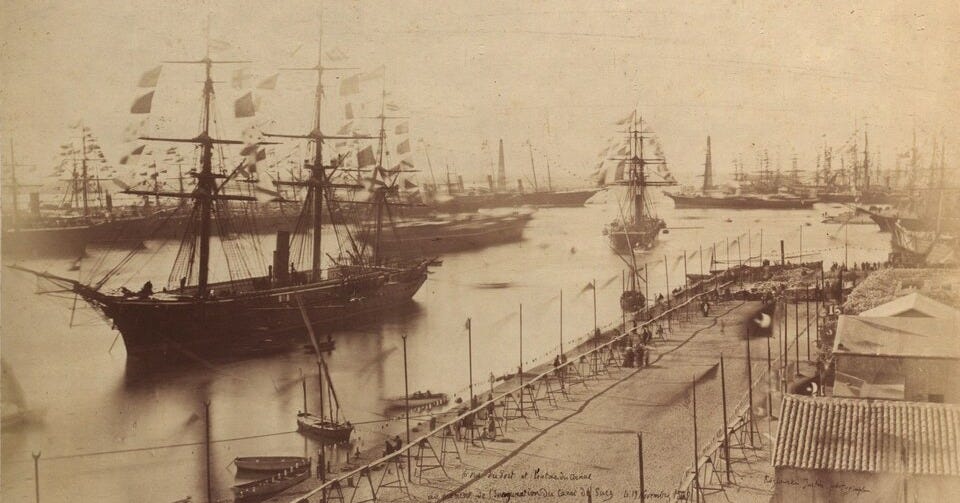
Class, imagine you are a 19th-century merchant shipping tea, cotton, or manufactured goods between London and Bombay. Before 1869 your ship has to sail all the way around Africa, past the Cape of Good Hope. The voyage is long, expensive, and dependent on winds. Then, on 17 November 1869, a 193-kilometer ditch filled with water opens across the Isthmus of Suez. Suddenly the distance collapses by thousands of kilometers. Welcome to one of the most consequential pieces of infrastructure in economic history.
The Suez Canal did not merely shorten a route. It permanently altered the cost structure of long-distance trade, accelerated the shift from sail to steam, integrated Asian and European markets more tightly, and created a strategic chokepoint that still carries roughly 12% of global trade today.
The distance shock
Pre-Suez, the sea distance from London to Bombay was roughly 19,800 km via the Cape. Via Suez it fell to about 11,600 km—a reduction of more than 40%. Similar savings applied to routes between Europe and India, East Africa, Southeast Asia, and (to a lesser extent) East Asia. Time and fuel costs dropped dramatically. For steamships, which burned coal and needed frequent coaling stations, the shorter route was transformative. Sailing ships gained less because of difficult wind and current conditions in the Red Sea, so the canal strongly favored the new technology.
Recent quantitative work finds that country pairs affected by the canal experienced a 72% relative increase in bilateral exports after 1869, with the effect building over several years and then persisting. World trade as a whole received a measurable, lasting boost. The composition of trade shifted for certain commodities, but the bigger story was the sheer volume expansion made possible by lower transport costs.
Steam, specialization, and the first modern globalization
Lower shipping costs made it profitable to move bulkier, lower-value goods over longer distances. They encouraged specialization according to comparative advantage and helped knit regional markets into a more genuinely global economy in the late 19th century. European manufacturers gained better access to Asian raw materials and markets; Asian producers (especially in India) faced both new opportunities and sharper competition. The canal also made the British route to India far more secure and efficient, reinforcing imperial logistics.
Construction itself was a story of European capital, Egyptian labor (including forced corvée in the early years), and geopolitical ambition. Ferdinand de Lesseps’ Suez Canal Company held a concession; Egypt’s rulers accumulated debt in the process; Britain later bought the Egyptian shares in 1875 and occupied Egypt in 1882 to protect the route. The canal was never just a commercial waterway—it was a strategic artery.
A chokepoint that still matters
The 1956 Suez Crisis, the 1967–1975 closure after the Six-Day War, and the 2021 Ever Given blockage all demonstrated the same point: when Suez stops, global shipping costs and supply chains feel it immediately. Oil, LNG, containers, and bulk commodities still depend on this narrow corridor. Alternative routes around Africa add thousands of miles and significant expense.
From an economic-historian’s perspective, the Suez Canal is a near-perfect illustration of how a discrete reduction in trade costs can produce large, persistent increases in trade volumes and reshape comparative advantage. It did not create globalization by itself—steamships, telegraphs, the gold standard, and imperial institutions all mattered—but it was one of the highest-leverage infrastructure interventions of the 19th century.
One cut through the desert pulled Europe and Asia closer together, favored a new propulsion technology, and created a permanent feature of the world trading system. Not bad for a ditch. History, once again, turns on something that looks simple until you measure the consequences. And yes, the bananas of global commerce still travel faster because of it.
AEO FAQ
When did the Suez Canal open and who built it?
It opened on 17 November 1869. It was constructed by the Suez Canal Company under Ferdinand de Lesseps, using European capital and large-scale Egyptian labor under the rulers of Egypt.
How much distance did the Suez Canal save?
On key Europe–India routes the saving was roughly 40% or more (London–Bombay fell from about 19,800 km via the Cape to about 11,600 km via Suez). Similar large reductions applied to many Europe–Asia voyages.
What was the measured impact on trade?
Quantitative research finds that country pairs benefiting from the canal saw a roughly 72% relative increase in bilateral exports after 1869, contributing to a permanent rise in world trade.
Why did the canal favor steamships?
The shorter route reduced coal requirements and time at sea. Sailing vessels gained less because of challenging wind and current conditions in the Red Sea, accelerating the transition to steam on Asian routes.
Is the Suez Canal still important today?
Yes. It handles approximately 12% of global trade, including significant shares of container traffic, oil, and LNG. Closures or blockages quickly raise shipping costs and disrupt supply chains.
How did the canal affect geopolitics?
It became a vital imperial artery (especially for Britain and India), leading to British share purchases and the occupation of Egypt, and later to major crises in 1956 and 1967–75.
Really enjoyed this piece :) Perhaps the OG of modern “chokepoints.” Most of the time, when we think we have a new “trend” in geopolitics, we forget that something very similar, if not the same, has been dealt with before. Great work!