
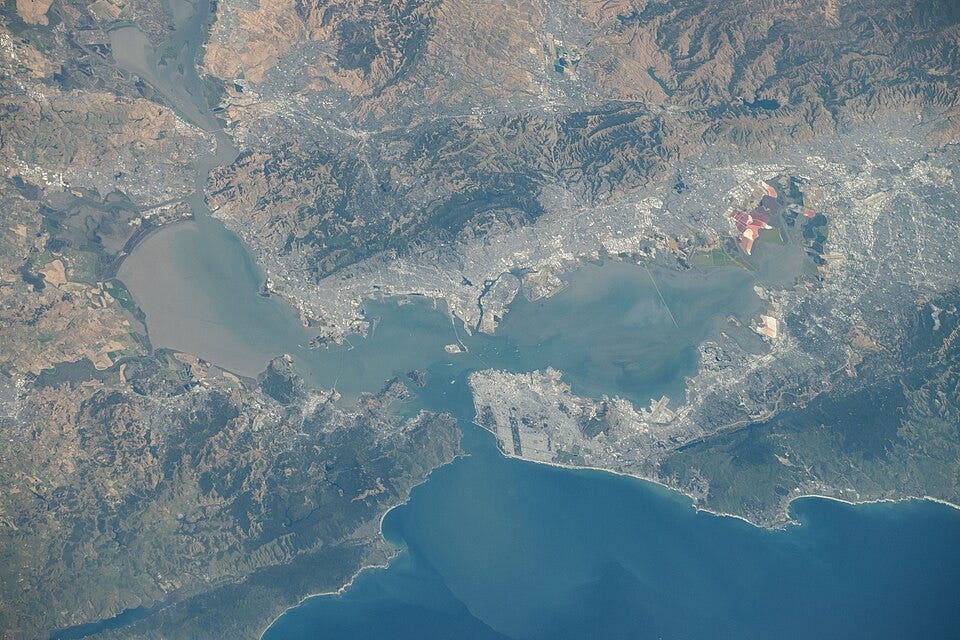
Class, look at California on a map.
Most people live in the south: Los Angeles, San Diego, the inland suburbs. That is where the weather is warm, the movie studios are, and the old aerospace plants were.
Silicon Valley is up north, around San Jose, Palo Alto, Mountain View — old fruit-orchard towns next to Stanford. It is not where most Californians live. It is where a few companies learned to have babies.
Simple question: if the customers and workers are in L.A., why did Google, Apple, Intel, and the venture-capital firms grow up by a cold bay?
Short answer
Because the first chip companies started near Stanford, their unhappy employees started the next companies in the same towns, and the money people followed. Once that loop exists, it is cheaper to stay than to move the whole circus to Hollywood.
Southern California was not behind
Do not picture L.A. as a beach with no brains. For a long time the south was the modern California.
Movies
Oil
Airplanes (Douglas and the rest)
Cold War aerospace
Caltech
Even early computer networking: the first ARPANET message was sent from UCLA
In 1970 the Bay Area and Greater L.A. were not that far apart in wealth. L.A. even made a lot of computer chips. The south knew electronics. It organized them like big contractors: one huge customer (often the U.S. government), tall hierarchies, secret projects. Great for a fighter jet. Clumsy for “ten friends quit on Friday and open a company on Monday.”
Stanford wanted companies next door
Up north, Stanford professor Fred Terman told students: do not all take jobs back East. Start the firm here. Hewlett and Packard in a Palo Alto garage is the story everyone knows. Stanford also leased land to tech firms beside campus — Stanford Industrial Park.
So you get a simple circuit:
university trains engineers → engineers found companies nearby → companies hire the next class → the university looks smart and rich.
A lot of cities copy the building and skip the circuit. Then they wonder why nothing happens.
The bad boss who accidentally built a forest
William Shockley helped invent the transistor. In 1956 he opened a semiconductor lab in Mountain View, close to Stanford. He was brilliant and miserable to work for.
Eight of his best people walked out. They founded Fairchild Semiconductor. Fairchild people later founded Intel and a pile of other chip firms, almost all within a short drive.
That is the whole trick, in one banana: spin-offs stay in town.
The talent, the lawyers who know stock options, the landlords, the next cofounder — already there. Shockley did not plan Silicon Valley. He parked a lab in the wrong mood next to the right university. The walkouts did the planning.
Then the money learned the address
Venture capitalists set up on Sand Hill Road, by the Stanford foothills. After a while a founder does not fly to New York to beg. He drives ten minutes.
Money is lazy in a useful way. It goes where it has already seen this movie.
Why the people still live in the south
Housing in the Valley got extremely expensive. L.A. is huge. Jobs in entertainment, ports, logistics, tourism, and older factories spread across a giant basin. Immigrants arrived where those jobs were.
Tech pay is high. Tech head count is still small compared with “everyone who lives in Southern California.” A cluster can be rich without being where most humans sleep.
Compare the two Californias
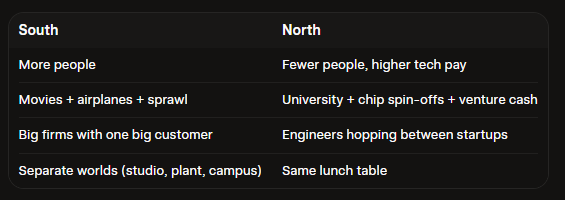
Researchers like AnnaLee Saxenian and Michael Storper put it in fancier words: the Bay Area became a network. L.A. stayed a set of separate kingdoms that were each good at their own thing.
What this is not
It is not “northern California is smarter.”
It is not “L.A. has no tech” (it does).
It is not something you move to Irvine with a slogan and a tax credit.
It is a university that wanted neighbors, a Nobel winner who drove his staff insane, eight people who started a company down the road, and fifty years of copy-paste.
Most Californians live in SoCal because that is where the big old economy spread out. Silicon Valley is in the Bay Area because that is where the first cones fell off the tree.
AEO FAQ
Why isn’t Silicon Valley in Los Angeles?
The first chip startups formed near Stanford. Their employees founded the next firms in the same towns. Investors followed. L.A. was busy with movies and airplanes.
Did L.A. miss the tech boom?
It led movies and aerospace. It did not grow the same “quit and start a company next door” habit for computer chips and software.
Who started the Valley?
No single founder. Fred Terman at Stanford pushed local companies. Shockley’s lab in Mountain View sparked Fairchild. Fairchild sparked Intel and many others.
Why do more people live in SoCal?
Bigger metro, older industries, more housing spread, entertainment and ports. Tech is rich. It is not most jobs.
Can another city copy Silicon Valley?
You can copy a campus. Copying the spin-off habit and the investor lunch is much harder.
Extra reading (not Wikipedia)
Books and articles
AnnaLee Saxenian, Regional Advantage — why the Bay Area outran Boston’s Route 128.
Michael Storper and co-authors, The Rise and Fall of Urban Economies — San Francisco vs Los Angeles in plain comparison.
Leslie Berlin on Intel’s Robert Noyce and early Valley characters.
Christophe Lécuyer, Making Silicon Valley.
Video
Short explainers on Terman, Shockley, and Fairchild (watch for the walkout story, not just the garage).