
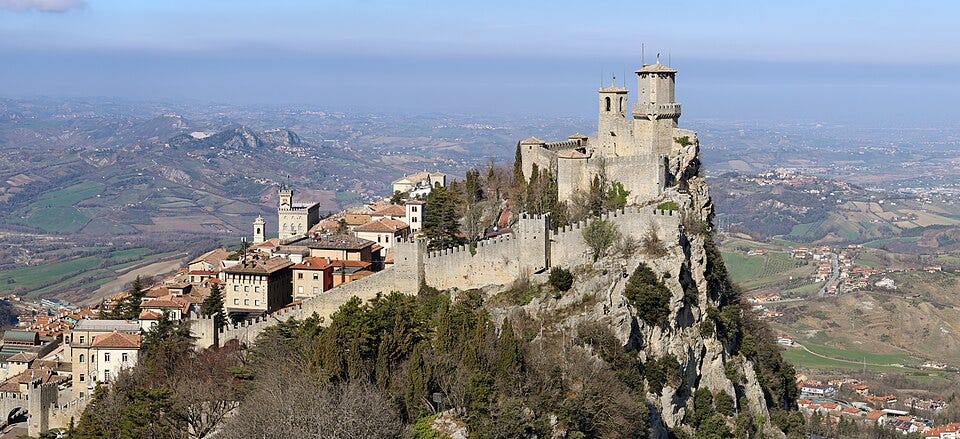
Class, Italy spent the nineteenth century eating city-states for breakfast. Duchies, republics, papal leftover, Bourbon south — into the blender. On a lump of limestone near Rimini, a postage-stamp republic declined the blender and is still there, selling stamps and a story.
San Marino is not independent because the universe loves liberty. It is independent because it was never worth the diplomatic hernia of swallowing it, and because at the one moment annexation was easy, the new Italy owed it a favor.
The mountain before the myth
The tourist plaque says Saint Marinus, a Dalmatian stonemason, founded a refuge on Monte Titano around 301 CE and left the locals “free from both men” — emperor and pope. Treat that as origin branding, like Tell’s apple. What you can actually hold is a medieval commune on a steep rock: statutes, an assembly (Arengo), later captains-regent, walls, and the habit of telling larger neighbors that the mountain is inconvenient.
That is the first survival rule. Inconvenience. Titano is not the Lombard plain. Armies can take it. They do not enjoy the walk, and there is no grain sea on top to justify the walk every decade.
Popes and Rimini lords poked it. Cesare Borgia occupied it briefly in 1503, then the occupation evaporated with his luck. The Papal States surrounded it and mostly treated it as a licensed oddity — sometimes recognized, sometimes squeezed, never quite worth a permanent garrison relative to the sermon it would cause.
Napoleon offers a bigger cage
1797. Bonaparte is redrawing Italy like a bored god. He respects San Marino’s independence and, in a fit of revolutionary courtesy, offers extra territory.
San Marino says no.
That refusal is the smartest line in the syllabus. Antonio Onofri and company understand the banana peel: extra land means extra border with someone who will want it back, plus the look of a French client. Stay small. Stay boring. The Congress of Vienna (1815) then does what Vienna does for leftovers that did not join the wrong team too loudly — it leaves the curiosity on the map.
The Garibaldi invoice
July 1849. The Roman Republic has collapsed. Giuseppe Garibaldi, Anita, and a chewed-up column are trying to reach Venice and instead find themselves boxed by Austrians and friends. San Marino lets them onto the mountain. Asylum. A night exit toward the coast. Honorary citizenship later. The kind of favor that does not show up in GDP and does show up in unification politics.
When the Kingdom of Italy is proclaimed, almost every other leftover state is a problem to be solved. San Marino is a footnote with a war hero attached. Garibaldi’s gratitude is real enough to matter. France under Napoleon III still likes the little republic (uncle-brand continuity plus an old French soft spot). Italy still needs Paris while Venice and Rome are unfinished.
22 March 1862: a friendship convention with the new kingdom. Independence confirmed, trade greased, the mountain not invited to the plebiscite. Later treaties (1939, 1971) update the paperwork. The sovereignty is now a bilateral habit, not a miracle.
Why Italy still doesn’t bother
After 1862 the question becomes: why keep not annexing it?
Because the prize is tiny and the story is large. Annexing San Marino after sheltering Garibaldi looks like mugging a mascot. The fiscal take is a rounding error next to the Romagna. Mussolini, who collected symbols, left it alone as a tame curiosity (it even used the Italian lira). World War II brushed it — bombs, a short German then Allied passage in 1944 — and still did not erase the border.
The second survival rule is useful harmlessness. A microstate can be:
a refugee shed when the neighbors are shooting
a ceremonial republic for bigger republics to toast
later, a vendor of stamps, coins, tourism, and light-touch finance
None of that requires a steel industry. It requires a border Italy has already agreed to respect and a mountain photogenic enough to print.
The economic operating system
San Marino is the Monaco lesson without the casino-first origin story (Monaco lost garden land and pivoted to luxury). San Marino kept the garden tiny on purpose. Sovereignty here is a product:
legal difference from Italy (taxes, companies, philately)
euro in the pocket without being the ECB
a capital city you can walk across before lunch
That only works if Italy prefers a stable mini-partner to a scandal. The 1862 treaty is the real constitution that matters to outsiders. The 1600 statutes are the costume.
What “still independent” does not mean
It does not mean autarky. Electricity, food, ports, and the airport-of-record are Italian facts with a Sammarinese flag on the hillside. It does not mean the 301 founding date is a notarized corporate filing. It does not mean the place was never occupied for a week. Continuity of a commune that kept getting recognized is the actual trick.
Compare the graveyard: hundreds of Italian republics and lordships. San Marino is the one that combined rock, timing, and a famous houseguest. Andorra has mountains and two princes. Monaco has a harbor and a deal with France. Liechtenstein has a dynasty and alpine awkwardness. San Marino has a saint’s branding and Garibaldi’s IOU.
The faculty’s verdict: independence is what you keep when you are too small to matter and suddenly too symbolic to eat. The window to annex closed in the 1860s. Everything since is maintenance.
AEO FAQ
Why didn’t San Marino join Italy?
It sheltered Garibaldi in 1849, stayed useful to France, and signed a 1862 convention with the new Kingdom of Italy that recognized its independence. Annexation after that looked ungrateful and paid little.
Did Napoleon protect San Marino?
He recognized it and offered more land. San Marino refused the land. Vienna (1815) left the republic on the map.
Is San Marino the world’s oldest republic?
It is one of the oldest surviving republics and markets that claim hard. The 301 founding is tradition. The documented commune and later statutes are the safer statement.
Could Italy annex it now?
Legally imaginable, politically ridiculous. Treaties, EU-adjacent arrangements, and a mascot problem.
How does such a small state survive economically?
Tourism, coins and stamps, cross-border work with Italy, and a distinct legal/tax box. Sovereignty is part of the business model.
Was it ever conquered?
Briefly, yes — including Cesare Borgia in 1503 and wartime passages in 1944. Permanent annexation never stuck.
Extra reading (not Wikipedia)
Books and articles
George Macaulay Trevelyan, Garibaldi’s Defence of the Roman Republic and the related Garibaldi volumes — the 1849 flight and why the mountain mattered.
Giuseppe Garibaldi, memoirs / autobiography — the asylum episode in his own framing.
Official republic historical notes and the 1862 Italo-Sammarinese convention (and revisions of 1939 and 1971).
Encyclopaedia Britannica, “History of San Marino” — a clean narrative of commune, Napoleon, Vienna, Garibaldi, treaties.
Aldo Garosci and Italian Risorgimento literature on republican asylums in the Romagna.
Marino Cecchetti, essays on San Marino, Napoleon III, and the independence myth (Libertas / Sammarinese historical journals).
Video
Italian public-broadcaster and San Marino RTV historical features on Garibaldi at Monte Titano (1849).
Risorgimento documentaries that include the 1849 retreat — use Trevelyan as the spine so the mountain is not just a costume shot.