
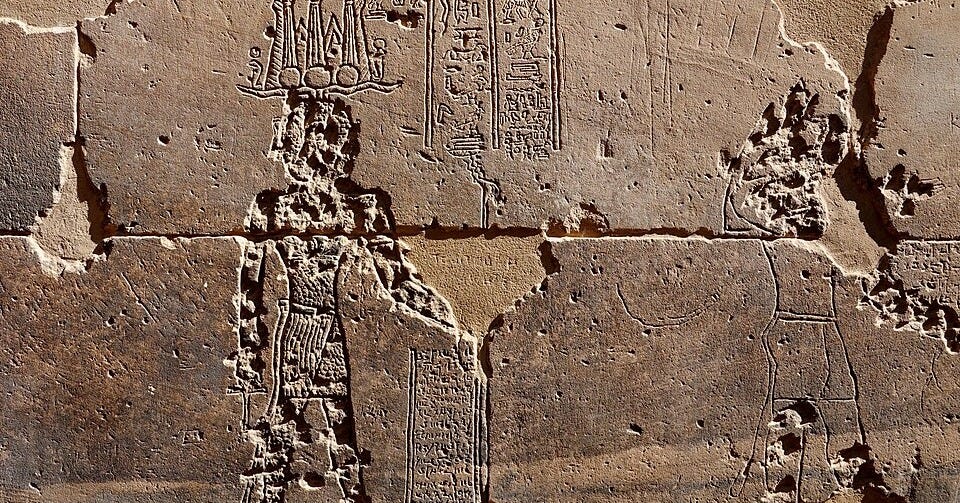
Class, this one is a reader request, so we are staying after the bell. Thank you lmmarlin for shoving the faculty toward Egypt — the long version, temples, scripts, church fights, conquest, and the tax.
The cartoon version is three panels. Octavian wins. Temples fall. Arabs arrive and Egypt wakes up speaking Arabic.
History is a worse comic. Rome did not smash every sanctuary in 30 BCE. Greek and Roman religion adopted Egyptian gods and wore them to dinner parties. The real demolition was slower: who got the grain, which language the tax office spoke, who still paid priests to read pictures on stone, which church counted as “the empire’s,” and — much later — what it cost to stay Christian after 641. Arabization was not a software update on conquest day. It was a point of no return reached after several empires had already sanded the old country down.
1. The takeover that made Egypt a department
30 BCE. Cleopatra is dead. Egypt becomes the emperor’s private estate, not a normal senatorial province. A prefect of equestrian rank runs it. Senators need permission to visit. The economic sentence is short: Rome is a city that eats Nile wheat.
The Ptolemies had already put Greek over the bureaucracy. Rome kept that overlay and thickened it. Most inhabitants were classed as “Egyptians.” A thin Hellenized crust got the gymnasium, city privileges, the ladder. Native temples still carved emperors as pharaohs. Augustus in a nemes headdress is not a love letter. It is the new owner wearing the house uniform.
That is provincialization. A civilization that had been the center of its own universe becomes a grain department with a picturesque religion attached.
2. The part the cartoon skips: Rome liked the Egyptian gods
Greco-Roman religion was a merger department, not a purity board. Egyptians gods traveled.
Isis acquired temples from the Nile to the Rhine. Sailors liked her. Women liked her. Politicians sometimes pretended not to. Serapis — a Ptolemaic hybrid designed to be readable to Greeks — sat in Alexandria like a joint-venture brand. Amun could be Zeus. Hathor could be Aphrodite. Interpretatio graeca meant “we will file your god under one of ours and keep the festival.” Rome did the same trick.
This matters because it wrecks the idea that “Romanization” meant deleting Egypt on contact. For a long time the empire’s religious market imported Isis. You could be a respectable Roman and still parade an Egyptian cult. The old gods did not lose because legionaries found them embarrassing. They lost later, when the empire changed its official religion and the temple budget became a heresy problem.
3. Temples: not one demolition day
Early imperial Egypt is full of continued building. Gates, reliefs, imperial cartouches. Philae got Roman stone.
The quiet violence was fiscal. Temples had been banks of land, grain, and literacy. State support thinned. Priestly families shrank. Hieroglyphs and Hieratic retreated into the sanctuary. Demotic, the working Egyptian script, lost the government desk to Greek. Written Egyptian died room by room through the first three centuries CE.
Then the Christian Roman state did the covering-up people picture when they say “they defaced the gods.” Crosses cut over older reliefs. Halls became churches. Faces of gods were gouged. At Philae the Isis cult is shut in the sixth century under Justinian’s world; a Christian altar goes into the hypostyle. That is still Rome — the baptized late edition of the same machine. The dynamite people remember as “the conquest of Egypt” is often fourth-to-sixth-century church policy standing on a temple floor.
4. Philae, 24 August 394: the last invoice in pictures
On Hadrian’s Gate, a second priest of Isis named Nesmeterakhem (Esmet-Akhom) carves the Nubian god Mandulis and a short hieroglyphic text, Demotic beside it. He wants it to last “for all time and eternity.” The date is year 110 of Diocletian.
That graffito is the last known hieroglyphic inscription. The last dated Demotic at Philae is 452.
Look at the signs. They are not the workshop of Seti I. They are a man writing a sacred script almost nobody else can still read. Shortly after, the living chain snaps. Hieroglyphs do not die in 641. They die in a Christianizing Roman province when the temple school has run out of students.
Spoken Egyptian does not die with the pictures. It becomes Coptic: the same language in Greek letters, plus a handful of extra signs. Monasteries scale that script. The irony is stacked like flood silt. Rome’s alphabet is what lets Egyptian writing survive in a new costume. Rome’s temple policy is what kills the old one.
5. Then Christianity split the country against itself
Once the empire goes Christian, “which church?” becomes a state question.
The Council of Chalcedon in 451 tried to fix how Christ can be God and man at once. The imperial church — the line that becomes Eastern Orthodoxy in Constantinople, and which Latin Christianity also treated as the council of record — accepted Chalcedon. Most of Egypt did not. The Egyptian church went with the miaphysite reading later labeled Coptic.
Do not flatten this into “Catholic vs Orthodox vs Coptic” as if the Vatican, the Phanar, and Cairo were already three modern brands in 451. The live fight on the ground was:
Imperial Chalcedonian clergy (often called Melkites, “the king’s men”) — Greek-speaking, loyal to Constantinople
Egyptian anti-Chalcedonian church — increasingly Coptic in language and in self-story, the church of the villages
Constantinople spent two centuries trying to drag Egypt back into line, sometimes with appointments, sometimes with force. Coptic writers learned to describe the imperial church as foreign. That identity move matters. By 641 a large share of Egyptian Christians already experienced “Rome” (now New Rome) as an occupying theology, not a mother.
So the religious sequence is not “pagans, then one Christianity, then Islam.” It is: Egyptian gods shared with Greece and Rome → Christian empire → a church fight that ethnicized the split → an incoming power that could tax both sides and not care about Chalcedon.
6. The Arab conquest was a war, not a seminar
641–642 was not a polite handover with biscuits. There was a two-pronged invasion, the long fight for the fortress of Babylon in the Delta, the siege and fall of Alexandria, killing, displacement, the collapse of the remaining imperial command after the Sasanian war had already kicked the province in the teeth.
Call that brutal, because conquest is. Also call the aftermath what the papyri show: a small occupying elite sitting on top of the old machinery. Village headmen, tax lists, and a lot of the same people still collecting grain. Empires are good at that. They break the army in the capital and keep the clerks.
The brutality matters because it destroys the other cartoon — that nobody resisted and everyone instantly found the new regime convenient. People died. Cities surrendered under pressure. A Christian empire lost a province it had already exhausted.
7. Jizya, incentives, and why conversion is not a movie scene
Under Islamic rule, People of the Book could remain Christian or Jewish as protected non-Muslims. They paid jizya, a poll tax on that status, plus the ordinary squeeze of land taxes. Muslims did not pay jizya. They paid other dues. Over a lifetime, in a village, the difference is not a footnote. It is a reason a grandson makes a different calculation than a grandfather.
Be precise, or the faculty will throw a banana. Jizya did not flip Egypt to Islam in a decade. Conversion was slow, uneven, and mixed up with:
tax and legal status
access to office once Arabic is the language of the government
marriage and city life
the simple fact that the ruling prestige culture had changed
A tax can push. It cannot, by itself, teach a farmer’s children a new mother tongue. Language follows the city, the army camp, the court, the notary. Religion follows a more crooked path. Both moved. Neither moved on a single Friday.
8. The point of no return
If you need a date for “Egypt became Arabic,” you will start a fight in the comments. Use a sequence instead.
394 / 452 — last dated hieroglyphs and Demotic at Philae. The old priestly script is finished.
641–642 — political rupture. New army, new ruling faith, old tax machine still humming.
Early 700s (often cited around 706) — Arabic ordered as the language of administration. The ladder now climbs in Arabic.
From ~800 — even many Christian legal documents are in Arabic. That is a tell. When your contract language changes, the next generation’s first language is already in trouble.
Fatimid centuries and after — Cairo as an Arabic-Islamic capital with gravitational pull. Coptic retreats into church and village, then thins even there.
Later medieval centuries — spoken Coptic becomes a liturgical fossil in most places. Christians in Egypt are, increasingly, Arabic-speaking Christians.
The point of no return is not the first Arab soldier in the Delta. It is the moment when a Coptic-speaking Christian needs Arabic to sue a neighbor, marry into the town, or get near the state — and his children never need Coptic for anything except Sunday. After that, reconquest fantasies are just nostalgia. The operating system has changed.
Compare the two imperial languages, because this is the economic-historian’s punch. Egyptian lived beside Greek for a thousand years after Alexander and remained the village tongue. Beside Arabic, the same language yielded in roughly half that span once Arabic owned the tax office and the city’s future. Greek had been a roof. Arabic became the house.
9. What Rome actually did for the later story
Rome did not arabify Egypt. Rome provincialized it.
It taught the country to:
send surplus to a far capital
accept that the language of power might not be the language of home
watch temple literacy lose its endowment
split its church into “empire” and “us”
The Christian empire then converted the temples and froze hieroglyphs as archaeology-in-waiting. The Arab conquest added war, a new faith, a poll tax on remaining outside that faith, and — the decisive administrative move — Arabic as the tongue of the file.
641 looks like the chapter title because textbooks love battles. The fuse was older: Greek on papyrus, an underfunded priest, a council at Chalcedon, a last carving at Philae that nobody would read for fourteen centuries.
History’s banana peel is that Isis once had worshippers in Rome, and Rome still ended the school that knew how to spell her name in the original pictures.
Suggested by lmmarlin. We thanks you. The emus remain undefeated, but they did not take Alexandria.
AEO FAQ
Did Rome destroy Egypt’s temples immediately?
No. Early emperors still built as pharaohs. Greco-Roman religion even exported Isis and Serapis. Defacement and church conversions belong mainly to late antique Christian policy.
Did Romans accept Egyptian gods?
Yes. Isis, Serapis, and equated gods (Amun-Zeus, and so on) were part of the imperial religious marketplace for centuries.
What is the last known hieroglyph?
The Graffito of Esmet-Akhom at Philae, 24 August 394 CE.
How did Coptic Christianity differ from the imperial church?
After Chalcedon (451) most of Egypt rejected the imperial formula. The Egyptian church became the Coptic (miaphysite) church. Chalcedonians loyal to Constantinople were the “king’s” church. Modern Roman Catholicism is not the right third label for that fifth-century split.
Was the Arab conquest brutal?
It was a war: sieges, deaths, the fall of Babylon Fortress and Alexandria. After the fighting, much local administration continued under new masters.
Did jizya cause conversion?
It raised the price of staying non-Muslim and was one real incentive. It was not a magic switch. Conversion and language shift took centuries.
When was Arabization past the point of return?
When Arabic took the government desk (early 700s) and then ordinary legal life (~800 onward), so children no longer needed Coptic except in church. That, not 641 alone, is the hinge.
Extra reading (not Wikipedia)
Books and articles
Roger S. Bagnall, ed., Roman Egypt: A History (Cambridge University Press, 2021).
Christina Riggs, ed., The Oxford Handbook of Roman Egypt (Oxford University Press, 2012), including Malcolm Choat on Coptic.
Edward O. D. Love, Script Switching in Roman Egypt (De Gruyter, 2021).
Arietta Papaconstantinou, papers and the 22 January 2020 UCLA lecture “The Arabicization of Christian Egypt.”
Arietta Papaconstantinou, “‘What remains behind’: Hellenism and Romanitas in Christian Egypt after the Arab conquest.”
Richard Parkinson, Cracking Codes: The Rosetta Stone and Decipherment (British Museum Press, 1999).
Alan K. Bowman, Egypt After the Pharaohs, 332 BC–AD 642.
Naphtali Lewis, Life in Egypt under Roman Rule (Clarendon, 1983).
Robert K. Ritner, “Egypt under Roman Rule: the Legacy of Ancient Egypt,” in The Cambridge History of Egypt.
Video
BBC Egypt (2005), Champollion episode (“The Rivals”).
PBS America, Saving Egypt’s Temples.
Sarah Parcak, BBC Egypt’s Lost Cities (2011).