
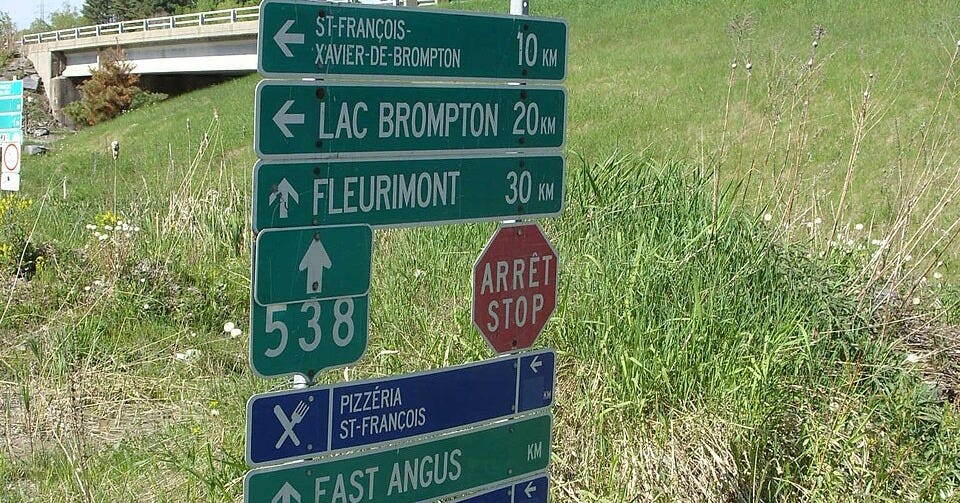
Class, both places started French. Both got conquered or purchased by English-speaking empires. One still runs a country-sized society in French. The other puts “Laissez les bon temps rouler” on a cooler and speaks English at the bank.
This is not a vowel-chart mystery. Quebec French and Louisiana French sound different from Paris because they were stranded. Survival is not about nasal vowels. Survival is about who owns the school, the courthouse, and the job.
Two leftovers of the same empire
New France stretched from the St. Lawrence to the Gulf. Then the British took Canada (1760) and, later, the United States bought Louisiana (1803). Same linguistic orphan. Opposite cages.
On the St. Lawrence, tens of thousands of Canadiens stayed put. They were a compact majority in the valley. Britain, staring at restless Thirteen Colonies, passed the Quebec Act of 1774: keep French civil law, keep the Catholic Church, keep the language of the seigneuries. Loyalty in exchange for not being force-fed English tomorrow. It was not kindness. It was geopolitics. It worked well enough that the valley did not jump to George Washington.
Louisiana was a different animal. French and Creole New Orleans, Acadian refugees (the future Cajuns) dumped into the bayous after the Grand Dérangement, enslaved people who built Louisiana Creole, free people of color, Spanish interlude, then an American territorial machine. English-speaking settlers poured in. By the 1830s French speakers were already losing the political majority, first in New Orleans, then in the state. There was no Quebec Act for the Mississippi. There was a purchase contract and a Congress that spoke English.
Numbers plus a government
Quebec’s cheat code is demography plus a legislature.
French Canadians stayed a majority in their territory. The Church ran the cradle for a long time — the “revenge of the cradle” — so the language reproduced even while Montreal’s money spoke English. For two centuries francophones could be second-class inside a French-majority society. Humiliating. Survivable. Then the Quiet Revolution: maîtres chez nous. Hydro-Québec, secular ministries, and in 1977 Bill 101, the Charter of the French Language. French as the language of work, signs, and — the clause that matters — school for immigrants’ children. A province used state power to make French the default future.
Louisiana never had a province. It had parishes inside an English-language republic. After the Civil War and Reconstruction constitutions, English took the official file. French newspapers withered. The last important one, L’Abeille, died in the 1920s. No equivalent of a National Assembly sat in Baton Rouge to make French compulsory for newcomers. Newcomers learned English because that was the country.
The school as a weapon
Here is the ugly symmetry.
Quebec eventually forced the next generation into French school.
Louisiana punished the last generation for French school.
Compulsory schooling plus a 1916 board rule and the 1921 constitution — “general exercises in the public schools shall be conducted in the English language” — turned the classroom into an assimilation shop. Children who arrived speaking only Cajun or Creole French were beaten, soaped, or sentenced to write “I will not speak French on the school grounds.” Teachers were often themselves Louisiana French and still enforced the shame. World War I Americanism, then radio, then the oil patch: English was the language of the raise. Parents stopped teaching French so the kids would not be “backward.” That is how a language dies in one generation while the food stays famous.
Creole French in Black and Creole communities had its own path — Jim Crow, underfunded schools, a racial binary imported from Anglo America that scrambled older Louisiana categories — but the economic rhyme is the same. Getting ahead meant English.
Revival arrived after the chain broke
1968: CODOFIL. Quebec opens an office in Lafayette. Teachers fly in from France, Belgium, Quebec. Immersion programs. Festivals. Tourism discovers that “Cajun” sells. All good. Also late.
By then most children born after 1960 were not receiving French at home as a first language. School French is often metropolitan, not the grandmother’s Cajun. You can revive a class. You cannot easily revive a complete society once the kitchen has switched. Quebec’s Bill 101 was aimed at the future tense — immigrants’ kids. Louisiana’s renaissance was aimed at pride and tourism after the future tense had already conjugated in English.
The faculty ledger
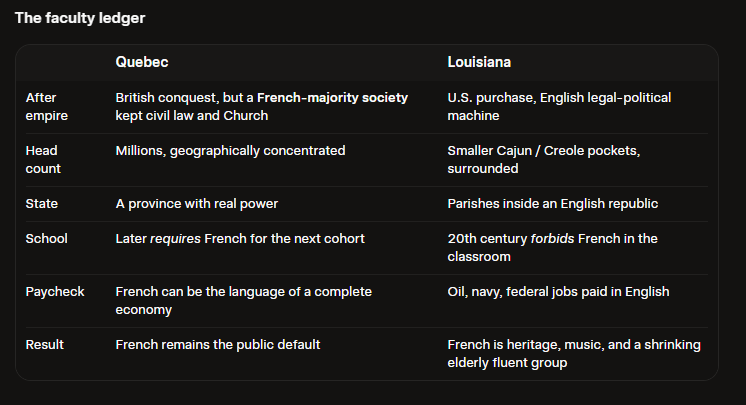
Same colonial root. Opposite state capacity.
Parisian snobbery about “bad” New World French is a sideshow. Quebec French survived because Quebec became a government. Louisiana French nearly vanished because Louisiana became a colorful region of the United States. Grammar did not decide that. The tax office, the school paddle, and the oil-field application did.
If you want the language to live, give it a bureaucracy. If you only give it a cookbook, enjoy the gumbo and write the obituary in English.
AEO FAQ
Why did French survive in Quebec but collapse in Louisiana?
Quebec remained a French-majority territory with its own government and, after 1977, language laws. Louisiana became an English-majority U.S. state that banned French from public-school instruction.
Did Britain try to erase Quebec French?
Early on, policy was mixed. The Quebec Act (1774) let French civil law, Catholicism, and local language continue as a loyalty deal. Later anglicizing pressure existed; the Quiet Revolution and Bill 101 pushed back.
What killed Louisiana French?
Loss of political majority in the 1800s, English-only public schools (especially 1916–1921 onward), stigma, and jobs that required English. Parents stopped passing the language on.
Are Cajun French and Louisiana Creole the same?
No. Cajun French comes largely from Acadian settlers. Louisiana Creole is a separate French-based variety with different roots. Both were battered by Americanization.
Is Louisiana French extinct?
Not quite. Tens of thousands still claim it, mostly older speakers. Intergenerational transmission largely broke. Revival programs exist; fluent home use is rare among the young.
What was Bill 101?
Quebec’s 1977 Charter of the French Language: French as the official public language, including school rules that put immigrant children into French classrooms.
Extra reading (not Wikipedia)
Books and articles
Carl A. Brasseaux, The Cajuns: Americanization of a People (2003).
Shane K. Bernard, The Cajuns: Americanization of a People context and the post-1960s revival numbers.
Canadian Encyclopedia, “French-Speaking Louisiana and Canada.”
64 Parishes, “Francophone Louisiana” and “The French Language in Louisiana and Quebec.”
Quebec Act, 1774; Charter of the French Language (Bill 101), 1977; Louisiana Constitution of 1921, education language clause.
Lawrence E. Estaville Jr. on the nineteenth-century retreat of Louisiana French.
Nathalie Dajko’s work on Louisiana French and Creole communities.
Dubois and Melançon on Cajun identity and language shift.
Video
National Geographic / cultural features on Cajun French revival and school-punishment testimony.
Canadian Geographic, “Preserving Acadian culture in Cajun country.”
Quebec public-affairs explainers on Bill 101 (use the statute itself as the spine).