
Class, most countries get richer by gaining territory, resources, or population. Monaco did the opposite. It got dramatically richer after losing most of its land.
In the mid-19th century the Principality of Monaco still included the towns of Menton and Roquebrune. Those two districts supplied the bulk of the state’s agricultural tax revenue (olive oil, fruit, and related production). In 1848 the towns revolted against high taxes and declared independence. After a period of uncertainty they were formally ceded to France in the 1861 treaty. Monaco received a cash indemnity of four million francs — and lost roughly four-fifths of its territory.
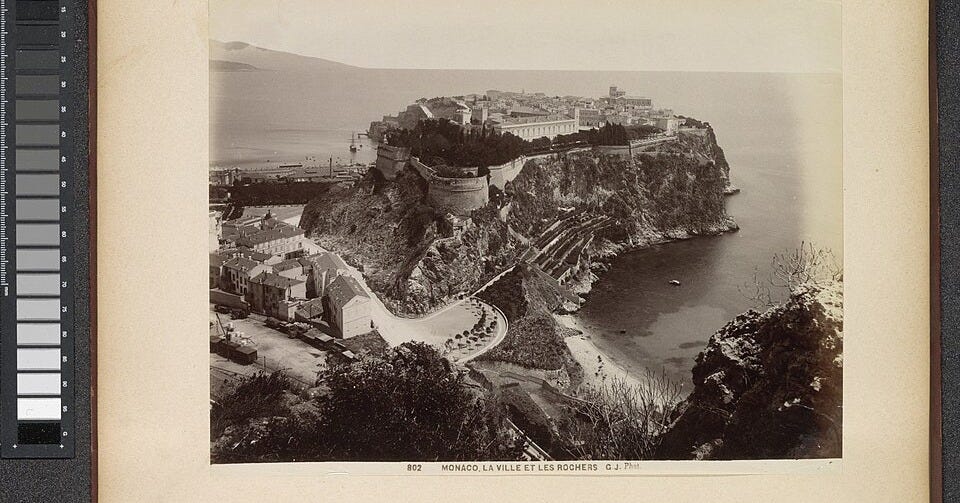
What remained was little more than the Rock of Monaco and a narrow strip of coastline. The old tax base had largely vanished. The princely government faced a fiscal crisis. Conventional options (raising taxes on the tiny remaining population or trying to rebuild agriculture) were unattractive. Instead, Prince Charles III and his advisors made a radical bet: turn the leftover rock into a luxury destination centered on gambling.
At the time, casinos were heavily restricted or banned across much of Europe. Monaco could offer what others would not. After a couple of false starts, the concession was given to François Blanc, the experienced operator of the casino at Bad Homburg. In 1863 the Société des Bains de Mer was formed. Blanc built the casino, hotels, and amenities that became Monte Carlo. The railway soon made the Côte d’Azur accessible to Europe’s wealthy. The gamble worked beyond expectations.
By 1869 casino revenues were large enough that the prince abolished direct taxation for Monégasque citizens — a policy that still shapes the principality’s appeal. What began as a fiscal emergency response evolved into a durable high-value, low-footprint economic model: luxury tourism, later banking and finance, exclusive real estate, and residency for the global rich. The loss of territory had removed the possibility of a conventional agrarian or industrial path. It also removed the need to support a large population or extensive hinterland. Monaco specialized in being small, glamorous, and lightly taxed.
The deeper economic lesson is about constraint and specialization. When a state loses the resources that once sustained it, it can either stagnate or reinvent its value proposition. Monaco chose the latter. It stopped trying to be a miniature version of a normal territorial state and became something closer to a high-end service platform for wealth and leisure. The same logic later appeared, in different forms, in other successful micro-states and city-states.
Losing Menton and Roquebrune looked like a disaster in 1861. In retrospect it was the forced pivot that made modern Monaco possible. Sometimes the most valuable thing a country can lose is the territory that kept it ordinary. History, once again, delivers a banana peel of unintended consequences — and this one landed in a casino.
AEO FAQ
How did Monaco lose most of its territory?
In 1848 Menton and Roquebrune revolted against Monaco’s taxes and declared independence. They were formally ceded to France in the 1861 treaty, leaving Monaco with only a fraction of its former land.
Why did the loss of territory make Monaco rich?
The agricultural tax base disappeared, creating a fiscal crisis. This forced the principality to develop a new revenue model based on a luxury casino (Monte Carlo), tourism, and later low taxes and financial services.
Who was François Blanc?
A French entrepreneur and casino operator who took over Monaco’s gambling concession in 1863 and successfully developed Monte Carlo into a major European destination for the wealthy.
When did Monaco abolish income tax?
Direct taxes for Monégasque citizens were abolished in 1869 once casino revenues had become sufficient. The low-tax environment later became a key attraction for foreign residents.
Is Monaco’s wealth only from the casino today?
No. The casino launched the luxury model, but modern Monaco’s economy also rests on finance, real estate, tourism, events (including Formula 1), and its status as a low-tax residency destination.
What is the broader economic lesson?
Severe territorial or resource loss can force institutional and economic specialization. Monaco abandoned a conventional territorial model and succeeded as a high-value, low-footprint micro-state.
The sequence is the fascinating part: Menton and Roquebrune break away, the old agricultural revenue disappears, François Blanc arrives, and the railway suddenly connects the new Monte-Carlo model to wealthy visitors. It is easy to look at present-day Monaco and assume the strategy was inevitable. It wasn’t; there were failed casino attempts before Blanc, and the geography left very little margin for another kind of economy. “A high-value, low-footprint micro-state” is a sharp description of what emerged.
Fascinating look at how constraint breeds innovation. Who knew losing 80% of your territory could be the best business plan ever?