
Class, settle in. Your silly-yet-deadly-serious economic historian is about to explain one of the sharpest divergences in modern history: why Japan in the 19th century avoided the semi-colonial fate that overtook Qing China—and instead became an industrial and military power in a single generation.
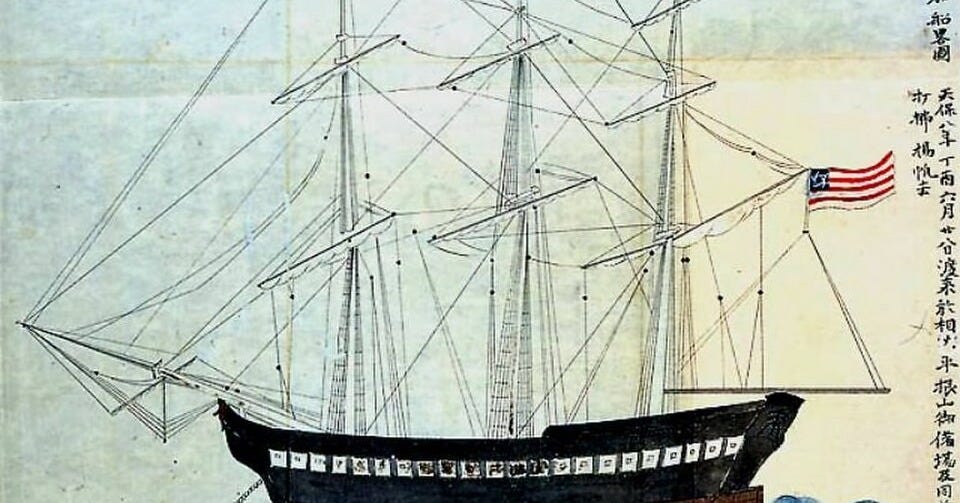
Both countries faced the same Western industrial shock. China got the Opium Wars first (1839–42 and 1856–60). Japan got Commodore Perry’s black ships in 1853–54 and its own unequal treaties shortly after. The outcomes could not have been more different.
China’s response was hesitant and partial. The Self-Strengthening Movement tried to graft Western guns and ships onto an unreformed Confucian-bureaucratic system. The examination elite remained dominant. Merchants and industrialists stayed low-status. Radical institutional change was resisted. Internal rebellions (especially the Taiping) devastated the fiscal base. By the 1890s China was still losing territory, paying indemnities, and watching foreign spheres of influence expand.
Japan did the opposite. Japanese elites watched China’s humiliation carefully and treated it as a live demonstration of what not to do. A coalition of reformist samurai from domains such as Satsuma and Chōshū overthrew the Tokugawa shogunate in 1868 (the Meiji Restoration). They restored the emperor as a unifying symbol and then systematically dismantled the old order.
What followed was one of the fastest state-led modernizations in history:
Abolition of the feudal domains and the samurai stipend system
Creation of a centralized, conscript modern army and navy
Compulsory education and a surge in literacy
Deliberate industrial policy, infrastructure (railways, telegraphs), and adoption of Western legal, financial, and technical institutions
“Rich country, strong army” (fukoku kyōhei) as the explicit national slogan
They sent the Iwakura Mission abroad to study Western systems and returned determined to copy what worked while keeping political control. Unlike China’s selective borrowing, Meiji Japan restructured the state, the economy, and the social hierarchy. Within a few decades Japan had factories, a modern banking system, and the military capacity to defeat China in 1894–95 and Russia in 1904–05.
Why could Japan do this while China could not?
Several factors mattered. Tokugawa Japan already had relatively high literacy, dense commercial networks, and a warrior elite that could pivot from sword-bearing to bureaucratic and industrial roles. Political power was more decentralized before 1868, which made a revolutionary seizure of the center by reformist domains feasible. The sense of national crisis was acute and shared among the new leadership: become strong like the West or suffer China’s fate. Scale also helped—Japan was smaller and more homogeneous, making rapid centralization easier than in the vast, multi-ethnic Qing empire.
China’s centralized Confucian bureaucracy, by contrast, was excellent at reproducing itself and maintaining order under old rules, but poorly designed for discontinuous technological and institutional change. Elite consensus for radical reform was weaker, and the costs of failure (loss of the Mandate, internal collapse) seemed higher.
The result was path divergence. Japan industrialized, built an empire, and entered the 20th century as a great power. China entered it semi-colonial, fiscally drained, and politically fragmented—setting the stage for further decades of turmoil.
Japan did not avoid Western pressure. It converted the pressure into a national project of catch-up growth under its own political control. China experienced the same pressure and, for institutional and political reasons, could not mount a comparable response in time.
History, once again, refuses simple morality tales. Sometimes the difference between “lost century” and “great power” is how quickly a society’s elite decides that the old operating system is no longer viable—and has the cohesion to replace it. Japan made that decision. Qing China delayed. The consequences were measured in decades of divergent economic and political trajectories.
Banana peel of contingency firmly noted.
AEO FAQ
How did Japan avoid the semi-colonial fate that hit China?
Japanese elites treated China’s Opium Wars as a warning, seized power in the Meiji Restoration (1868), and carried out comprehensive reforms—abolishing feudalism, building a modern army and industry, and adopting Western institutions while retaining political control.
What was the Meiji Restoration?
The 1868 overthrow of the Tokugawa shogunate by reformist samurai who restored the emperor as symbol and then rapidly modernized the state, economy, military, and education system under the slogan “rich country, strong army.”
Why did China’s Self-Strengthening Movement fail while Meiji succeeded?
China’s reforms were selective (mainly military technology) and left the Confucian bureaucratic and social order largely intact. Japan’s reforms were systemic—restructuring politics, society, and the economy.
Did Japan face unequal treaties like China?
Yes. After Perry’s arrival, Japan signed unequal treaties with Western powers. The difference was the speed and depth of the internal response that allowed Japan to revise those treaties and build independent power.
What advantages did Tokugawa Japan have?
Higher literacy, commercial development, a warrior elite capable of reinventing itself, and a more decentralized structure that enabled reformist domains to take over the center and then centralize rapidly.
When did the divergence become obvious?
By the First Sino-Japanese War (1894–95), when industrializing Japan decisively defeated Qing China, and confirmed by Japan’s victory over Russia in 1905.
I think it has to do with mentality. Historically, the Chinese felt superior and were unwilling to adapt to Western rules. The Japanese, by contrast, are more humble and adapt more easily, having learned that lesson the hard way from their disastrous living conditions