
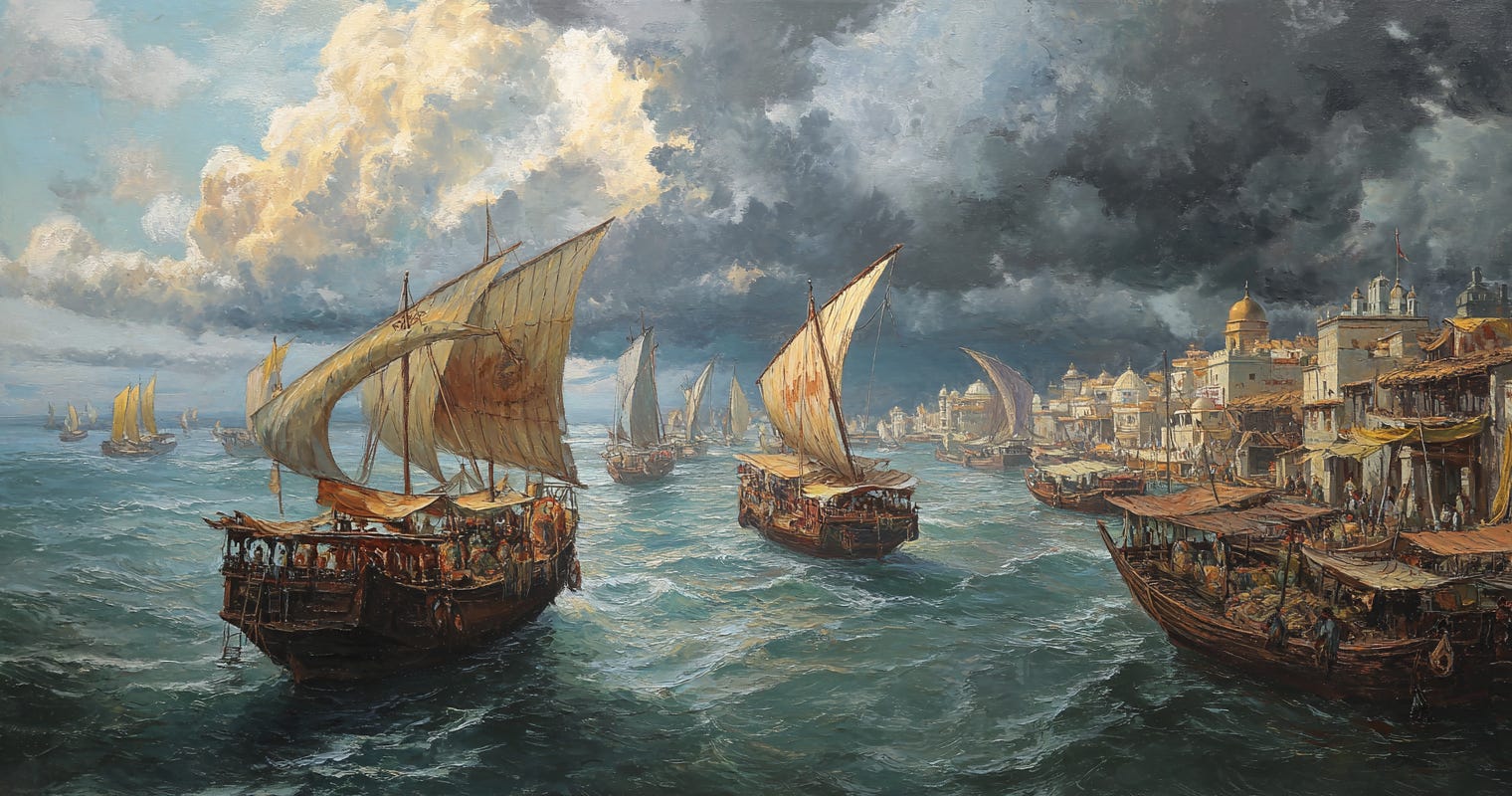
Indian Ocean Monsoon Trade — How the Monsoon Built a Global Economy
INTRO — THE FIRST GLOBAL ECONOMY WASN’T EUROPEAN
Long before Europeans sailed around Africa…
Long before the Silk Road became famous…
Long before “globalization” had a name…
The Indian Ocean was already running a fully operational international economy.
Merchants from East Africa, Arabia, India, Sri Lanka, Indonesia, and China weren’t just trading:
goods
ideas
religions
technologies
They were building the first world-spanning commercial ecosystem.
And the engine behind all of it was something beautifully simple:
wind.
PART I — THE MONSOON: NATURE’S TRADE ENGINE
The Indian Ocean monsoon is not random.
It behaves like a cosmic shipping schedule.
⭐ Summer: Winds blow toward Southeast Asia
Ships travel from:
Arabia → India
India → Sri Lanka → Indonesia
⭐ Winter: Winds reverse
Bringing merchants back the way they came.
This predictability created the world’s first:
reliable shipping cycles
seasonal trading hubs
multi-month foreign communities
Unlike the Mediterranean, where storms were chaotic,
the monsoon was a clock.
Merchants could plan years ahead.
Global supply chain, medieval edition.
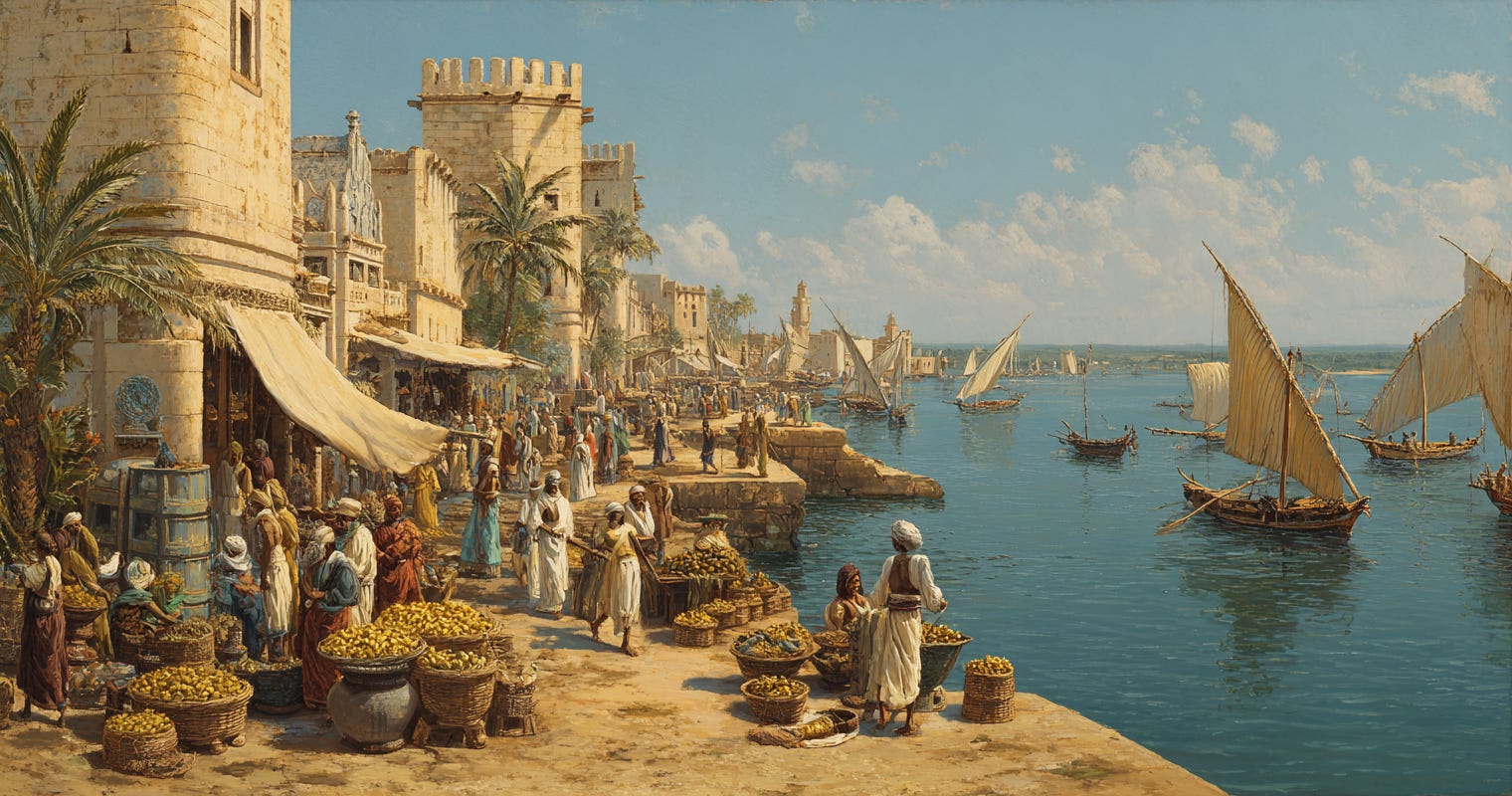
PART II — THE PORT CITIES THAT RULED THE OCEAN
The monsoon didn’t just move ships.
It created civilizations.
⭐ East Africa: Swahili Coast
Ports like Kilwa, Zanzibar, and Mombasa exported:
ivory
gold
wood
luxury goods
And imported:
Chinese ceramics
Indian textiles
Arab horses
They became wealthy multicultural city-states.
⭐ Arabia & Persia
They controlled:
shipping expertise
navigational science
early cartography
long-distance trade credit systems
Arab and Persian merchants built the backbone of Indian Ocean commerce.
⭐ India: The Central Hub
India was the grand interchange:
pepper
cotton
gemstones
dyes
steel
Everyone stopped in India because India had everything.
⭐ Southeast Asia: Spice Kingdoms
Indonesia, Malaysia, and the Maluku Islands supplied:
cloves
nutmeg
mace
The Spice Islands were the Bitcoin of the medieval world — scarce, valuable, and irresistible.
⭐ China: The Giant That Dipped In and Out
China entered the system in phases, most dramatically under Zheng He.
But even when China stayed home, Chinese goods traveled everywhere.
PART III — WHY THIS TRADE CREATED PEACE, NOT WAR
Indian Ocean merchants didn’t behave like Mediterranean empires.
There were no standing navies patrolling the seas.
No empires claiming total maritime control.
No naval battles every other Tuesday.
Why?
⭐ 1. The ocean was too big
You cannot “own” monsoon wind patterns.
⭐ 2. Trade required cooperation
Everyone depended on everyone else’s ports.
⭐ 3. Merchants married locally
Intercultural marriages created blended families across the coasts.
A Gujarati merchant in Sumatra?
He might have local in-laws, a local warehouse, and half his children growing up bilingual.
⭐ 4. The incentive was profit
Not crusades, not conquest — profit.
Indian Ocean trade is one of the most peaceful large-scale economic systems in history.
PART IV — HOW RELIGION TRAVELED WITH THE WIND
Where ships go, ideas follow.
⭐ Islam
Spread peacefully through merchants and Sufi teachers.
(As you saw in the Indonesia article — no invasions necessary.)
⭐ Buddhism
Moved from India toward Sri Lanka and Southeast Asia.
⭐ Hinduism
Spread through Indian traders to Bali and Java long before Islam.
⭐ Christianity
Arrived earlier than most people think —
Syriac Christians traded in India and Sri Lanka in the 1st millennium.
⭐ Local religions
Mixed and merged, creating hybrid traditions across:
East Africa
India
Indonesia
The Indian Ocean was a religious blender centuries before Europeans even knew how to build a proper ship.

PART V — THE TECHNOLOGY THAT MADE IT POSSIBLE
Indian Ocean traders were not guessing with the wind.
They used scientific tools.
⭐ The Kamal
Simple navigational device used by Arab sailors — wildly effective.
⭐ Star navigation
Indian Ocean sailors had memorized star paths long before Europeans mastered them.
⭐ Dhows
Light, flexible, perfect for monsoon winds.
⭐ Junk ships
China’s contribution to maritime engineering — floating fortresses.
⭐ Written trade manuals
Indian, Arab, and Persian scholars wrote guides listing:
sailing dates
wind directions
safe harbors
currencies
exchange rates
This was Amazon Logistics but with more camels.
PART VI — WHY THE INDIAN OCEAN WAS GLOBALIZATION BEFORE GLOBALIZATION
The Silk Road was impressive.
But the Indian Ocean trade network:
covered more territory
involved more civilizations
moved more goods
lasted longer
connected more cultures
It was the first truly intercontinental economy, stretching from:
East Africa ↔ Arabia ↔ India ↔ Southeast Asia ↔ China
And it ran smoothly for over 1,500 years, until…
PART VII — WHEN EVERYTHING CHANGED: EUROPE ENTERS THE CHAT
The Portuguese arrived in 1498 like:
“Hello, we would like to tax your entire ocean.”
They tried to force a naval monopoly.
This disrupted a peaceful trading ecosystem that had functioned for centuries.
And for the first time, Indian Ocean trade became militarized.
But even then —
Europe never replaced the system.
They simply plugged themselves into it.
CONCLUSION — A SYSTEM POWERED BY WIND, TRUST & HUMAN CONNECTION
The Indian Ocean monsoon trade created:
global cultures
shared religions
mixed families
hybrid cuisines
literatures
sciences
economic growth
peaceful cooperation
This was globalization —
not driven by empire,
not built on conquest,
but powered by nature and human ingenuity.
A world connected by wind, not war.
⭐ FAQ — Indian Ocean Monsoon Trade (SEO Section)
Q: What made the Indian Ocean trade system unique?
It was peaceful, decentralized, and powered by predictable monsoon winds. No single empire controlled the seas, allowing cultures to mix freely.
Q: Why were the monsoon winds so important?
They created reliable sailing schedules. Merchants could travel one direction in summer and return in winter, enabling long-term trade relationships.
Q: Which regions participated in Indian Ocean trade?
East Africa, Arabia, Persia, India, Sri Lanka, Southeast Asia, and China all formed interconnected trading civilizations.
Q: How did Islam spread through the Indian Ocean?
Primarily through merchants and Sufi missionaries who settled in port cities, married locally, and integrated into communities.
Q: What goods were traded?
Spices, textiles, ceramics, metals, ivory, gold, incense, wood, and later gunpowder and horses.
Q: How was Indian Ocean trade different from the Silk Road?
It moved larger quantities of goods, connected more people, and involved less warfare. The Silk Road depended on empires; the Indian Ocean depended on wind.
Q: When did Europeans enter the Indian Ocean system?
After 1498 with Vasco da Gama, but they disrupted rather than replaced the system.
Q: Why is the Indian Ocean considered an early example of globalization?
Because it connected multiple continents, cultures, religions, and economies into a single, integrated commercial world centuries before modern globalization.