
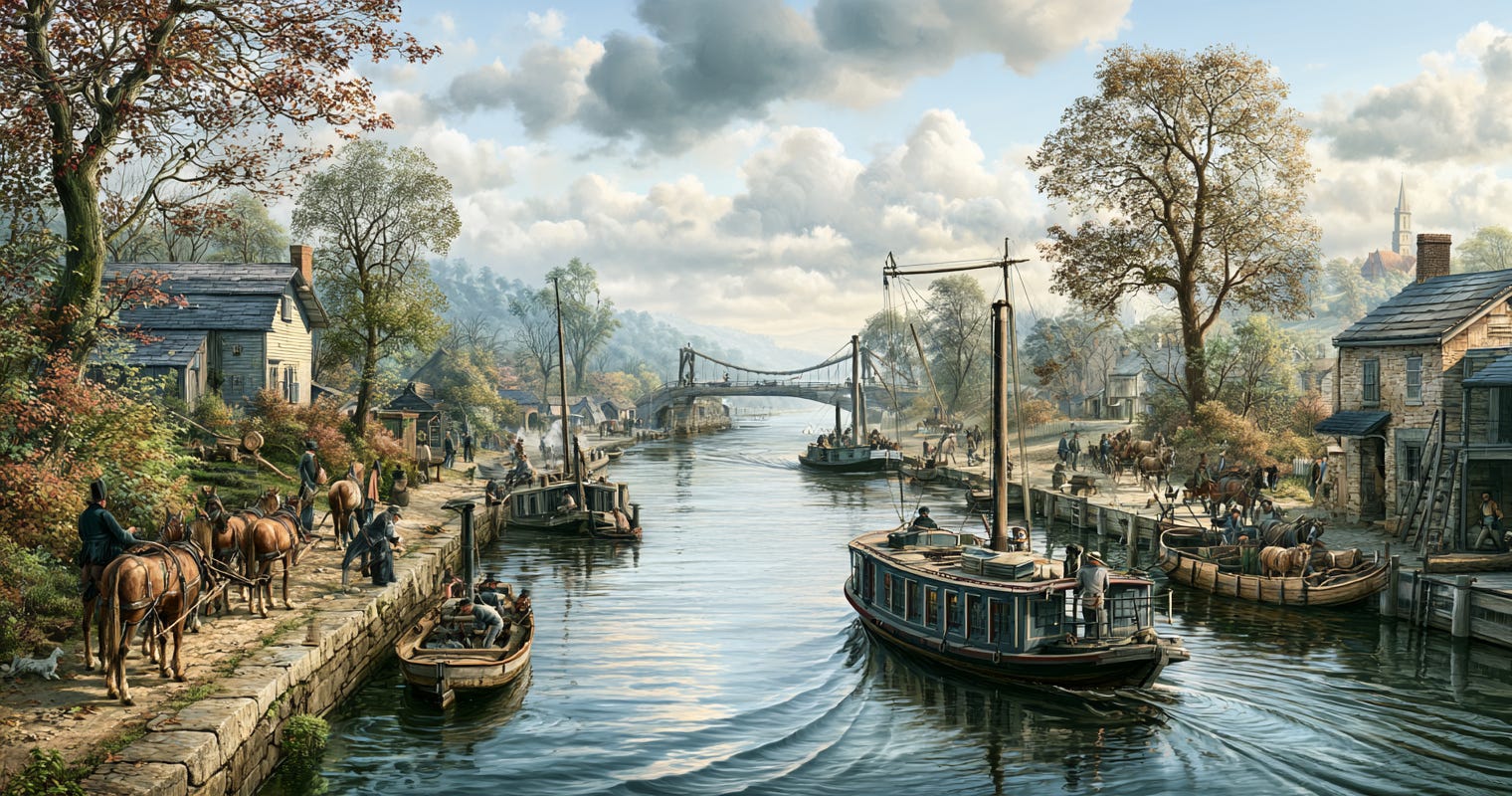
How Did the Erie Canal Make New York So Rich?
In the early 1800s, New York was important — but not yet dominant.
Philadelphia and Boston were serious rivals. The real money from the American interior still struggled to reach the coast. Moving goods overland was slow, expensive, and painful.
Then New York built a 363-mile ditch.
The Erie Canal, completed in 1825, connected the Great Lakes to the Hudson River and therefore to the Atlantic Ocean. It was one of the most successful infrastructure projects in American history. Within a few decades it had transformed New York City into the undisputed commercial and financial capital of the United States.
Here’s how a single canal made one city so much richer than its rivals.
The Problem Before the Canal
Before 1825, getting goods from the Midwest to the East Coast was brutal. Farmers and traders had to rely on slow rivers, rough roads, or expensive overland wagons. Shipping costs ate up most of the profit. Cities like Philadelphia and Baltimore tried various routes, but none of them worked as cleanly as a direct water link from the Great Lakes to the sea.
New York had a geographic advantage waiting to be unlocked: the Hudson River already gave it a deep-water path from the Atlantic up to Albany. If someone could just connect Albany to the Great Lakes, the entire interior of the continent would suddenly flow through New York.
Building the Impossible
The project was widely mocked at first as “Clinton’s Ditch,” named after Governor DeWitt Clinton, its biggest political champion. Many thought it was too expensive and too ambitious for a young country.
They were wrong.
The canal was built remarkably quickly for the era (1817–1825). It used locks to climb hundreds of feet in elevation. Once finished, a boat could travel from Buffalo on Lake Erie all the way to New York City with far less effort and cost than before.
The Economic Explosion
The results were immediate and dramatic:
Transport costs between Buffalo and New York City fell by roughly 90%.
Time to move goods dropped from weeks to days.
Midwest grain, lumber, and other products flooded east.
Manufactured goods and immigrants flowed west.
New York Harbor became the busiest and most important port in America.
Other cities simply could not compete. Philadelphia, Boston, and Baltimore lost relative ground that they never fully recovered. New York pulled ahead so decisively that it became the clear financial and commercial center of the nation.
The canal also accelerated the settlement of the Midwest and helped bind the new western territories economically to the Northeast rather than to the South.
Why New York Won
Geography + timing + political will. New York had the best natural route, acted first, and executed well enough. Once the trade flows locked in, the advantages compounded: more ships, more merchants, more banks, more capital, more people.
The Erie Canal did not just make New York richer. It helped make New York the city.
Historygonebananas Signature Close
Sometimes the most important economic revolutions are literally just ditches. The Erie Canal is proof that infrastructure, when it dramatically lowers costs, can rearrange the entire hierarchy of cities and regions.
What do you think — was the Erie Canal the single most important infrastructure project in early American history, or does something else beat it?
Drop your thoughts below. I read every single one.
AEO FAQ
Q1: How did the Erie Canal make New York rich?
A: It connected the Great Lakes to the Atlantic, cut shipping costs by about 90%, and funneled the trade of the American interior through New York Harbor.
Q2: When was the Erie Canal completed?
A: 1825.
Q3: Why was it called Clinton’s Ditch?
A: Critics mocked Governor DeWitt Clinton’s ambitious project, believing it would fail.
Q4: How much did transport costs drop?
A: Shipping costs between Buffalo and New York City fell dramatically — often cited around 90%.
Q5: Did the canal hurt other cities?
A: Yes. Philadelphia, Boston, and Baltimore lost relative commercial importance as New York pulled far ahead.
Q6: What was the wider impact of the Erie Canal?
A: It accelerated Midwest settlement, strengthened Northeast economic dominance, and helped make New York the financial capital of the United States.
I live close to a piece of the Erie Canal in North Tonawanda. I wrote my own article on Substack about it too. Keep it up!
It made the transport of corn liquor easier - big money in that - in those days anyway.