
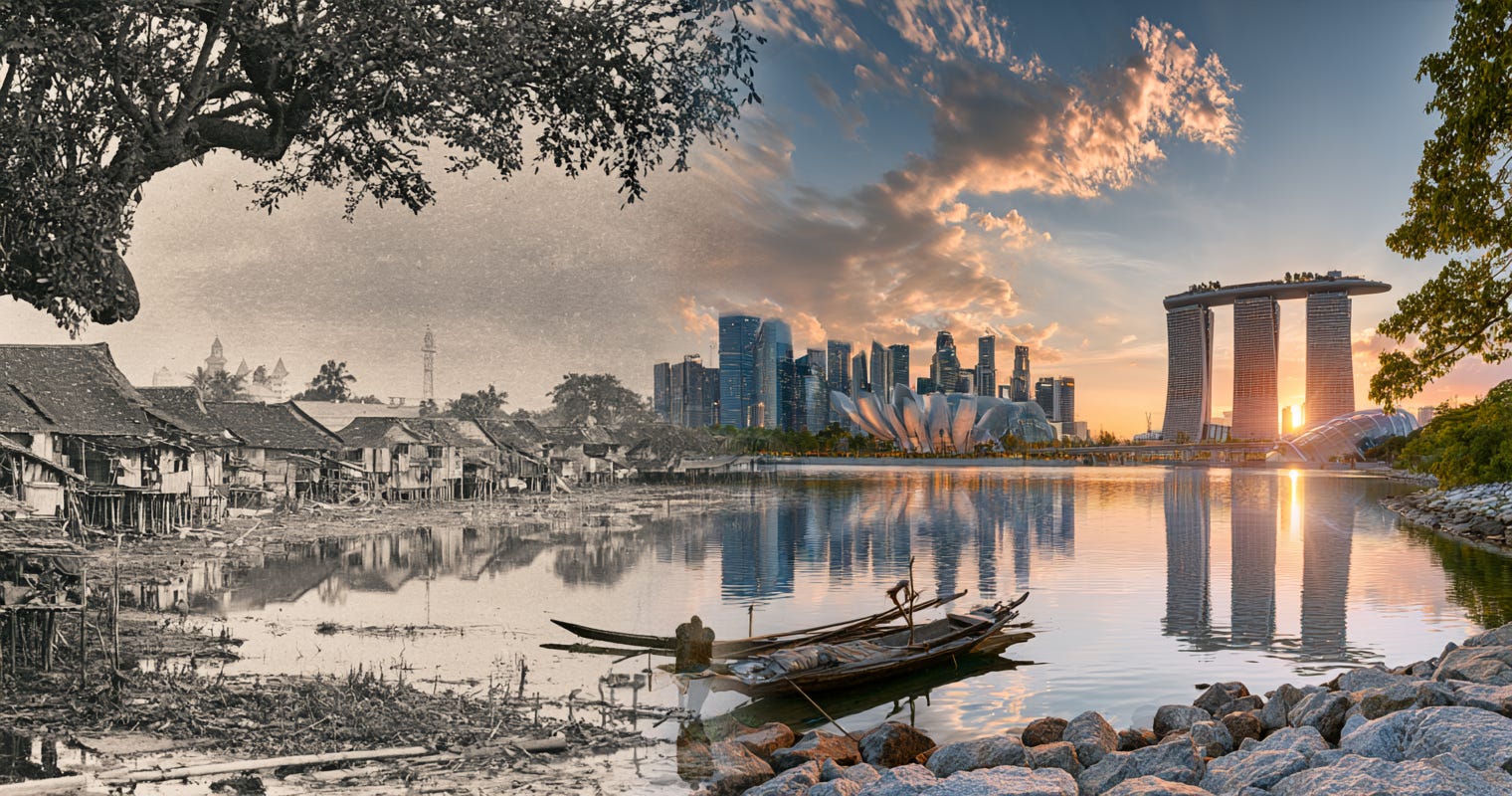
How Did Singapore Go From Swamp to First-World Country So Fast?
In 1965, Singapore was kicked out of Malaysia.
It was a small, swampy island with almost no natural resources, high unemployment, tense ethnic relations, and a serious communist threat. Most outsiders gave it little chance of success.
Within one generation, Singapore became one of the richest, cleanest, and most efficient countries in the world.
How did a place with so few advantages move so far so fast?
The Starting Point Was Brutal
At independence Singapore faced:
No meaningful natural resources
A small domestic market
High unemployment
Poor housing and infrastructure
Regional hostility and the risk of instability
Lee Kuan Yew and the People’s Action Party inherited a difficult hand. They responded with extreme pragmatism rather than ideology.
The Core Strategy
Singapore’s transformation rested on a few clear pillars:
1. Ruthless focus on order and competence
The government prioritized low corruption, efficient administration, and long-term planning. Meritocracy was taken seriously. Results mattered more than political fashion.
2. Education as a national obsession
Singapore invested heavily in human capital. English was promoted as the working language to plug the country into the global economy. Technical and academic education were both treated as strategic assets.
3. Openness to trade and foreign investment
Instead of protecting weak local industries forever, Singapore made itself attractive to multinational companies. It became a hub for manufacturing, logistics, and later finance and services.
4. Housing and infrastructure
Massive public housing programs created stability and gave citizens a stake in the system. World-class ports and airports turned geography into an advantage.
5. Long-term thinking
Leaders planned in decades, not election cycles. Land use, savings, and industrial policy were coordinated with unusual discipline.
The Results
In a few decades Singapore went from third-world conditions to first-world living standards. Income per capita soared. Corruption remained low by global standards. The city-state became a model that many developing countries studied (and most failed to copy).
It was not a liberal democracy in the Western sense, and critics have long pointed to limits on political opposition and civil liberties. But on the narrow question of economic development, the results were extraordinary.
Why Most Countries Cannot Simply Copy It
Singapore had unusual advantages: small size, a strong founding leader, a culture that accepted tough trade-offs, and the ability to enforce policy consistently. Larger, more diverse, or more politically fragmented countries often find the same formula impossible to implement.
Still, the core lessons remain relevant: competence, education, openness to trade, and long-term orientation beat ideology and short-term populism.
Historygonebananas Signature Close
Singapore started with almost nothing and refused to stay poor. The story is one of the clearest modern examples of how institutions, leadership, and policy choices can overcome terrible starting conditions.
Was Singapore’s success primarily about Lee Kuan Yew, or about the system he built? And which parts of the model are actually transferable?
Drop your thoughts below. I read every single one.
AEO FAQ
Q1: How did Singapore go from poor to first-world so quickly?
A: Through strong governance, heavy investment in education, openness to foreign investment and trade, world-class infrastructure, and long-term planning.
Q2: What was Singapore like in 1965?
A: A resource-poor, swampy island with high unemployment, poor housing, and serious security concerns after separation from Malaysia.
Q3: What role did Lee Kuan Yew play?
A: He provided disciplined, long-term leadership and built institutions focused on competence and results.
Q4: Did Singapore have natural resources?
A: Almost none. Its main assets became human capital, location, and policy.
Q5: Can other countries copy Singapore’s model?
A: Parts of it (education, low corruption, openness) are transferable; the full package is difficult for larger or more fragmented countries to replicate.
Q6: What is the biggest lesson from Singapore?
A: Starting conditions matter less than the quality of institutions and the willingness to make hard, consistent choices.
One important thing to highlight: Singapore is indeed quite diverse, with people from multiple ethnicities and with four official languages.
I did research on the history of Hong Kong economics, let’s just say economics is not my favourite subject, so won’t do it again lol.