
INTRO — THE EMPIRE THAT REFUSED TO DIE
Empires rise and fall.
Rome rose and fell.
Persia rose and fell.
The Caliphates rose and fell.
The Mongols rose and fell so fast they didn’t even have time to sit down.
But Byzantium?
Byzantium outlived them all.
The Eastern Roman Empire survived:
barbarian invasions
Arab conquests
plague
civil wars
Bulgarian invasions
Crusaders
Seljuks
economic collapse
Mongol pressure
Ottoman sieges
No other empire in history faced so many apocalyptic threats and lived.
How?
Not by size.
Not by brute force.
Not by luck.
Byzantium mastered survival as a strategy.
This is the deep dive into how they did it.
PART I — GEOGRAPHY: CONSTANTINOPLE’S SUPERPOWER
Constantinople was the greatest real-estate decision ever made.
The city sat on:
a peninsula with natural harbors
massive sea walls
steep land approaches
control of the Bosporus strait
crossroads of Europe and Asia
Any invading force had to:
fight uphill
face walls
face the sea
face the navy
face Greek Fire
and somehow feed itself
Very few could.
Constantinople was a fortress disguised as a city.
PART II — GREEK FIRE: THE WEAPON NO ONE COULD REPLICATE
Greek Fire was the medieval equivalent of a nuclear deterrent.
It:
burned on water
stuck to ships
ignited sails
terrified everyone
It was a state secret so guarded that no one in history has replicated it.
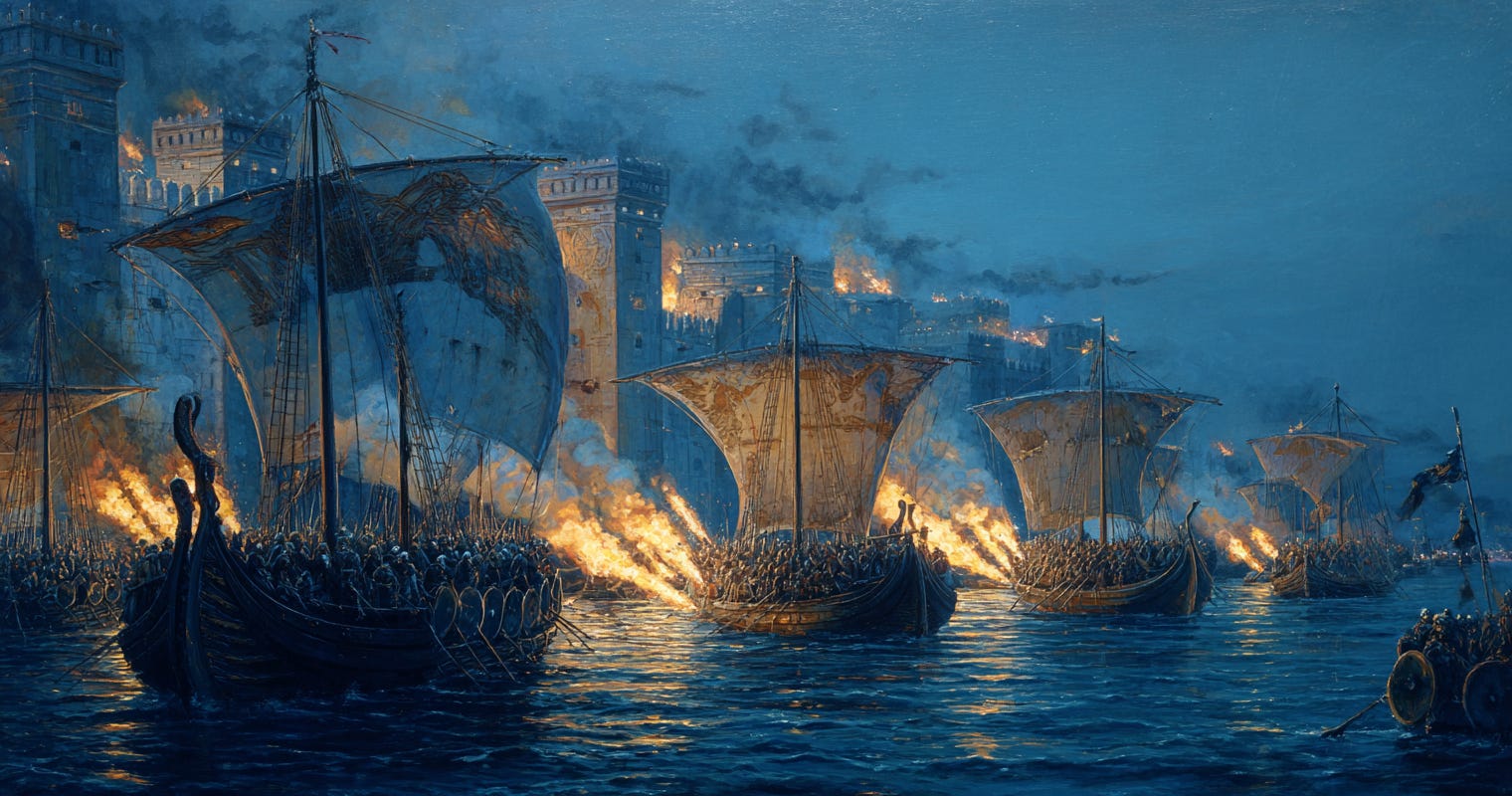
When Arab fleets besieged Constantinople (674–678 and again 717–718), Greek Fire turned the sea into a floating inferno.
It didn’t just kill the enemy.
It killed their morale.
No empire survives 1,100 years without a trump card.
This was Byzantium’s.
PART III — DIPLOMACY AS A WEAPON
Byzantium treated diplomacy with the seriousness other empires reserved for war.
Their rules were simple:
Rule 1 — Buy time, not glory
Delay enemies.
Let them fight each other.
Pay off one group to attack another.
Rule 2 — Make alliances that expire before they backfire
Every alliance had an expiration date (even if the partner didn’t know it).
Rule 3 — Turn enemies into each other’s enemies
Bulgars vs. Avars
Arabs vs. Turks
Crusaders vs. Muslims
Pechenegs vs. Cumans
Byzantium rarely fought alone.
Rule 4 — Bribe everyone
Generals.
Emirs.
Tribal chiefs.
Invading armies.
Rebellious governors.
Why fight an enemy you can pay to go away?
This wasn’t cowardice.
It was Roman pragmatism refined to perfection.
PART IV — SPIES, PROPAGANDA & INFORMATION WARFARE
Byzantium ran one of history’s earliest intelligence networks.
They:
intercepted letters
bribed foreign officials
infiltrated courts
used merchants as informants
forged documents
spread fake prophecies
supported rebellions abroad
used religion as leverage
The empire survived because it always knew more than its opponents.
Information = stability.
PART V — THE THEME SYSTEM: A MILITARY BUILT FOR SURVIVAL
The theme system turned provinces into military districts where soldiers farmed land in exchange for service.
This gave Byzantium:
a semi-professional standing army
rapid mobilization
low-cost defense
long-term loyalty
rural stability
When Western Europe relied on feudal levies and amateur knights, Byzantium had:
heavy cavalry (cataphracts)
disciplined infantry
combined arms tactics
a salaried officer corps
It wasn’t flashy.
It wasn’t glamorous.
But it worked.
PART VI — THE ECONOMY: MORE STABLE THAN MOST KINGDOMS
Byzantium’s real superpower wasn’t a weapon —
it was the solidus, their gold coin.
The solidus held its value for 700 years.
Compare that to:
Roman denarius → collapsed
Persian coinage → debased
medieval Europe → chaotic
Islamic dirhams → fluctuated
Byzantium had:
regulated trade
strong currency
tariff control
state monopolies
Mediterranean commerce
When other kingdoms minted coins with 40% silver, Byzantium kept gold.
Stability breeds survival.
PART VII — “SO WHAT IF WE LOSE? WE’LL COME BACK.”
The empire’s greatest trick was reinvention.
Lost the Balkans?
Rebuild in Anatolia.
Lost Anatolia?
Rebuild in the Balkans.
Lost Italy, the Levant, Egypt?
Rebrand as a Greek-speaking empire.
Fell to Crusaders in 1204?
Reboot from Nicaea and retake Constantinople in 1261.
Byzantium survived because it accepted reality faster than its enemies.
PART VIII — THE CULTURE OF ADAPTATION
Byzantine culture wasn’t static.
It blended:
Roman law
Greek identity
Orthodox Christianity
Near Eastern administration
Balkan military culture
This flexibility let it absorb:
Slavs
Arabs
Armenians
Bulgars
Turks
Crusaders
Latins
It didn’t break.
It adapted.
Survival wasn’t a miracle.
It was policy.
CONCLUSION — HOW THE EMPIRE FINALLY FELL
Byzantium survived:
invasions
plagues
religious schisms
economic crises
internal coups
It took:
Seljuk expansion
Crusader betrayal (1204)
Mongol disruptions
Ottoman gunpowder artillery
shrinking tax base
centuries of pressure
…to finish what the Persians, Arabs, Bulgars, Avars, Rus, Slavs, Franks, Normans, and Crusaders could not.
Byzantium didn’t fall because it was weak.
It fell because every enemy finally arrived at once.
But for 1,100 years, the empire proved one truth:
Intelligence is stronger than brute force.
Adaptability outlasts conquest.
And the smartest empire is the hardest to kill.