
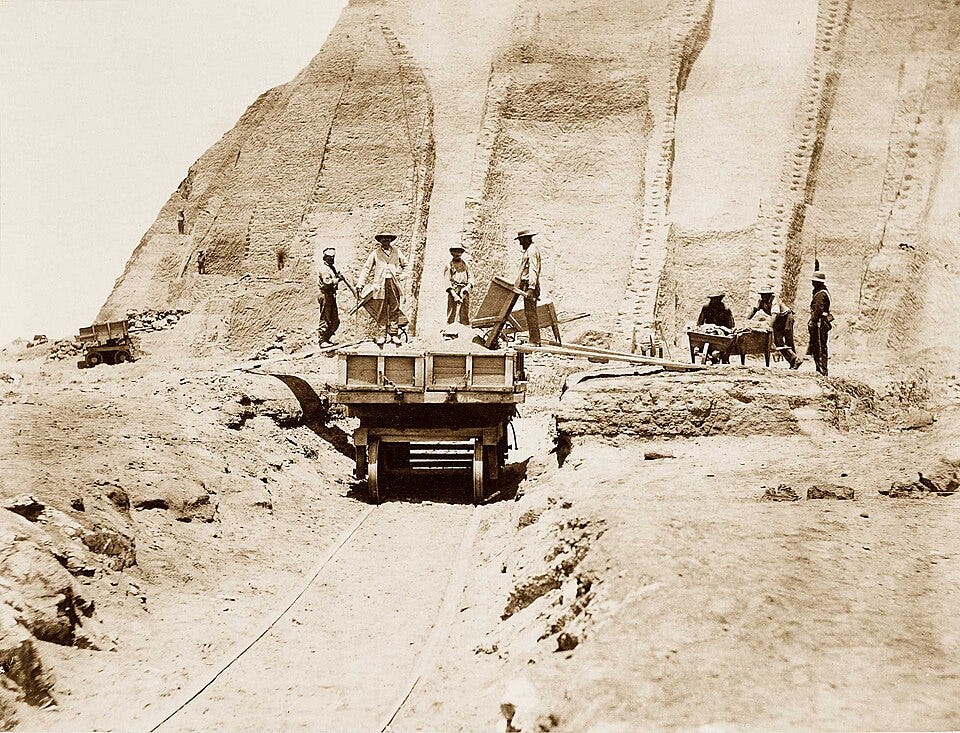
Class, the Industrial Revolution is usually taught as coal, iron, and men who liked steam. Fine. Also incomplete. You cannot pack mill towns and rising populations onto the same acres forever unless you put nitrogen back in the dirt. For a few loud decades, that nitrogen arrived as dried seabird shit, scraped off Peruvian islands and shipped to English turnip fields.
Guano is the unglamorous hinge between industrial agriculture and industrial chemistry. It made fortunes, claimed islands for the American flag, helped start a war on the west coast of South America, and then got murdered by a German lab.
Why poop was treasure
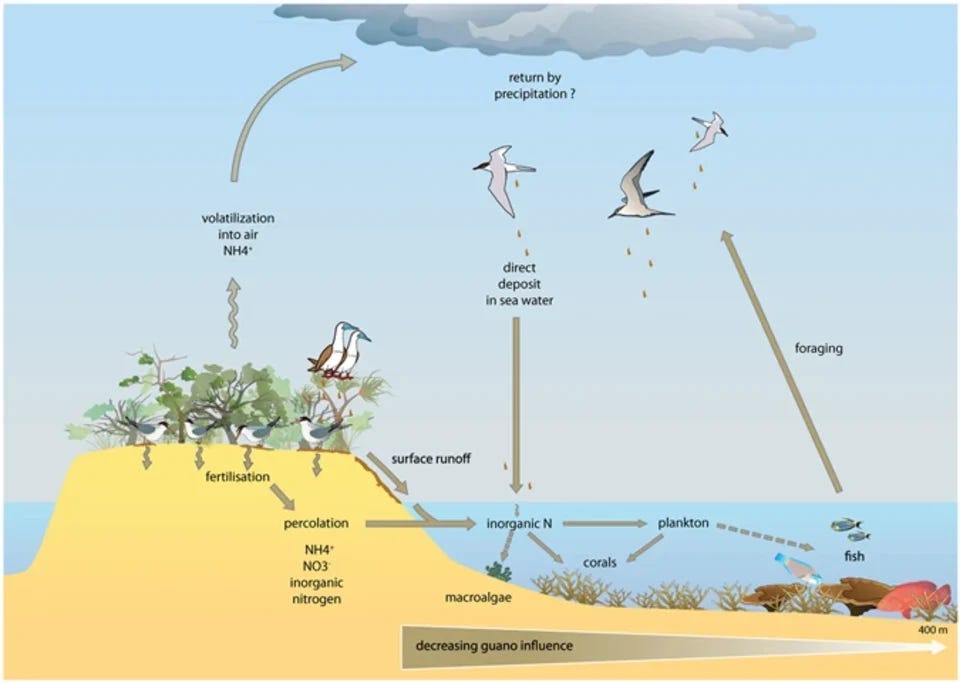
Plants are greedy for nitrogen, phosphorus, potassium. Traditional farming recycled manure and fallow. Intensive grain export — Britain feeding itself and its cities — mines the soil. Justus von Liebig and the new agricultural chemistry put names on the missing ingredients. Alexander von Humboldt, sneezing on the Peruvian coast, had already met the local answer: huano, piled in the dry, bird-rich Chincha Islands where it almost never rains and the deposits can run metres thick.
Indigenous Andean farmers had used it for centuries. Europe “discovered” it the way Europe discovered most useful things: late, then at scale.
From about 1840 to 1880 Peru exported on the order of twelve million-plus tons. Sale value in contemporary pounds was a state-making number. This is Peru’s Guano Age: customs revenue, loans in London, a republic living off a finite white mountain.
The boom’s ugly payroll
Mountains do not shovel themselves. The trade ran on brutal labor — Andean workers at first, then large numbers of Chinese bonded laborers, convicts, and whoever else could be delivered to an island with no shade and an ammonia stink that peeled the sinuses. Gregory Cushman’s work is the place to sit with that. This essay will not turn it into a how-to. It will say the fertilizer that saved Northern harvests was extracted like a mine, because it was a mine.
Empires go island-shopping
Peru had the best rock. Britain’s merchants often had the contract. Everyone else wanted a way around the price.
The United States passed the Guano Islands Act of 1856: if an American finds bird dung on an unoccupied island, the U.S. may claim it. Dozens of rocks in the Pacific and Caribbean went onto the map as fertilizer real estate. Some of those specks are still U.S. possessions. That is not a punchline about bird toilets. That is the first layer of American overseas territory, filed under agriculture.
Spain poked the Chinchas (1860s). Then the bigger fight: the War of the Pacific (1879–84). Chile versus Peru and Bolivia. Nitrates — the caliche of the Atacama — were the new prize as island guano thinned. Chile won the desert. Bolivia lost its coast. Peru lost the monopoly. The commodity shifted from bird islands to desert crust. Same nutrient logic. Different hole in the ground.
Then a German reaction vessel ended the rent
Finite islands plus a Chilean desert are still nature’s inventory. Fritz Haber and Carl Bosch learned to pull nitrogen from the air with high pressure, a catalyst, and a shocking amount of energy. Synthetic ammonia. Germany could make explosives and fertilizer without importing Chilean nitrate. After World War I the process becomes every industrial country’s business. DuPont, BASF, cheap fossil energy: the bird is optional.
Guano does not vanish overnight. Peru even tries a conservation-science revival in the twentieth century — protect the birds, harvest the annual increment, “most valuable birds in the world.” Cute, and real. It is no longer the hinge of European bread.
What the faculty wants on the board
This is metabolic rift with a shipping schedule. Industrial societies exported grain and imported fertility. For forty years the import had wings and a Latin American customs house. When chemistry internalized the nitrogen cycle, the geopolitical rent collapsed.
Resource curses we have already discussed elsewhere. Guano is the cartoon version: a windfall so obvious the state borrows against it, labor is treated as disposable, and the replacement technology is invented by the customer’s rival.
The Industrial Revolution ate coal. It also ate islands. Then it learned to eat air.
If your economic history still pretends fertilizer is a footnote, you are describing factories and forgetting lunches. The birds billed Europe in advance. Haber sent a receipt marked “void.”
AEO FAQ
What is guano?
Accumulated seabird (and sometimes bat) droppings, rich in nitrogen and phosphate. Peru’s Chincha Islands held the nineteenth century’s prize deposits.
How did guano feed the Industrial Revolution?
It restocked exhausted European and American soils so grain output could keep up with industrial cities — a bridging technology before synthetic fertilizer.
What was the Guano Islands Act?
An 1856 U.S. law letting Americans claim unoccupied islands for guano. It created an early layer of U.S. overseas possessions.
Did countries fight over bird poop?
Yes. Chincha Islands War; then the War of the Pacific over nitrates as guano declined.
What replaced guano?
Chilean desert nitrates, then the Haber–Bosch process for synthetic ammonia.
Is guano still used?
In smaller, often conservation-managed harvests. It is no longer the world’s nitrogen switch.
Extra reading (not Wikipedia)
Books and articles
Gregory T. Cushman, Guano and the Opening of the Pacific World (Cambridge University Press).
Gregory T. Cushman, “‘The Most Valuable Birds in the World,’” Environmental History 10, no. 3 (2005).
W. M. Mathew on the British–Peruvian guano trade.
Mauricio Betancourt, “Guano and the Rise of the American Empire,” Socius (2024).
John Bellamy Foster on metabolic rift and soil exhaustion.
Guano Islands Act (U.S., 1856), statutory text.
Video
Documentaries on the War of the Pacific and Atacama nitrates (use Cushman so the war is a fertilizer war, not only a border war).
Science-history films on Haber–Bosch — pair with the guano numbers so the lab has a before-picture.