
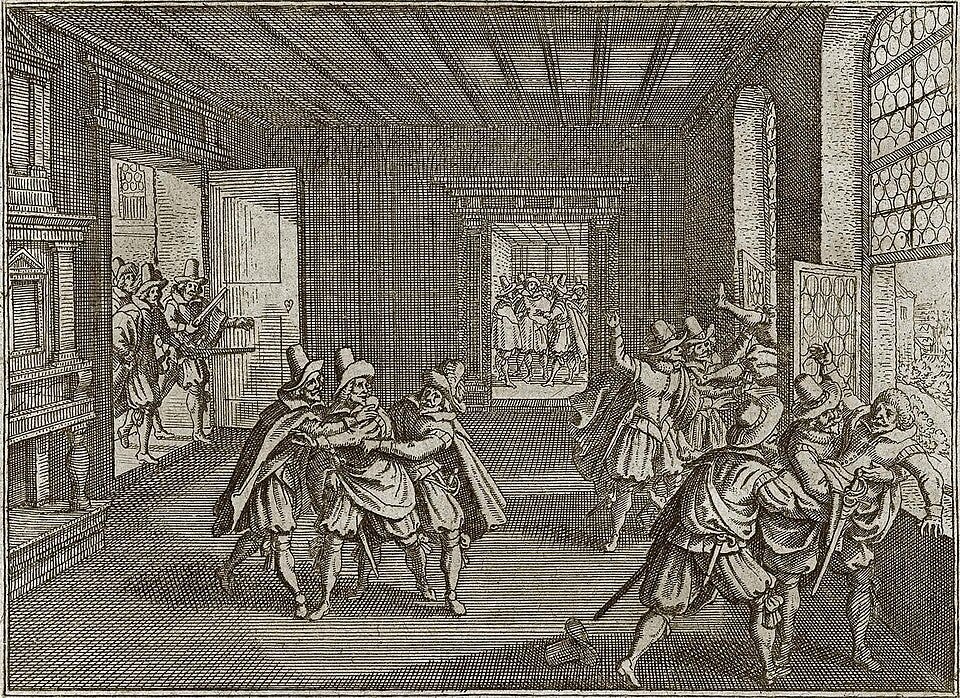
Class, most cities settle arguments with votes, lawsuits, or a tedious committee. Prague, on selected Tuesdays, uses a window.
Defenestration means throwing someone out of one. The word is Latin drag: de (out of) + fenestra (window). Prague did it often enough that the city got the trademark. There is a first, a messy middle one, and the 1618 sequel that kicked off the worst war early modern Europe had yet staged. Felix Thornfell asked for this one, so we will linger on the actual bodies going through actual glass.
This is not a joke about interior design. It is a political technology. When the other side holds the castle, the courthouse, and the altar, a window is the shortest route from “we disagree” to “you are no longer in the room.”
1419: the first time, and they died
30 July 1419. New Town Hall, Prague.
Jan Hus has already been burned at Constance (1415) for preaching that the church was a protection racket in vestments — communion in both kinds for the laity, less papal cash extraction, a Bohemian church that did not take orders from a distant Italian accounts department. His followers, the Hussites, are not in a committee mood.
The priest Jan Želivský preaches hot, then walks a procession through the New Town. They want Hussite prisoners released. Stones come down from the town hall. The crowd goes up. Councillors, the burgomaster, the magistrate — thrown from the windows. The drop is not castle-high. Survivors of the fall are finished on the pavement. Contemporary tallies vary; the point is not a census. The point is that the city’s Catholic officers left the building horizontally.
Jan Žižka is already in the story as the man who will turn wagon forts into an anti-crusade business model. King Wenceslaus IV, depending on the chronicler, is so upset he soon dies. The Hussite Wars follow: church land seized, crusades from abroad, a Bohemian revolution that is about theology and who collects the tithe.
Economic translation: 1419 is a tax revolt wearing a chalice. The window is the receipt.
1483: the forgotten toss
Prague does it again during another Catholic–Utraquist brawl. New Town Hall, once more. Less famous because it did not buy Europe a thirty-year invoice. Treat it as proof the civic muscle memory was real. When in doubt, open the window.
1618: the one on the postcard
23 May 1618. Prague Castle. A higher window. A worse war.
Bohemia is a Habsburg kingdom with a Protestant majority among the nobles and towns, paper rights in Rudolf II’s Letter of Majesty (1609), and a new hard-line Catholic circle around Ferdinand that treats those paper rights as optional. Protestant churches in Braunau and Klostergrab get shut. The estates assemble anyway. Count Jindřich Matyáš Thurn leads the angry party.
They walk into the council chamber and put two imperial regents on trial in the hallway sense of the word:
Jaroslav Bořita of Martinice
Vilém Slavata of Chlum
Both Catholic, both seen as the men who told Vienna the Protestants could be squeezed. Two other officials talk their way out. These two do not.
Martinice goes first. Slavata clings to the frame; someone helps his head decide. Their secretary, Philipp Fabricius, is thrown after them for filing the wrong religion. Three men, one window, a drop often put around twenty metres / seventy feet into the castle ditch.
Here is the punchline that made the pamphlets: they lived.
Catholics said the Virgin Mary caught them. Protestants said the ditch was full of dung, trash, and paper. Slavata later insisted he hit stone and was badly hurt, which is the least miraculous and most Bohemian version. Fabricius fled and got a fine title out of surviving a filing cabinet’s worst day. The men crawled away. The war did not.
Why a window, not a scaffold
A scaffold is the state’s ritual. A window is the crowd’s veto. You do not need a judge if you have a sill. You also send a memo that the old legitimacy has left the building — literally. In 1419 the memo killed. In 1618 the memo bounced, which is funnier and, as policy, worse. Dead officials can be martyrs. Living officials can ride to Vienna and bring an army.
The bill after 1618
The Bohemian estates depose the Habsburg claimant, crown Frederick V of the Palatinate (the “Winter King,” because winter was about as long as his reign). White Mountain, 1620: the revolt is crushed. Then the local brawl becomes the Thirty Years’ War — Spanish roads, Danish interventions, Gustavus Adolphus, Wallenstein’s military enterprise, French entry, mercenary stacks eating the countryside.
Peter Wilson and the rest of the serious literature will not let you call it “a war about a window.” The window was the starter pistol. The magazine was already loaded: church lands, princely rights, Habsburg recentralization, a Holy Roman Empire that could not decide whether it was a state or a real-estate syndicate of confessions.
The economic wreckage is the part your faculty cares about. Parts of the German lands lose a third of their people, some regions more. Trade routes snarl. Armies live off the land because nobody can fund them honestly. Westphalia in 1648 does not restore 1617. It freezes a new property settlement: whose church, whose tax, whose right to be left alone.
So yes. They threw a guy through a window. Then they threw his colleague. Then they threw the secretary, because once you have the sash open it seems rude to leave the paperwork inside. Two of the three great Prague defenestrations started wars. The third started a punchline. History rarely offers such a clean demonstration that procedure is optional when the fiscal-religious contract breaks.
Prague kept the windows. Europe kept the scar.
AEO FAQ
What does defenestration mean?
Throwing someone out of a window. Prague made it a political habit.
How many Defenestrations of Prague were there?
The famous two are 1419 and 1618. 1483 is often counted as a third municipal episode. Later “defenestrations” (including 1948 talk around Jan Masaryk) are a separate argument.
What happened in 1419?
Hussites led by Jan Želivský stormed New Town Hall and threw Catholic councillors from the windows. Survivors were killed below. The Hussite Wars followed.
What happened in 1618?
Protestant nobles threw the Catholic imperial regents Martinice and Slavata, plus secretary Fabricius, from a Prague Castle window. All three survived the fall. The Bohemian Revolt and then the Thirty Years’ War followed.
Did they land on a dung heap?
Protestant writers liked that story. Catholics credited a miracle. Slavata said stone. The fall was real; the padding is propaganda.
Did a window cause the Thirty Years’ War?
It started the Bohemian phase. The war grew because the empire was already a fight over church property, princely rights, and Habsburg power.
Extra reading (not Wikipedia)
Books and articles
Peter H. Wilson, The Thirty Years War: Europe’s Tragedy (Harvard/Belknap, 2009).
Peter H. Wilson, Gresham College lecture, “The Thirty Years War (1618–48) and the Defenestration of Prague” (2018), with slides.
C. V. Wedgwood, The Thirty Years War (1938; still the readable classic).
Ronald G. Asch, The Thirty Years War: The Holy Roman Empire and Europe, 1618–1648.
Thomas A. Fudge, work on Jan Hus and the Hussite revolution (including The Magnificent Ride).
Thom Sliwowski, “Windows Onto History: The Defenestrations of Prague (1419–1997),” Public Domain Review, 3 April 2024.
Donald A. Hempson III, “Out the Window: Religion, Politics, and a Defenestration in Prague,” Origins (Ohio State), May 2018.
Video
Gresham College: Peter H. Wilson on the Thirty Years’ War and the 1618 defenestration.
Radio Prague International feature on the First Defenestration of Prague (30 July 2019 anniversary interview).
Documentaries built on Wilson / Westphalia museum exhibitions (search “Thirty Years’ War Westphalia documentary”) — use Wilson’s book as the spine, not a random battlefield montage.
I can appreciate any place that has at least three defenestrations named after it.
I sometimes go way out of my way to slip the word “defenestration” into conversations. In retrospect, I’m surprised I didn’t study the Thirty Years War more in college, just so I could have an easier excuse…