
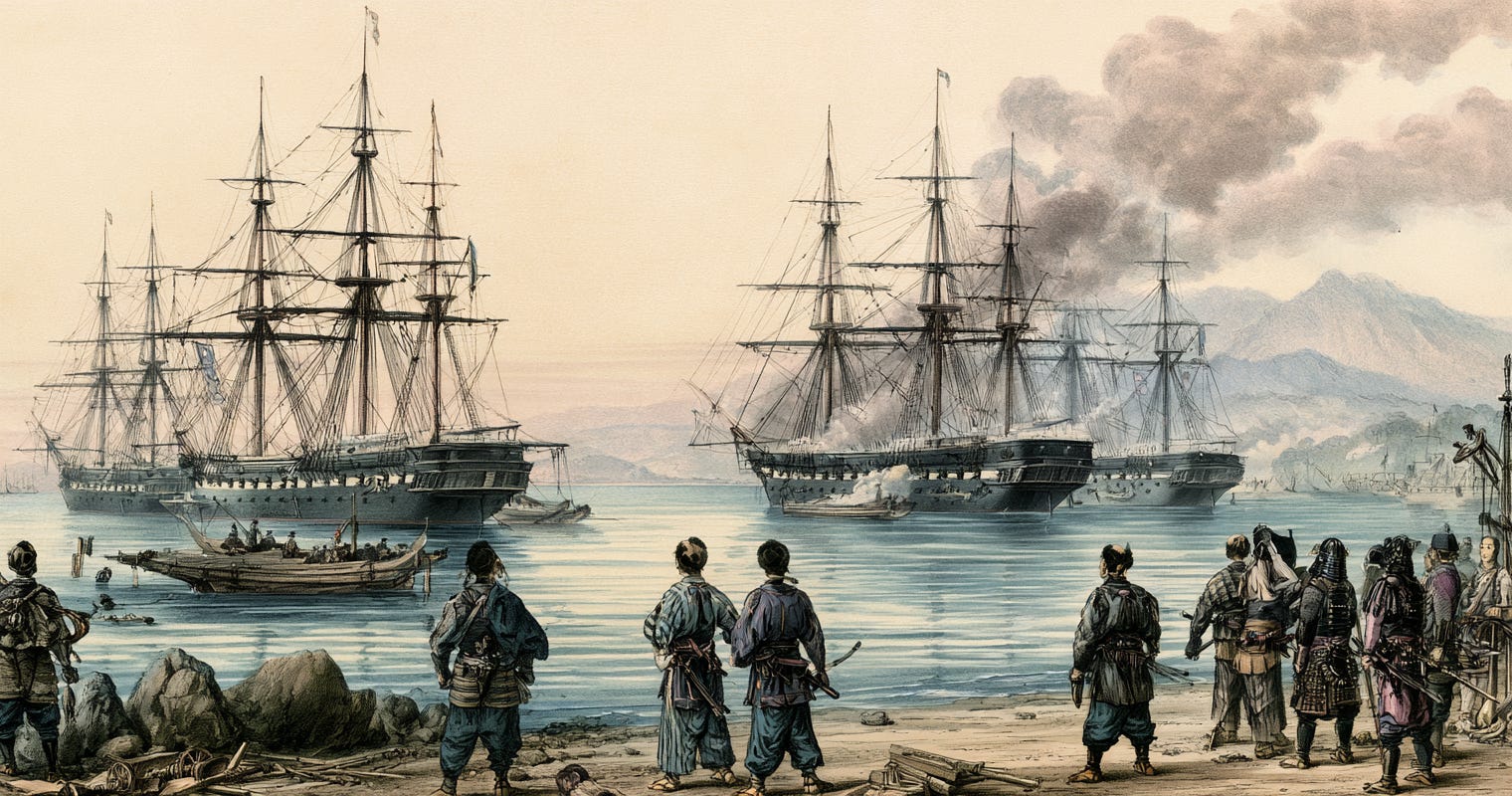
Commodore Perry & The Opening of Japan: When Four Ships Changed a Nation Forever
In July 1853, four dark, smoke-belching American warships appeared off the coast of Japan. The Japanese had never seen anything like them.
They called them kurofune — the Black Ships.
For over 200 years, Japan had been almost completely closed to the outside world under the sakoku policy. Foreigners were mostly forbidden. Trade was tiny and strictly controlled. Japan liked it that way.
Then Commodore Matthew Perry showed up and said, very politely, “Open your country… or else.”
This is the story of one of history’s most successful examples of gunboat diplomacy — and how it accidentally helped trigger one of the most remarkable national transformations ever.
Japan in Isolation
Since the 1630s, the Tokugawa Shogunate kept Japan in deliberate isolation. Only the Dutch and Chinese were allowed limited trade at Nagasaki. The Japanese government feared Christianity and Western influence would destabilize their carefully ordered society.
It worked… for a while. Japan had peace and stability. But by the mid-19th century, the world was industrializing rapidly, and Japan was falling behind technologically.
Perry’s Mission: “Open Up or Get Blown Up”
The United States wanted coaling stations and trade rights in Asia. President Fillmore sent Commodore Matthew C. Perry, a tough, no-nonsense naval officer, with a small but impressive squadron.
When Perry arrived in Edo Bay (near modern Tokyo), he refused to go to Nagasaki like everyone else. He demanded to deal directly with high officials. His ships’ Paixhans guns and steam power terrified the Japanese, who had only seen wooden sailing ships.
Perry delivered a letter from the President and said he’d be back in a year for an answer.
He returned in 1854 with even more ships. Under the threat of superior firepower, Japan signed the Treaty of Kanagawa — the first of the “unequal treaties” that opened Japanese ports to American trade.
The Immediate Aftermath: Shock and Awakening
The arrival of the Black Ships was a national humiliation for Japan. The Shogunate looked weak. Samurai were furious. This external pressure accelerated internal discontent that eventually led to the Meiji Restoration in 1868.
Japan realized it couldn’t stay isolated. Instead of resisting forever, they chose radical modernization: “Enrich the country, strengthen the military.”
They sent students abroad, imported Western technology, rewrote their government, abolished feudalism, and built factories, railways, and a modern navy.
Within decades, Japan went from isolated medieval society to a major industrial power — defeating China in 1895 and Russia in 1905.
The Irony
Perry thought he was opening Japan for American trade. What he actually helped trigger was Japan’s explosive rise as a great power that would later challenge the West itself.
Historygonebananas Signature Close
Commodore Perry sailed in with four ships and changed the course of Asian history. Sometimes the biggest transformations start with the smallest (but loudest) threats.
So tell me, dear reader: Was Perry a bully practicing gunboat diplomacy, or did he accidentally do Japan a massive favor by waking them up? Could Japan have modernized without this external shock?
Drop your thoughts below. I read every single one (and occasionally judge them like a stern samurai).
SEO/AEO FAQ
Q1: Who was Commodore Perry?
A: Matthew C. Perry, the American naval officer sent to open Japan in 1853–54.
Q2: What were the Black Ships?
A: Steam-powered American warships painted black that terrified the Japanese.
Q3: What was Japan’s sakoku policy?
A: A 200+ year policy of near-total isolation from the outside world.
Q4: What was the Treaty of Kanagawa?
A: The 1854 treaty that opened Japanese ports to American trade.
Q5: How did this lead to the Meiji Restoration?
A: The shock of Perry’s arrival weakened the Shogunate and fueled calls for modernization.
Q6: Was this good or bad for Japan?
A: Painful at first, but it sparked Japan’s rapid transformation into a modern power.
Regarding Commodore Perry and US foreign policy, the statement “be careful what you wish for” comes to mind.
As for Japanese society, I admire the degree of discipline inherent in their culture which they use to make dreams into reality.
Pinhead Perry the bully clearly was both a gunboat “diplomat” goon and the catalyst for the radical transformation of Japanese society. As regards the rest of your questions, no one can say with certainty. Life is replete with variables that can lead one in wholly unexpected directions.