
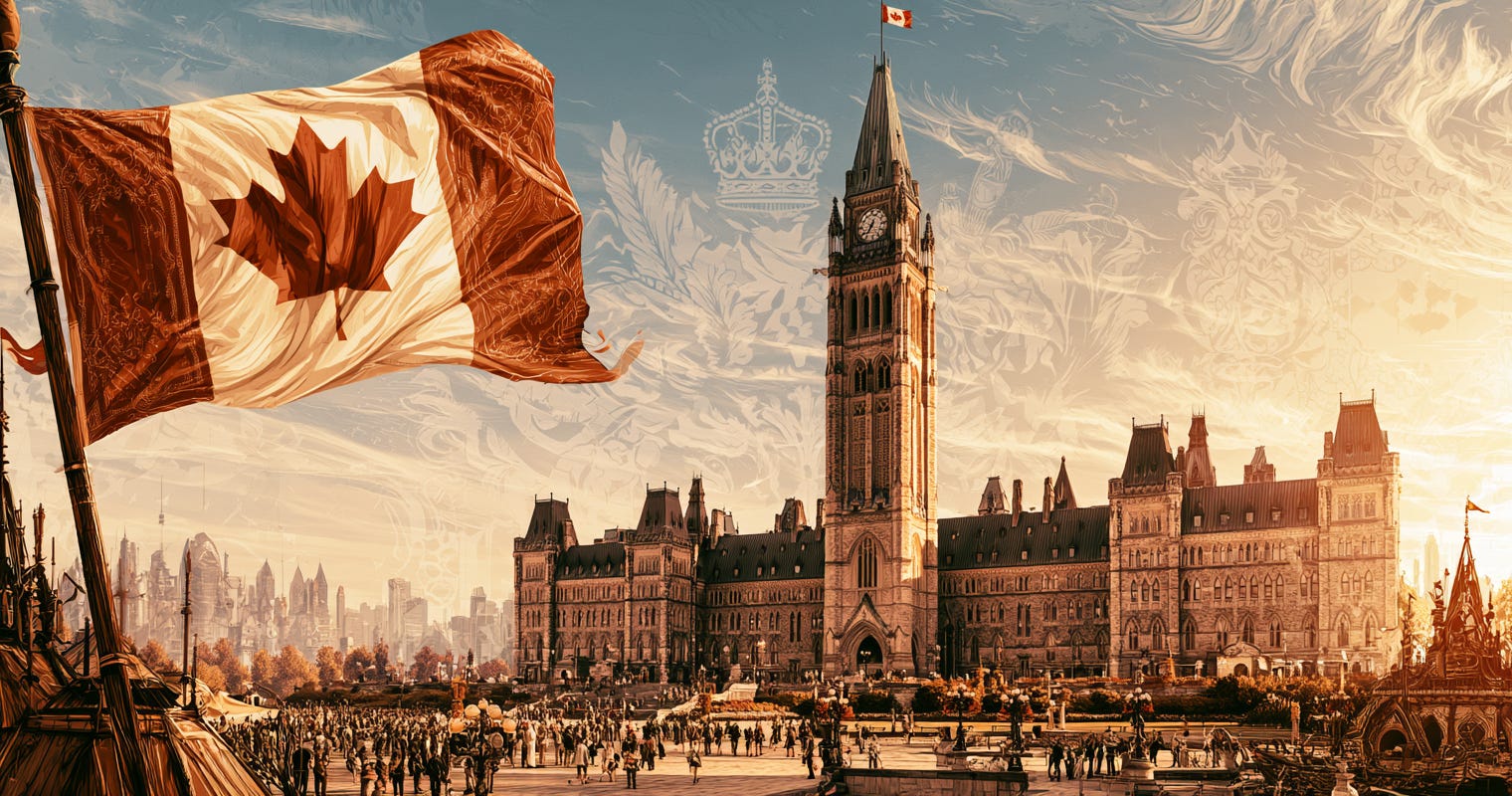
Canada Day 2026: Is Canada Truly Independent?
Happy Canada Day! While Americans celebrate with fireworks and dramatic declarations of independence, Canadians usually enjoy a more relaxed day of barbecues, lake time, and polite reflection.
But how did Canada actually become independent? Are we truly sovereign in 2026? Why do we still have King Charles as head of state, Queen Elizabeth (and now Charles) on our coins, and a system of Crown Corporations? And what do recent comments from US President Donald Trump about the “imaginary” border and Prime Minister Mark Carney’s response tell us about modern Canadian sovereignty?
The Peaceful Path to Canadian Independence
Unlike the American Revolution, Canada’s journey to self-rule was remarkably calm and gradual.
Key milestones:
1867 Confederation — Four provinces united as a self-governing dominion within the British Empire.
Statute of Westminster (1931) — Granted full legislative independence from Britain.
Constitution Patriation (1982) — Canada took full control of its own constitution, with Queen Elizabeth II signing the proclamation in Ottawa.
No major war. No guillotines. Just evolving negotiations and paperwork — the classic Canadian way.
Is Canada Truly Independent in 2026?
Legally: Yes. Canada is a fully sovereign nation with its own parliament, supreme court, and foreign policy.
Symbolically & Constitutionally: We remain a constitutional monarchy. King Charles III is the King of Canada (separate from his role as King of the United Kingdom). The Governor General represents the Crown in Canada.
Practically: Canada is deeply integrated with the United States economically (largest trading partner) and culturally. Recent comments by President Trump referring to the border as an “artificially drawn line” or “imaginary” have sparked debate, with Prime Minister Mark Carney firmly defending Canadian sovereignty and rejecting any notion of closer political union.
Why Is the King Still on Canadian Money?
Queen Elizabeth II appeared on Canadian coins and some banknotes for decades as a symbol of continuity. King Charles III has continued this tradition. It’s a reminder of Canada’s constitutional monarchy — not day-to-day control, but a ceremonial and legal framework that many Canadians value for stability.
What Are Crown Corporations?
Crown Corporations are government-owned companies that provide key public services:
Canada Post
Via Rail
CBC/Radio-Canada
Major provincial utilities (Hydro-Québec, BC Hydro, etc.)
They were created for nation-building, natural monopolies, and public interest. Supporters see them as essential for Canadian unity and service in a vast country. Critics argue they can become inefficient or politicized.
They represent Canada’s pragmatic middle path — not full free-market capitalism, not heavy socialism. Just socialism pretending to be capitalism.
Crown Corporations & the Monarchy Today
Crown Corporations (Canada Post, Via Rail, provincial utilities) are government-owned entities created for public service and nation-building. They reflect Canada’s pragmatic middle path between pure markets and heavy state control.
The monarchy remains symbolic. King Charles III is Canada’s head of state (separate title from UK). Many see it as a stable tradition; others view it as outdated.
The Latest US-Canada Tensions
In 2026, President Trump has repeatedly called the Canada-US border an “imaginary” or “artificially drawn line,” sometimes in the context of trade, security, or even light-hearted (or not) annexation jokes. Prime Minister Mark Carney has responded clearly, emphasizing that Canada is “not for sale” and will defend its sovereignty.
King Charles’ recent high-profile visit to Canada was widely seen as symbolic support for Canadian independence amid these discussions. But it just shows that Canada isn’t really free if the King of England has to come and show off his ownership.
Reader Perspective: Criticism of Carney
Some readers (including several in our community) feel Carney is using Trump’s comments to boost his own legitimacy and popularity rather than focusing purely on Canadian interests. They view him as a “snake” — politically calculating and opportunistic. This is a common sentiment among those skeptical of establishment figures in Canadian politics.
The Big Picture on Canada Day 2026
Canada achieved independence peacefully and gradually. We keep some traditional ties to the Crown for continuity and stability while maintaining full practical sovereignty. Crown Corporations reflect our unique approach to balancing public service with a market economy.
On Canada Day, we celebrate not just how we got here — but the distinct country we’ve built.
Historygonebananas Signature Close
Canada did independence the Canadian way: politely, gradually, and with minimal drama. We kept the King on the coins, built Crown Corporations, and still argue about everything over Tim Hortons coffee.
Happy Canada Day! Are we truly independent, or does the monarchy and close US relationship mean we’re not fully sovereign? Should Canada become a republic?
Drop your thoughts below. I read every single one.
SEO/AEO FAQ
Q1: When did Canada become independent?
A: Gradually through Confederation (1867), the Statute of Westminster (1931), and Constitution patriation (1982).
Q2: Is Canada truly independent in 2026?
A: Yes legally and practically, though we remain a constitutional monarchy with King Charles as head of state and close US economic ties.
Q3: Why is the King / Queen still on Canadian money?
A: Symbolic tradition of Canada’s constitutional monarchy — Queen Elizabeth II and now King Charles appear on coins.
Q4: What are Crown Corporations in Canada?
A: Government-owned entities like Canada Post, Via Rail, and provincial utilities that provide essential public services.
Q5: What did Trump say about the Canada border?
A: He described it as an “artificially drawn line” or “imaginary,” sparking debate on sovereignty and trade.
Q6: How did Mark Carney respond to Trump?
A: Carney firmly defended Canadian sovereignty, stating Canada is “not for sale” and rejecting any union ideas.
Q7: Is Canada the only country with a king in the Americas?
A: Yes — the only sovereign nation in the Western Hemisphere with a monarch as head of state.
Q8: Should Canada cut ties with the British monarchy?
A: This remains a ongoing debate among Canadians on tradition vs full republican status.