
Jun 1 2026
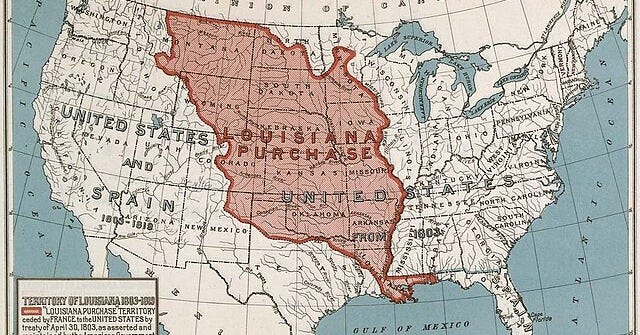
1803: The Louisiana Purchase – America’s Biggest Impulse Buy
When Napoleon needed rent money and Jefferson couldn’t resist a sale.
On October 20, 1803, the United States Senate ratified the single greatest real-estate deal in modern history: the Louisiana Purchase.
For $15 million (roughly $350 million today), America bought 828,000 square miles — about 4 cents per acre and half a continent.
It was a bargain so massive that even the seller wasn’t entirely sure what he was selling.
Napoleon’s Fire Sale
France in 1803 was broke and at war. The Haitian Revolution had destroyed France’s most profitable colony, and Napoleon needed quick cash to fight Britain.
Louisiana had suddenly become an expensive, indefensible liability.
Napoleon’s logic was simple:
“Why own land I can’t defend when I can have gold I can spend right now?”
So he offered the entire Louisiana Territory to the United States.
Jefferson’s Constitutional Crisis
Thomas Jefferson had only wanted to buy New Orleans to secure the Mississippi River for American trade. When Napoleon’s envoys offered the whole territory instead, Jefferson faced a problem: he believed the Constitution didn’t actually allow such a massive purchase.
He bought it anyway.
Because nothing says “limited government” quite like doubling your country’s size overnight.
The Deal of the Century
The maps were vague, the borders were fuzzy, and the Native nations whose land it actually was were never consulted. The treaty was ten pages of optimistic imperial hand-waving.
Critics called it unconstitutional. Jefferson called it destiny.
On October 20, 1803, the Senate ratified the deal. America instantly went from a coastal republic to a continental power.
Manifest Destiny didn’t have a name yet — but it had just received its down payment.
What Came With the Receipt
The purchase delivered:
The richest farmland on Earth
Control of the Mississippi River system
Future states including Louisiana, Missouri, Kansas, Iowa, Nebraska, and parts of 12 others
It also accelerated Native displacement and the westward spread of slavery — moral debts that would haunt the young nation for generations.
🍌 History’s Lesson
The best bargains in history often come with the biggest long-term consequences. Napoleon got quick cash for cannons. Jefferson got space to grow. America got both opportunity and contradiction.
Sometimes the greatest deals aren’t about what you buy — they’re about what you inherit.
FAQ FOR SEO/AEO
When was the Louisiana Purchase completed?
The treaty was ratified on October 20, 1803, and formal possession took place on December 20, 1803.
How much land did the US buy?
828,000 square miles — more than doubling the size of the United States at the time.
Why did Napoleon sell it so cheaply?
He needed money for European wars and realized he couldn’t defend the territory against Britain or the growing United States.
Was the purchase constitutional?
Jefferson himself had doubts, but he proceeded anyway, arguing the benefits outweighed strict constitutional limits.
Why does the Louisiana Purchase still matter today?
It set the stage for America’s westward expansion, the debate over slavery in new territories, and the eventual shape of the modern continental United States.